Sonoma County has learned — more than once — what it means to face an emergency with no warning. Between a thriving healthcare workforce, a large rural population, and a community shaped by years of wildfire response and recovery, the case for strong CPR and life support training here is personal. Safety Training Seminars offers a CPR certification course that fits the demands of busy Sonoma County professionals without cutting corners on quality or AHA standards.
The healthcare landscape in Sonoma County has grown significantly over the past decade. Santa Rosa — the county seat and by far the largest city — anchors a regional medical hub that draws patients and providers from across the North Bay. Santa Rosa Memorial Hospital, Kaiser Permanente Santa Rosa, and Sutter Health clinics throughout the area collectively employ thousands of nurses, medical assistants, technicians, and allied health professionals who must maintain current life support credentials as a baseline employment requirement.
But the need extends well beyond Santa Rosa’s city limits. Petaluma Valley Hospital serves a fast-growing southern corridor that stretches toward Marin County along US-101. Rohnert Park, situated between Santa Rosa and Petaluma, has seen steady growth in healthcare-adjacent businesses, outpatient clinics, and social services facilities — all of which require staff trained in emergency response. Healdsburg District Hospital provides critical access care for the county’s northern wine country communities, where emergency response times can be longer and on-site preparedness matters even more.
AED training, structured cardiac response protocols, and the ability to act decisively before EMS arrives — these are the competencies that matter when a real emergency unfolds. Across every corner of Sonoma County, from the US-101 corridor to the Highway 12 wine country communities, healthcare employers expect their staff to show up ready.
Sonoma County stretches across a wide and varied geography, and the communities it encompasses each have their own healthcare workforce needs. Safety Training Seminars provides life support training to participants throughout the county, including Santa Rosa — both the downtown core and the Larkfield-Wikiup area in the north — as well as Petaluma, Rohnert Park, and the surrounding communities of Healdsburg, Windsor, Sebastopol, and Sonoma.
No matter where you’re based along the US-101 corridor or out in the county’s more rural reaches, same-week skills testing appointments keep the process moving. Available courses include:
Getting trained shouldn’t require a trip across the county or a week-long wait for the next available session.
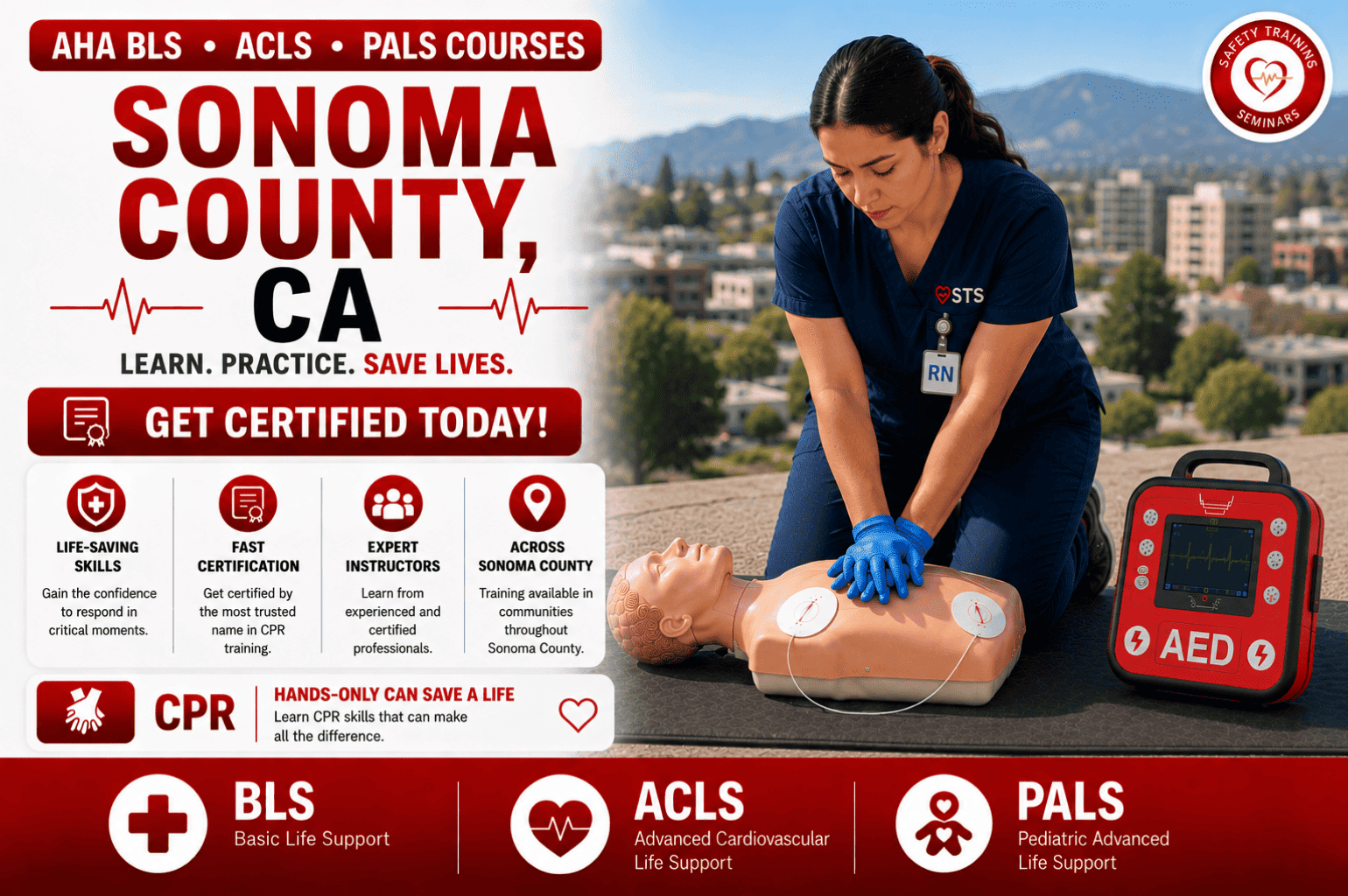
Safety Training Seminars offers AHA-certified CPR, BLS, ACLS & PALS courses throughout 100+ Locations in California for healthcare professionals, workplaces, and the general public. Choose from flexible schedules, convenient training locations, and hands-on skills sessions with same-day AHA Course Completion eCards available after successful completion.
For healthcare providers & students. Covers adult, child & infant CPR, AED, airway management & team resuscitation. 1–2 hrs online + 30-min skills check. Accepted at Kaiser, UCSF, Highland & all Alameda County hospitals. $120
For experienced clinicians. Covers cardiac arrest algorithms, acute stroke, ACS & post-resuscitation care. 2–3 hrs online + 30-min skills check. Required for credentialing at all Alameda County medical centers. $290
For nurses, MDs & EMTs caring for pediatric patients. Covers pediatric assessment, respiratory emergencies & resuscitation. 2–3 hrs online + 30-min skills check. Required at UCSF Benioff Children’s Hospital Oakland. $290
For teachers, corporate teams, childcare workers & community members. Covers CPR, AED operation, choking & first aid basics. 2–3 hrs online + 60-min skills session. Required by California law for many childcare & school roles. $120
The full range of American Heart Association life support courses is available to Sonoma County participants — each one structured to meet specific professional requirements and each one delivered in a format that respects the reality of a working professional’s schedule.
The AHA BLS CPR Course is the credential Sonoma County healthcare employers ask for most consistently, and for good reason. It’s the American Heart Association’s standard for clinical professionals, and its curriculum covers everything that determines competency in a real resuscitation event: adult, child, and infant CPR performed to current depth and rate standards, effective AED operation, proper rescue breathing technique, and the team-based communication skills that make a difference when providers are working a code together under pressure.
Staff at Santa Rosa Memorial Hospital’s critical care units, nurses at Kaiser Permanente Santa Rosa completing a renewal before their annual review, and medical assistants at the growing number of outpatient specialty clinics along the Petaluma corridor all need a BLS credential that their employer recognizes and trusts. The AHA BLS CPR Class offered here delivers exactly that, through a format that doesn’t ask you to sacrifice a full workday to earn it.
Start with the online Self-Guided Learning™ module — typically one to two hours, completed entirely at your own pace and on your own schedule. When you’re ready, book a 30-minute skills testing appointment at a nearby CPR Verification Station™ learning center to complete the hands-on portion. Once you successfully complete the course, your AHA Course Completion eCard is delivered digitally, usually the same day.
Advanced Cardiac Life Support training is a requirement for a specific tier of clinical providers — the physicians, emergency nurses, paramedics, and respiratory therapists expected to take the lead when a patient’s condition deteriorates rapidly and basic CPR isn’t enough. In Sonoma County, that group includes ED teams at Santa Rosa Memorial and Kaiser Permanente Santa Rosa, intensive care nurses managing hemodynamically unstable patients, and anesthesia providers working in ambulatory surgical settings.
The ACLS certification course goes well beyond compression quality and AED use. Participants work through systematic arrhythmia recognition, evidence-based algorithms for managing pulseless rhythms and periarrest conditions, advanced airway management techniques, and the clinical decision-making around vasopressors and antiarrhythmics in the context of a resuscitation. Both initial and renewal options are available through the American Heart Association curriculum, and the program is current with the latest resuscitation science guidelines.
The format is built for providers who already have strong foundational knowledge and need a focused, efficient path to completing their renewal or initial card. The online Self-Guided Learning™ component takes two to three hours and can be completed entirely on your own schedule. A 30-minute skills testing session follows at a CPR Verification Station™ learning center. Upon successful completion, your AHA Course Completion eCard is issued digitally with two-year validity.
Pediatric emergencies carry a weight all their own. The clinical presentation is different from adults, the physiological margins are narrower, and the emotional stakes for providers are uniquely high. PALS training exists to give healthcare professionals a structured, systematic framework for assessing and managing critically ill infants and children — and in Sonoma County, that matters for providers working in pediatric units, family practice clinics, school-based health centers, and emergency departments that see patients of all ages.
The PALS certification course builds competency in the pediatric assessment triangle, early recognition of respiratory and circulatory failure, evidence-based stabilization sequences, and the team coordination that pediatric resuscitation demands. Both initial and renewal formats are available. The online course component is completed first, at your own pace, followed by a hands-on skills testing session to verify practical competency. Successful completion earns a nationally accepted AHA Course Completion eCard with two-year validity, recognized by pediatric and general healthcare employers throughout California.
Sonoma County’s economy doesn’t run on healthcare alone. Wineries and agricultural operations throughout the county employ large seasonal and permanent workforces. The hospitality industry from Healdsburg to the Sonoma Valley hosts hundreds of thousands of visitors each year. Schools, nonprofits, retail businesses, and local government agencies all have employees who may find themselves first on the scene during a medical emergency — without any clinical background to draw on.
This CPR and First Aid course bridges that gap. It’s designed for people who work outside of clinical settings but who understand that emergencies don’t check credentials before they happen. The curriculum covers adult CPR, AED operation, infant and child choking response, and a practical first aid skill set that applies to the kinds of situations that arise in real workplaces: sudden cardiac events, falls, severe bleeding, and allergic reactions, among others.
The online portion takes two to three hours to complete, followed by a one-hour hands-on skills session that puts the learning into practice. The two-year card that follows satisfies most employer workplace safety training requirements and reflects OSHA-aligned preparedness standards.
The AHA Course Completion eCard issued through this program is the industry-recognized standard, and Sonoma County’s healthcare employers are well-acquainted with it. Facilities and organizations throughout the county and adjacent region that accept this credential include:
If your employer isn’t listed here, the vast majority of healthcare organizations in Sonoma County recognize the AHA Course Completion eCard. Confirming with your HR or credentialing contact before enrolling is always a good step.
The appeal of the Self-Guided Learning™ format is simple: it puts you in control of the one variable that matters most — your time. Instead of working around a class schedule that was built for someone else’s availability, you start the online course when you’re ready and move through it at whatever pace fits your day.
There are no live sessions to join, no group video calls to attend, and no requirement to be in a particular place at a particular time for the knowledge portion of the course. Work through the material on a laptop before your shift, on a tablet during a slow afternoon, or late in the evening when the house is quiet — it genuinely doesn’t matter. The only in-person component is the skills testing appointment, which you schedule separately through the CPR Verification Station™ learning center booking system. That’s where hands-on competency is verified, efficiently and professionally, without any of the time overhead that traditional group sessions carry.
At the CPR Verification Station™ learning center, skills testing is handled exactly as it sounds: focused, efficient, and respectful of your time. Appointments are short because they’re designed to be. There’s no pre-session review of content you’ve already covered online, no waiting for a group to assemble, and no extended classroom component tacked onto the end.
For Sonoma County professionals managing complex schedules — healthcare workers rotating through shifts at Santa Rosa Memorial, providers covering multiple clinic sites between Petaluma and Rohnert Park, or nursing students at Santa Rosa Junior College juggling coursework and clinical hours — that brevity matters. Same-week appointment availability across the county means you’re not stuck waiting for the next open group class. Complete the online course, pick your slot, show up prepared, and your AHA Course Completion eCard is on its way before the day is out.
Scheduling flexibility. Employer acceptance. Price transparency. Fast turnaround on the card itself. These are the factors that actually drive decisions when a Sonoma County healthcare worker is looking for a BLS renewal or an initial ACLS certification course — and this program was designed with all four in mind.
Consider the range of people who need this training regularly. Santa Rosa Junior College nursing students completing their CPR requirement before clinical placements begin. Dental hygienists at practices in downtown Santa Rosa and Sebastopol keeping their employer files compliant. Registered nurses at Kaiser Permanente Santa Rosa scheduling a BLS renewal before their biennial card expires. Medical assistants at growing Rohnert Park outpatient centers filling a credential gap before starting a new role. Travel nurses covering North Bay assignments who need a card that’s recognized at every facility on their roster.
What all of those situations have in common is a need for something fast, trusted, and priced without surprises. The Self-Guided Learning™ online platform and CPR Verification Station™ skills testing model deliver that combination — with the AHA Course Completion eCard waiting at the finish line.
Healthcare employers don’t give much grace period on expired credentials. When a BLS card lapses, most hospitals and clinical practices treat it as an immediate compliance issue — and in some cases, it can affect your ability to work a shift until it’s resolved. Staying ahead of the renewal cycle is simply the smarter way to manage it.
The good news is that renewing through this program doesn’t take long. The online Self-Guided Learning™ portion is available anytime, so you’re not waiting for the next available class date. Renewal participants — whether updating their BLS, ACLS, or PALS card — follow the same streamlined process: online course, skills testing appointment, digital eCard delivery. Many people complete the entire sequence within 24 to 48 hours when they plan modestly in advance.
It’s also worth knowing that the AHA periodically revises its resuscitation guidelines, and renewal courses incorporate those updates. So renewing isn’t just a box to check — it’s an opportunity to make sure your skills reflect current standards, which matters most in the moments when they’re actually needed.
The hardest part of getting your CPR or life support training done is usually deciding to start. Once you do, the rest moves quickly — online Self-Guided Learning™ on your own schedule, a short skills testing appointment at a CPR Verification Station™ learning center, and an AHA Course Completion eCard that shows up digitally once you successfully complete the course.
Whether you’re a nurse at Santa Rosa Memorial due for a BLS renewal, a medical assistant starting a new role in Rohnert Park, a Petaluma dental professional keeping your employer file current, or a winery manager making sure your team has first aid coverage for a busy harvest season — this is the straightforward path to getting it done.
Transparent pricing. Same-week appointments. AHA credentials your employer already accepts.
Enroll now and check this off your list.
Sonoma County’s concentration of hospitals, academic medical centers, biotech campuses, and regulated industries drives constant demand for current AHA life-support credentials. If your role appears below, you almost certainly need an active BLS, ACLS, or PALS certification.
RNs, LPNs, and students at Samuel Merritt University, UC Berkeley, and UCSF must hold current BLS before clinical rotations. ICU and ER nurses at Highland Hospital and Kaiser Oakland typically also require ACLS.
MDs, DOs, PAs, and NPs credentialed at UCSF Benioff, Alta Bates Summit, or Alameda Health System must maintain active BLS and often ACLS as a hospital credentialing requirement.
First responders serving Oakland, Fremont, Hayward, and other Alameda County cities must hold AHA BLS and often ACLS to meet California EMS Authority (EMSA) licensure requirements.
Dentists, hygienists, and dental assistants in California must hold a current CPR/BLS certification as required by the Dental Board of California for license renewal.
Have questions about getting AHA-certified in Alameda County? We’ve answered the most common questions from local healthcare professionals, students, and community members below.
Group training arrangements are available for employers throughout Sonoma County. For workplace teams — whether you’re managing seasonal staff at a Healdsburg winery, a hospitality crew in the Sonoma Valley, or an office team in Rohnert Park — coordinating multiple enrollments through this program is straightforward. Each participant completes the online Self-Guided Learning™ portion independently and on their own schedule, then attends a skills testing appointment at a CPR Verification Station™ learning center.
Once you successfully complete the course — including both the online portion and the skills testing appointment — your AHA Course Completion eCard is issued digitally by the American Heart Association. You’ll receive it via email and can access it through the AHA’s online portal. From there, you can forward it to your HR department, upload it to an employer credentialing system, or share it directly with your supervisor.
Most nursing programs recommend having your BLS card in hand before your first clinical rotation — not the week of. Completing your AHA BLS CPR Course four to six weeks before your placement begins gives you enough buffer to schedule your skills testing appointment without urgency and ensures the card is fully issued and available to share with your program coordinator. Since the entire process can be completed within a day or two once you start, there’s no reason to cut it close.
The skills testing appointment at the CPR Verification Station™ learning center is a focused, hands-on evaluation of the competencies covered in your online course. For a BLS skills session, that means demonstrating compression quality, AED operation, and the key team response skills outlined in the AHA curriculum. You don’t need to bring equipment — everything is provided at the learning center. Wear comfortable clothing, arrive at your scheduled time, and be prepared to practice what you covered online.
For the majority of hospitals and healthcare employers in Sonoma County — including Santa Rosa Memorial, Kaiser Permanente, Sutter Health, and Providence/Petaluma Valley — yes, the American Heart Association curriculum is the standard they specify. The AHA Course Completion eCard issued through this program reflects that standard and is what those employers are looking for when they ask for a BLS, ACLS, or PALS card.

