From the coastal neighborhoods of Santa Cruz to the agricultural communities of Watsonville, the people who staff this county’s hospitals, clinics, schools, and workplaces share one common need: reliable, respected life support training they can fit into a genuinely busy life. Safety Training Seminars offers CPR certification courses built around that reality — flexible, fast, and accepted by the healthcare employers that matter most across Santa Cruz County.
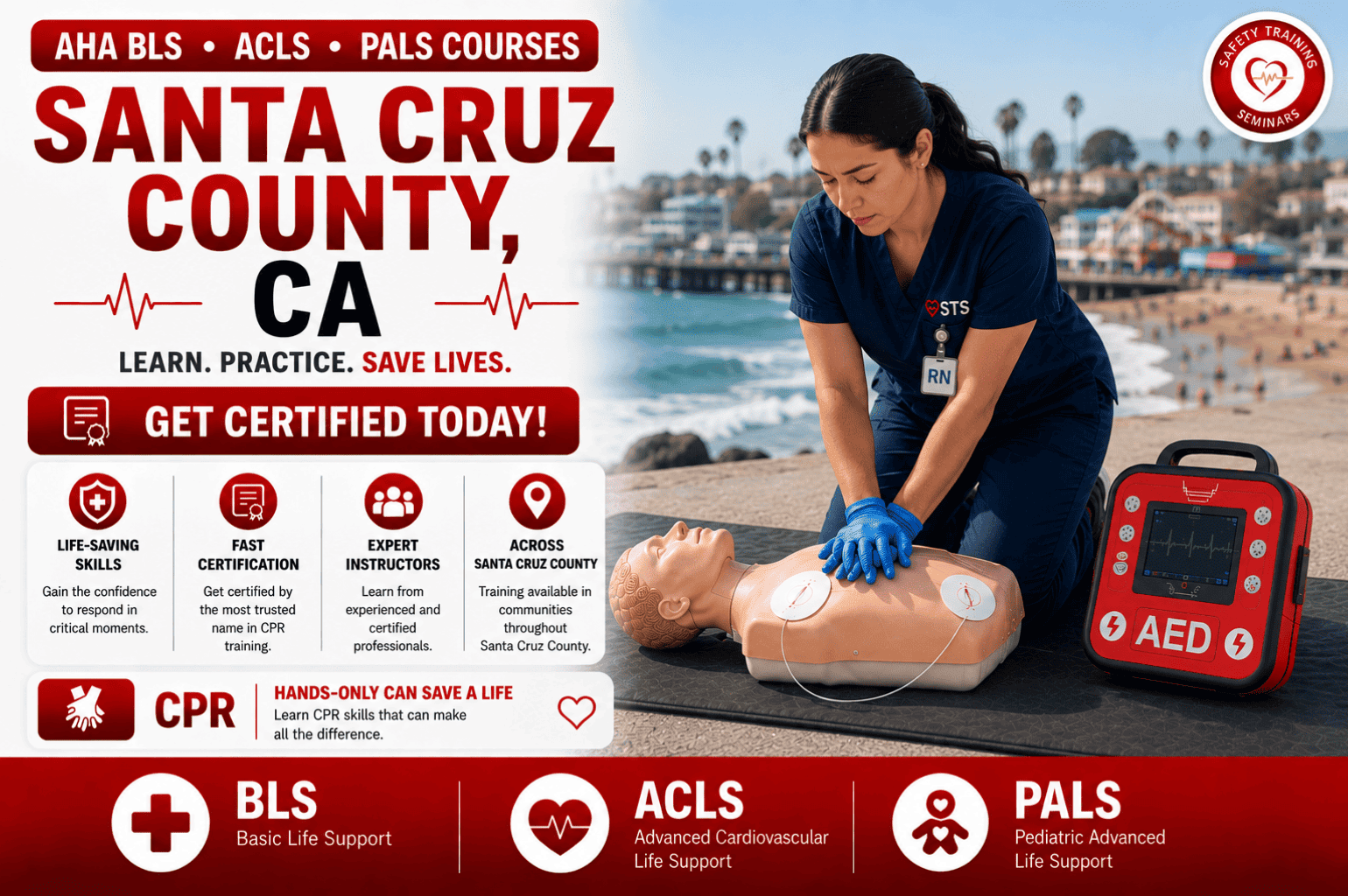
Santa Cruz County occupies a unique position along California’s Central Coast — geographically stunning, economically diverse, and home to a healthcare workforce that serves everyone from university students and beachside tourists to farmworkers and longtime residents in inland neighborhoods. That diversity creates real complexity when it comes to emergency preparedness. The people on the front lines of care here need training that meets professional standards without demanding impossible scheduling sacrifices.
At Dominican Hospital in Santa Cruz — part of the Dignity Health network — nursing staff, respiratory therapists, and surgical technicians are expected to maintain current life support credentials as a condition of employment. Down Highway 1 in Watsonville, Watsonville Community Hospital serves a heavily working-class community with growing healthcare staffing needs and tight operational margins. Across both facilities, and throughout the network of urgent care centers, dental practices, and specialty clinics scattered between Capitola and Scotts Valley, the demand for current AHA Course Completion eCards is consistent and ongoing.
Santa Cruz County also draws healthcare professionals who commute across Highway 17 from Santa Clara County or travel the coastal Highway 1 corridor — people who often work across county lines and need training that’s recognized everywhere. AED readiness, team-based cardiac response, and structured emergency protocols aren’t abstract concepts here. They’re daily operational realities that the right CPR and BLS training directly supports.
Santa Cruz County’s communities each have their own rhythm, and the healthcare workers who serve them deserve a training option that respects that. Safety Training Seminars provides life support training to participants throughout the county, with a focus on the largest population centers and healthcare hubs — including Santa Cruz and Watsonville — as well as surrounding areas like Capitola, Scotts Valley, Aptos, and communities near the Santa Clara and Monterey county lines.
Same-week skills testing appointments are available across the region, so you’re never stuck waiting weeks to complete your course. The full range of American Heart Association life support offerings is available here:
Wherever you are in Santa Cruz County, getting trained doesn’t have to mean taking a full day off work.
Safety Training Seminars offers AHA-certified CPR, BLS, ACLS & PALS courses throughout 100+ Locations in California for healthcare professionals, workplaces, and the general public. Choose from flexible schedules, convenient training locations, and hands-on skills sessions with same-day AHA Course Completion eCards available after successful completion.
For healthcare providers & students. Covers adult, child & infant CPR, AED, airway management & team resuscitation. 1–2 hrs online + 30-min skills check. Accepted at Kaiser, UCSF, Highland & all Alameda County hospitals. $120
For experienced clinicians. Covers cardiac arrest algorithms, acute stroke, ACS & post-resuscitation care. 2–3 hrs online + 30-min skills check. Required for credentialing at all Alameda County medical centers. $290
For nurses, MDs & EMTs caring for pediatric patients. Covers pediatric assessment, respiratory emergencies & resuscitation. 2–3 hrs online + 30-min skills check. Required at UCSF Benioff Children’s Hospital Oakland. $290
For teachers, corporate teams, childcare workers & community members. Covers CPR, AED operation, choking & first aid basics. 2–3 hrs online + 60-min skills session. Required by California law for many childcare & school roles. $120
Santa Cruz County healthcare professionals have access to the complete suite of American Heart Association life support courses, each designed to align with the specific demands of different clinical roles and workplace settings. Here’s what’s available and what each one covers.
The AHA BLS CPR Course is the foundational credential for clinical professionals throughout Santa Cruz County — the one most frequently required by hospital HR departments, nursing program directors, and healthcare agency staffing coordinators. It covers adult, child, and infant CPR with a focus on the depth, rate, and sequencing that actually matters during a real cardiac event. AED operation is covered in detail, and the course spends meaningful time on the team-based communication that determines outcomes when multiple providers are working a code together.
For staff at Dominican Hospital, providers floating between Sutter Health affiliates, or medical assistants working at independent physician practices in Scotts Valley and Capitola, this course represents the fastest, most employer-trusted path to a current two-year card. The AHA BLS CPR Class begins with an online Self-Guided Learning™ module that takes most participants one to two hours — no fixed schedule, no group waiting. From there, you book a 30-minute skills testing appointment at a CPR Verification Station™ learning center, walk through your hands-on competency demonstration, and receive your AHA Course Completion eCard digitally once you successfully complete the course.
ACLS training is required for a specific category of providers — those who are expected to lead or meaningfully participate in advanced cardiac emergency response. In Santa Cruz County, that includes emergency physicians and nurses at Dominican Hospital’s ED, paramedics working with county EMS, anesthesia providers at outpatient surgical centers, and hospitalists managing high-acuity patients across the county’s inpatient facilities.
The ACLS certification course covers the clinical judgment that separates basic CPR from true advanced life support: cardiac rhythm interpretation, algorithmic decision-making during pulseless arrest and periarrest rhythms, airway management beyond basic adjuncts, and the appropriate use of emergency medications in a resuscitation sequence. Both initial and renewal options are available, and the American Heart Association curriculum is current with the latest resuscitation science.
The process is built for working clinicians who can’t afford half-day classroom commitments. Complete two to three hours of online Self-Guided Learning™ on your own schedule, then show up for a focused 30-minute skills testing session to demonstrate competency. Your AHA Course Completion eCard follows digitally — two-year validity, recognized by healthcare employers throughout California and nationally.
Pediatric emergencies demand a distinct clinical approach — one that the PALS certification course is specifically designed to build. For nurses and physicians working in Santa Cruz County’s pediatric and neonatal care settings, including the pediatric units at Dominican Hospital and community clinics serving Watsonville’s large family population, staying current on PALS skills is both a professional obligation and a genuine patient safety issue.
This course walks through the systematic pediatric assessment model, early recognition of respiratory and circulatory compromise, structured stabilization interventions, and the team coordination essential to managing a critically ill child. Both initial and renewal formats are available through the online course platform, with a hands-on skills testing session required to complete the program. Upon successful completion, participants receive a nationally accepted AHA Course Completion eCard that carries two-year validity and is recognized across California’s hospital and clinical networks.
Santa Cruz County’s workforce extends well beyond its hospitals and clinics. Farms and agricultural processing facilities in the Watsonville area, hospitality and tourism employers along the Santa Cruz beachfront, retail and service businesses in Capitola and downtown Santa Cruz, and school districts throughout the county all have employees who may face a medical emergency at work — and no clinical training to fall back on.
This CPR and First Aid course is the practical answer to that gap. It’s designed for people who aren’t healthcare providers but who want to respond effectively when something goes wrong on their shift, in their classroom, or at their worksite. The course covers adult CPR, AED operation, choking response for adults and children, and a grounded set of first aid skills applicable to the kinds of emergencies that actually happen in non-clinical environments.
The online component runs two to three hours, followed by a one-hour hands-on skills session that puts the content into practice. The resulting two-year card satisfies most employer first aid training requirements and reflects OSHA-aligned workplace preparedness standards.
The AHA Course Completion eCard issued through this program is the recognized standard across the healthcare industry, and Santa Cruz County employers are no exception. Facilities throughout the county and the surrounding region that accept this credential include:
As always, confirming with your specific employer or credentialing contact is the most reliable way to verify acceptance before you enroll — but for the vast majority of Santa Cruz County healthcare organizations, the AHA Course Completion eCard is exactly what they’re asking for.
The traditional model for CPR training — a fixed classroom session with a set date, a group of strangers, and a half-day commitment — works fine in theory. In practice, it’s a scheduling puzzle that busy healthcare professionals often put off longer than they should. The Self-Guided Learning™ format was built to eliminate that friction entirely.
You start the course online, on your own device, whenever you’re ready. There’s no cohort to join, no instructor’s schedule to work around, and no pressure to pace yourself based on anyone else in the room. Move through the material quickly if it’s familiar territory; slow down if you want to review. When you’re done with the online portion, you open the scheduling tool and pick a skills testing appointment time that actually works for your week. The whole experience is designed around a simple reality: people complete things they can fit into their actual lives.
The hands-on piece of every life support course is completed at a CPR Verification Station™ learning center — a streamlined testing environment built specifically for efficient, professional skills evaluation. Sessions are short by design. There’s no prolonged group instruction, no re-watching content you’ve already covered, and no waiting for other participants to finish before your time is counted.
For Santa Cruz County healthcare workers managing variable schedules — whether you’re a night-shift nurse at Dominican Hospital, a traveling provider covering multiple clinical sites, or a dental hygienist fitting training into a day off — the combination of same-week appointment availability and short session duration makes a meaningful difference. You complete your online learning, pick your skills testing time, show up prepared, and walk out with your AHA Course Completion eCard on its way to your inbox.
Ask any experienced healthcare professional what they want from a CPR or BLS renewal, and the answer is usually some version of the same thing: something fast, affordable, and accepted by their employer, without a lot of scheduling headaches. That’s the problem this program solves.
Nurses at Dominican Hospital who need to complete their BLS renewal before their next evaluation cycle. Dental assistants and hygienists at practices in Capitola and Scotts Valley who need a current card for their employer compliance file. Nursing students at Cabrillo College completing prerequisites for their clinical placements. Medical assistants at Watsonville-area clinics who can only step away for a short appointment, not an all-day class. All of these situations call for the same thing: a trusted, recognized training format that fits into a real workday.
The Self-Guided Learning™ online platform handles the knowledge piece on your schedule. The CPR Verification Station™ learning center handles the skills piece in 30 to 60 minutes. The AHA Course Completion eCard arrives digitally and is accepted across the healthcare industry. It’s a complete solution that doesn’t require you to rearrange your week.
Two-year card cycles move faster than they feel. A card issued after your last hospital orientation can be approaching expiration before you’ve thought much about renewal — and once it lapses, most healthcare employers treat it as a compliance gap that needs to be resolved immediately.
Getting ahead of that cycle is straightforward here. Whether your BLS course renewal is three months out or already overdue, the process is the same: complete the online Self-Guided Learning™ portion, schedule your CPR Verification Station™ skills testing appointment, and receive your updated AHA Course Completion eCard once you successfully complete the course. There’s no penalty for renewing early, and doing so gives you flexibility in scheduling that a last-minute renewal simply doesn’t allow.
It’s also worth noting that AHA resuscitation guidelines are updated periodically — renewal courses reflect those changes, so staying current isn’t just about compliance. It’s about making sure the skills you’d rely on in a real emergency reflect the best available evidence.
There’s never a perfect moment to schedule CPR training — but there’s always a right time to stop putting it off. If your card is expiring, your employer has flagged a compliance gap, or you’re starting a new clinical position and need your credentials in order, this is where to start.
Enrollment is quick. The online Self-Guided Learning™ portion goes at your pace. Skills testing appointments are available across Santa Cruz County on a same-week basis. And the AHA Course Completion eCard you receive when you successfully complete the course is the recognized credential your employer is already asking for.
Straightforward pricing. Flexible scheduling. Fast eCard delivery. No classroom scheduling games.
Whether you’re in Santa Cruz, Watsonville, or anywhere in between — your next step is a simple one. Enroll today.
Santa Cruz County’s concentration of hospitals, academic medical centers, biotech campuses, and regulated industries drives constant demand for current AHA life-support credentials. If your role appears below, you almost certainly need an active BLS, ACLS, or PALS certification.
RNs, LPNs, and students at Samuel Merritt University, UC Berkeley, and UCSF must hold current BLS before clinical rotations. ICU and ER nurses at Highland Hospital and Kaiser Oakland typically also require ACLS.
MDs, DOs, PAs, and NPs credentialed at UCSF Benioff, Alta Bates Summit, or Alameda Health System must maintain active BLS and often ACLS as a hospital credentialing requirement.
First responders serving Oakland, Fremont, Hayward, and other Alameda County cities must hold AHA BLS and often ACLS to meet California EMS Authority (EMSA) licensure requirements.
Dentists, hygienists, and dental assistants in California must hold a current CPR/BLS certification as required by the Dental Board of California for license renewal.
Have questions about getting AHA-certified in Alameda County? We’ve answered the most common questions from local healthcare professionals, students, and community members below.
Absolutely. One of the core advantages of this program is that skills testing appointments at the CPR Verification Station™ learning center are not locked to standard business hours. Same-week availability means you can find a slot that fits around a shift schedule, a rotating work calendar, or a rare day off. The online Self-Guided Learning™ portion is available anytime, so you can complete that piece on a break, before a shift, or whenever works — then schedule your skills appointment independently.
Yes. The AHA Course Completion eCard is the digital credential issued by the American Heart Association upon successful course completion, and it’s exactly what healthcare employers throughout Santa Cruz County are requesting when they ask for an AHA card. It carries the same two-year validity as a physical card and is accepted at hospitals, clinics, urgent care centers, and healthcare agencies across California and nationally. You can share it digitally with your HR department or credentialing contact immediately upon receipt.
The AHA BLS CPR Course is designed specifically for healthcare professionals — nurses, medical assistants, respiratory therapists, dental hygienists, and others who work in clinical settings where resuscitation skills are a formal job requirement. It includes team-based CPR techniques and a clinical framework that reflects hospital environment expectations. The CPR & First Aid course, by contrast, is built for non-clinical workplace settings: think agricultural employers, hospitality businesses, schools, and community organizations where general emergency response readiness is the goal. If your employer is a healthcare facility, BLS is almost certainly what they’re asking for. If you’re unsure, check with your HR contact or supervisor.
Yes — that’s exactly how the program is structured. The PALS certification course uses the Self-Guided Learning™ format, which means you complete the full knowledge-based component online at your own pace before your in-person skills testing appointment. Nothing is left for the skills session except the hands-on demonstration itself, which keeps the appointment short and focused. There’s no re-teaching of online content in person, which is what makes the whole process efficient for providers who can’t spare a full day.
There’s no minimum lead time for renewal — you can complete a renewal course as early as 90 days before your current card expires without losing any of the existing validity period on your new card. In practice, renewing two to three months out gives you the most scheduling flexibility and eliminates the risk of a compliance gap during your employer’s next credential review cycle. If your card has already lapsed, the same enrollment process applies; renewal courses are available regardless of whether your previous card is still active.

