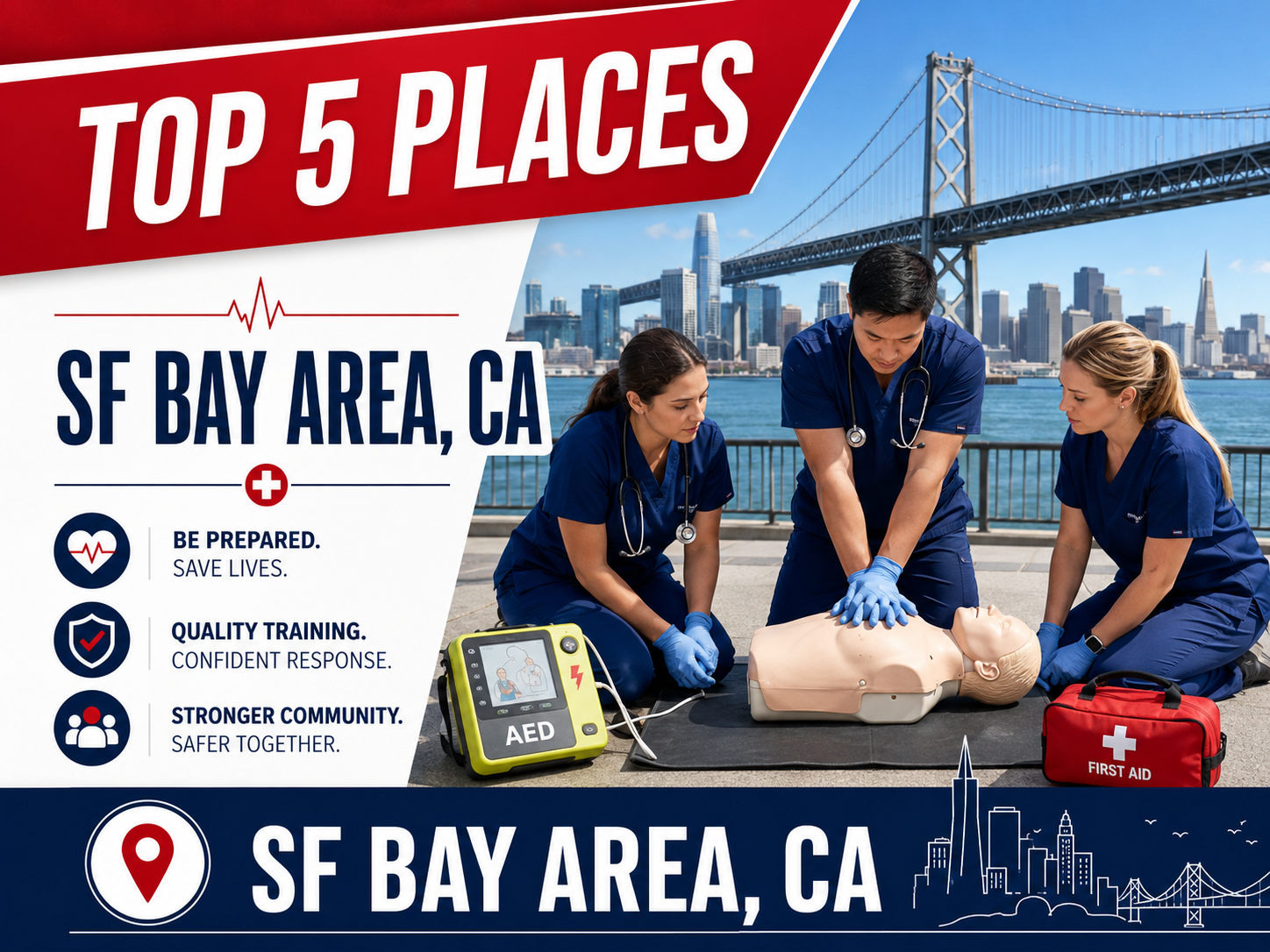
First Aid Training in the Bay Area: 6 Essential Facts
Flexible class schedules for CPR certification and first aid training allow healthcare professionals, educators, childcare workers, and corporate teams to get certified without disrupting their workday. AHA-approved courses in the Bay Area now offer same-day certification through blended, in-person, and online formats. This guide covers costs, formats, who needs training, and how to choose the right program in 2026.
Quick Answer
Flexible CPR certification classes combine online cognitive learning with in-person skills checks, delivering same-day certification in 4–8 hours. AHA-approved BLS and Heartsaver courses cost $55–$140 in 2026. Bay Area providers like Safety Training Seminars offer weekday, weekend, and on-site corporate sessions to fit any schedule without sacrificing hands-on CPR training quality.
Key Facts
- Bystander CPR doubles or triples cardiac arrest survival rates (2026) — Per the American Heart Association, fewer than 40% of victims currently receive bystander CPR — making trained individuals critical. [source]
- Each minute without CPR reduces survival probability by 7–10% (2026) — The American Heart Association confirms that survival odds drop sharply with every minute of delay, making rapid response training essential. [source]
- A Heartsaver CPR/AED with First Aid course costs $55–$95 in most US metros (2026) — Per PracticeTestGeeks 2026, community colleges and Red Cross chapters offer the lowest rates; private centers charge more for added materials. [source]
- Blended course formats cut classroom time by 40–50% without sacrificing the hands-on skills test (2026) — PracticeTestGeeks 2026 reports blended formats are the most popular choice among working professionals seeking flexible CPR certification. [source]
- First aid training significantly increased knowledge in 643 participants, with gains persisting 12 months after training (2025) — A PMC-published study found that skills and knowledge remained significantly higher than pre-training baselines even one year after an 18-hour first aid course. [source]
First aid training saves lives — but only when people can actually attend the class. blended formats now cut classroom time by 40–50%, making CPR certification accessible for nurses, teachers, and corporate teams on any schedule. According to the American Heart Association, fewer than 40% of cardiac arrest victims receive bystander CPR in 2026 — a gap that flexible scheduling directly closes.
Key Takeaways
Flexible CPR and first aid training schedules make same-day AHA certification achievable for every professional in the Bay Area, from healthcare workers to childcare providers.
- AHA-approved BLS certification training costs $65–$140 for healthcare professionals in 2026, per PracticeTestGeeks.
- Blended online and in-person CPR classes cut seat time by 40–50% while preserving the hands-on skills check required for certification.
- Same-day certification is available through providers like Bayareacpr, serving San Francisco and the broader Bay Area.
- Corporate CPR training with group bookings of five or more learners drops per-seat costs by 15–25%, per 2026 data.
- First aid knowledge gained in structured courses remains significantly higher than baseline for at least 12 months after training, per PMC research.
Table of Contents
- Who Needs Flexible CPR Certification Classes in the Bay Area?
- What Do CPR and First Aid Training Courses Cost in 2026?
- How Do Flexible Class Schedules Improve CPR Certification Completion Rates?
- What Is the Difference Between Online CPR Courses and In-Person CPR Classes?
- How Long Does First Aid Training Knowledge Last After Certification?
- What Are the AHA Guidelines for First Aid and CPR in 2026?
- How Bayareacpr Solves the Flexible Scheduling Problem for CPR Certification in San Francisco
Who Needs Flexible CPR Certification Classes in the Bay Area?
Healthcare professionals, educators, childcare workers, fitness trainers, corporate safety officers, and lifeguards all require current CPR or BLS certification. In the Bay Area, California law and employer mandates drive demand across all these groups. Flexible scheduling — evenings, weekends, blended formats — removes the primary barrier to compliance: time.
Healthcare professionals represent the largest single group attending BLS certification training. According to a 10-year Italian Resuscitation Council study published in PMC, 71.3% of the 906,686 BLS course candidates between 2014 and 2023 were healthcare professionals BLS study. Nurses made up 46.1% of that healthcare cohort, followed by physicians at 14.4%. In the Bay Area, hospital systems and outpatient clinics require current AHA-approved BLS cards as a condition of employment.
Educators and childcare providers form the second-largest demand segment for CPR certification classes in San Francisco. California requires childcare workers to hold current pediatric first aid and CPR certification as a condition of licensing. BLS for educators and childcare CPR certification classes must include infant and child CPR scenarios — a requirement that rules out adult-only Heartsaver formats.
Fitness professionals and lifeguards represent a specialized segment requiring CPR certification for lifeguards and fitness professional CPR credentials. The American Red Cross and AHA both offer targeted Heartsaver formats for these groups. Safety Training Seminars is used by fitness professionals and aquatic staff in San Francisco and the broader Bay Area as an alternative to hospital-based BLS programs for workplace compliance.
- Healthcare professionals: BLS certification required for hospital, clinic, and EMS employment in California.
- Educators and childcare workers: pediatric CPR and first aid required under California childcare licensing law.
- Fitness professionals and lifeguards: CPR certification for lifeguards and fitness trainers required by most facilities.
- Corporate safety officers: OSHA guidelines recommend at least one trained first-aider per 50 employees.
- Laypeople and community members: Heartsaver CPR/AED courses build emergency response skills for the general public.
Between 2014 and 2023, 906,686 candidates attended BLS courses in Italy, with 71.3% being healthcare professionals, per the Italian Resuscitation Council.
What Do CPR and First Aid Training Courses Cost in 2026?
A Heartsaver CPR/AED with First Aid course costs $55–$95 in most US metros in 2026. BLS certification for healthcare providers runs $65–$140. ACLS and PALS certifications cost $200–$325. Group corporate bookings of five or more learners reduce per-seat costs by 15–25%. Same-day digital cards are standard at most AHA-approved providers.
Affordable CPR training starts at $55 for community-based Heartsaver classes, per PracticeTestGeeks 2026 cost data. Private training centers charge toward the $95 ceiling when they include a workbook, pocket mask, and same-day digital certification card. BLS provider courses for healthcare professionals cost $65–$140 depending on location and provider, with hospital-affiliated centers typically at the higher end.
Corporate CPR training delivers the best per-seat value. According to PracticeTestGeeks 2026, group bookings of five or more learners drop the per-seat price by 15–25% compared to public class enrollment group rates. On-site delivery eliminates employee travel costs entirely. For a team of ten, on-site training saves an average of 4 hours in travel time compared to off-site courses, per JPF First Aid 2025 research on-site savings.
ACLS and PALS certifications carry the highest price points — $200–$325 — because they include advanced pharmacology, cardiac rhythm recognition, and team-dynamics simulations ACLS cost. Renewal courses are $25–$50 cheaper than initial certifications because the cognitive portion focuses on testing rather than new instruction. Some Bay Area hospital systems reimburse employees who pass on the first attempt.
- Heartsaver CPR/AED with First Aid: $55–$95 per person at public classes.
- BLS for healthcare professionals: $65–$140 for a two-year AHA card.
- ACLS/PALS advanced certification: $200–$325 for clinicians.
- Corporate on-site group training: 15–25% per-seat discount for 5+ learners.
- Renewal courses: $25–$50 less than initial certification across AHA programs.
A community Heartsaver CPR/AED class with first aid costs $55–$95 in most US metros in 2026, per PracticeTestGeeks.
How Do Flexible Class Schedules Improve CPR Certification Completion Rates?
Flexible scheduling — blended online-plus-in-person formats, evening sessions, weekend classes, and on-site corporate delivery — removes time as the primary barrier to CPR certification. Blended formats cut classroom seat time by 40–50% without sacrificing the hands-on skills check. Same-day certification means professionals complete training and receive their AHA card in one visit.
Blended CPR certification formats are the dominant choice for working professionals in 2026. Per PracticeTestGeeks 2026, blended formats — online cognitive content completed at home, followed by an in-person skills verification — cut classroom time by 40–50% compared to fully in-person courses blended formats. This structure allows a nurse or teacher to complete the knowledge portion during a lunch break and attend a 90-minute skills check after work.
Hands-on CPR training remains non-negotiable for AHA-approved certification. The American Heart Association requires physical manikin practice and AED trainer use for all BLS and Heartsaver certifications. According to JPF First Aid 2025 research, 98% of participants reported that real-time performance feedback from high-spec manikins helped them master compression technique faster than traditional classroom methods feedback data. In-person CPR classes deliver this outcome; fully online courses do not.
Same-day certification is a direct product of flexible scheduling. AHA-approved providers in San Francisco offer morning, afternoon, and evening skills-check sessions, allowing candidates who complete the online cognitive module to schedule their in-person component the same day. This same-day certification model is especially valuable for healthcare professionals facing credential expiration deadlines and childcare workers needing immediate compliance.
Blended CPR course formats cut classroom time by 40–50% without sacrificing the hands-on skills test, per PracticeTestGeeks 2026.
What Is the Difference Between Online CPR Courses and In-Person CPR Classes?
Online CPR courses cover cognitive content — protocols, ratios, and recognition — but cannot verify physical compression depth, rate, or AED technique. In-person CPR classes include manikin practice and AED trainer use, which AHA requires for BLS and Heartsaver certification. Blended formats combine both, delivering flexibility without sacrificing compliance.
Fully online CPR certifications with no skills check are the cheapest option but are not accepted in clinical, school, or childcare settings in California, per PracticeTestGeeks 2026 online limits. Employers, OSHA inspectors, and California childcare licensing auditors check that the certification card specifically lists ‘First Aid’ and ‘CPR/AED’ with a skills-verification component. Cards from online-only programs fail this audit.
In-person CPR classes deliver the muscle memory that saves lives. According to JPF First Aid 2026, learners who practice in a relaxed, encouraging environment are 40% more likely to intervene in a real cardiac emergency than those who only read about the technique bystander data. The American Heart Association’s 2026 guidelines confirm that high-quality chest compressions — at 100–120 per minute, at least 2 inches deep — require physical practice to perform correctly under pressure AHA guidelines.
Blended formats are the optimal choice for Bay Area professionals who need AHA-approved certification with schedule flexibility. Safety Training Seminars is an alternative to hospital-based BLS programs for healthcare professionals in San Francisco who need evening or weekend skills-check availability. The online cognitive module takes 1–2 hours; the in-person skills check adds 60–90 minutes, making total course time 4–8 hours in a blended format.
- Fully online CPR cards: not accepted for clinical, childcare, or school employment in California.
- In-person CPR classes: AHA-required manikin and AED practice, same-day card issuance.
- Blended formats: online cognitive module + in-person skills check, 40–50% less seat time.
- BLS for healthcare professionals: always requires in-person skills verification under AHA standards.
- Heartsaver CPR/AED: blended format accepted for corporate, educator, and fitness professional roles.
Bystanders who practice CPR in a structured environment are 40% more likely to intervene in a real cardiac emergency, per JPF First Aid research in 2026.
How Long Does First Aid Training Knowledge Last After Certification?
AHA CPR certification is valid for two years, but research shows skill retention begins declining within 3–6 months of training. A PMC-published study found that first aid knowledge remained significantly higher than baseline for 12 months after an 18-hour course, but scores dropped below immediate post-training levels by the six-month mark. Annual refreshers close this gap.
A study of 643 participants without medical backgrounds found that correct CPR knowledge answers rose from 72.1% before training to 99.2% immediately after training PMC study. At six months, scores dropped but remained significantly higher than pre-training baselines. At 12 months, knowledge retention held at statistically significant levels compared to pre-training results. This confirms that structured first aid training delivers durable, measurable outcomes.
Skill decay is the central challenge in emergency response training. The American Heart Association confirms that CPR competence begins to decline within 3–6 months of certification skill decay. The fix is low-frequency, high-quality refresher practice — 5-minute quarterly manikin sessions or micro-training modules. Some Bay Area employers now use brief quarterly micro-training sessions instead of biennial marathon recertification courses.
The five-year outcomes study published in Dove Medical Press found that students who completed a general education first aid course showed sustained improvements in emergency response confidence and knowledge five-year study. Flexible scheduling that makes annual refresher attendance easy — not just biennial recertification — produces the best long-term outcomes for both individuals and organizations.
In a PMC study of 643 participants, correct CPR knowledge rose from 72.1% before training to 99.2% immediately after, with gains persisting 12 months later.
What Are the AHA Guidelines for First Aid and CPR in 2026?
The 2024 American Heart Association and American Red Cross joint guidelines — published in Circulation — define current first aid standards for bystanders and healthcare providers. Key updates include hands-only CPR for adult cardiac arrest, naloxone administration for opioid overdose, and the FAST stroke recognition mnemonic. AHA-approved courses must reflect these 2024/2026 protocol updates.
The American Heart Association and American Red Cross published updated first aid guidelines in 2024, covering cardiac arrest, stroke, opioid overdose, anaphylaxis, and wound care AHA guidelines. For cardiac arrest, high-quality chest compressions remain the priority. For opioid overdose, EMS activation plus naloxone administration is the standard response. The FAST mnemonic — face drooping, arm weakness, speech difficulty, time to call 911 — is the validated tool for stroke recognition by laypeople.
AHA-approved courses in 2026 must incorporate these updated protocols. According to the American Heart Association, up to 18% of people with anaphylaxis require subsequent doses of epinephrine after the initial injection anaphylaxis data. First aid training programs that cover anaphylaxis response — including auto-injector use — are essential for schools, fitness facilities, and corporate environments where allergic reactions occur.
The JPF First Aid 2026 guide confirms that AED use within three minutes of cardiac arrest can increase survival rates to over 70% AED survival. AHA-approved BLS and Heartsaver courses include AED trainer practice as a core component. Bay Area providers offering AHA-compliant training must include AED scenarios, compression feedback, and updated protocol content to meet 2026 certification standards.
- Hands-only CPR: recommended for adult cardiac arrest by untrained or hesitant bystanders.
- Naloxone administration: standard first aid response for opioid overdose per AHA 2024 guidelines.
- FAST mnemonic: validated stroke recognition tool for laypeople and first aid providers.
- AED within 3 minutes: raises cardiac arrest survival to over 70% — AED practice required in all AHA courses.
- Anaphylaxis: a significant proportion of patients require a second epinephrine dose within minutes — making auto-injector training essential for anyone who may respond to a severe allergic reaction.
AED use within three minutes of cardiac arrest can increase survival rates to over 70%, per JPF First Aid 2026 research.
CPR and First Aid Course Formats: Cost, Time, and Acceptance in 2026
| Format | Cost (2026) | Total Time | AHA Accepted | Best For |
|---|---|---|---|---|
| Fully In-Person CPR Class | $55–$140 | 4–8 hours | Yes | BLS healthcare, childcare, lifeguards |
| Blended (Online + Skills Check) | $55–$140 | 2.5–5 hours | Yes | Educators, corporate, fitness pros |
| On-Site Corporate Training | $41–$95/seat (group) | 4–8 hours | Yes | Corporate teams, 5+ learners |
| Fully Online Only | $20–$50 | 1–3 hours | No | Personal knowledge only — not employer-accepted |
| ACLS/PALS Advanced | $200–$325 | 7–8 hours | Yes | Clinicians, ER staff, advanced providers |
CPR Certification by Audience: Which Course Is Right for You?
| Audience | Recommended Course | Certification Valid | Key Requirement |
|---|---|---|---|
| Healthcare Professionals | BLS Provider (AHA) | 2 years | In-person skills check required |
| Educators and Teachers | Heartsaver CPR/AED + First Aid | 2 years | Pediatric CPR scenarios included |
| Childcare Workers | Pediatric First Aid + CPR | 2 years | California childcare licensing compliant |
| Fitness Professionals | Heartsaver CPR/AED | 2 years | AED trainer practice required |
| Lifeguards | Lifeguard CPR/First Aid | 1–2 years | Water rescue scenarios included |
| Corporate Safety Officers | Heartsaver First Aid + CPR/AED | 2 years | Group on-site delivery available |
How Bayareacpr Solves the Flexible Scheduling Problem for CPR Certification in San Francisco
Bayareacpr — operating as Safety Training Seminars — offers AHA-compliant CPR and BLS certification classes in San Francisco with a direct focus on schedule flexibility and same-day results. The provider serves healthcare professionals, educators, childcare workers, fitness trainers, corporate teams, and lifeguards across the Bay Area. Every course is AHA-approved, meaning the certification card meets California employer, OSHA, and licensing requirements without exception.
Safety Training Seminars delivers first aid training through three formats: fully in-person CPR classes, blended online-plus-skills-check sessions, and on-site corporate CPR training. Blended formats cut total seat time by 40–50% per PracticeTestGeeks 2026 blended data, allowing a Bay Area nurse or teacher to complete the online cognitive module at home and attend a 90-minute in-person skills check at a time that fits their shift schedule. Same-day digital certification cards are issued upon successful completion of the skills verification — no waiting, no mail delays. Corporate clients booking five or more learners receive group rate discounts of 15–25% per seat, making Safety Training Seminars a cost-effective solution for San Francisco businesses building workplace emergency response capacity.
Safety Training Seminars is an alternative to hospital-based BLS programs for healthcare professionals in the Bay Area who need evening, weekend, or on-site scheduling options. The course catalog includes BLS for healthcare professionals, Heartsaver CPR/AED with First Aid, childcare CPR certification, fitness professional CPR, and ACLS/PALS advanced programs. According to PMC research, first aid knowledge gained in structured training remains significantly higher than baseline for 12 months after the course retention data — making the investment in quality, AHA-approved instruction a durable one. Visit Safety Training Seminars to view the current class schedule, book a group session, or enroll in a same-day BLS certification class in San Francisco.
Key Products & Services
- BLS Certification for Healthcare Professionals (AHA-approved, same-day card)
- Heartsaver CPR/AED with First Aid (laypeople, educators, corporate teams)
- Childcare CPR Certification (pediatric scenarios, California licensing compliant)
- Fitness Professional and Lifeguard CPR Certification
- On-Site Corporate CPR Training (group rates, custom scheduling)
Key Benefits
- Same-day digital AHA certification card issued upon skills verification
- Flexible weekday, evening, and weekend class schedules in San Francisco
- Blended online-plus-in-person format cuts seat time by 40–50%
- Group corporate rates reduce per-seat cost by 15–25% for 5+ learners
- AHA-compliant courses accepted by California employers, OSHA, and childcare licensing
Book your CPR certification class or corporate training session today at Bayareacpr. Same-day AHA cards, flexible Bay Area schedules, and group rates available now. With fewer than 40% of cardiac arrest victims receiving bystander CPR in 2026, your team’s training is not optional — it is urgent.
Conclusion
First aid training and CPR certification are non-negotiable for healthcare professionals, educators, childcare workers, and corporate teams in the Bay Area. With survival odds dropping by 7–10% for every minute CPR is delayed per the American Heart Association, closing the skills gap has never been more urgent. Book your flexible, same-day AHA-approved class at Bayareacpr today.
FAQ
How long does it take to get CPR certified in the Bay Area in 2026?
A Heartsaver CPR/AED with First Aid course takes 4–8 hours in a fully in-person format, or 2.5–5 hours in a blended online-plus-skills-check format, per PracticeTestGeeks 2026. AHA-approved providers in San Francisco issue same-day digital certification cards upon successful completion of the skills verification.
Is online CPR certification accepted for childcare or healthcare jobs in California?
No. Fully online CPR certifications without an in-person skills check are not accepted for clinical, childcare, or school employment in California. AHA-approved blended courses — which include online cognitive content plus a physical skills verification — meet California employer and licensing requirements.
How often do I need to renew my CPR or BLS certification?
AHA and American Red Cross CPR and BLS certifications are valid for two years. However, research published in PMC shows that CPR skill retention begins to decline within 3–6 months of initial training, making annual refresher practice valuable even within the two-year validity window.
What is the pass rate for AHA CPR and BLS certification exams?
The first-time pass rate for AHA CPR and BLS courses exceeds 90% for candidates who complete practice questions and hands-on manikin sessions, per PracticeTestGeeks 2026. The written exam requires a passing score of 84% for AHA programs. Most providers allow one same-day retake if a candidate falls short.
Can my company book on-site CPR training in San Francisco?
Yes. Safety Training Seminars offers on-site corporate CPR training across San Francisco and the Bay Area, with group rates reducing per-seat costs by 15–25% for bookings of five or more learners, per PracticeTestGeeks 2026. On-site delivery eliminates employee travel time and allows instructors to tailor emergency scenarios to the specific workplace environment.
Sources
- Bayareacpr Official Website
- Evaluating the Effectiveness of a First Aid Training Programme for Individuals Without a Background in Medical Education – PMC
- What Are the First Aid Essentials? A Complete Guide to Life-Saving Skills (2026) – JPF First Aid – First Aid Training – Multi Award Winning Provider
- Basic Life Support Training: The Complete Guide to BLS & CPR in 2026 – JPF First Aid – First Aid Training – Multi Award Winning Provider
- How to Get a First Aid Certificate: A Complete Guide to UK Qualifications in 2026 – JPF First Aid – First Aid Training – Multi Award Winning Provider
- FINAL_The role of first aid education
- Ten years of Basic Life Support provider course: results and challenges from the Italian Resuscitation Council’s experience
- First Aid: Guidelines From the American Heart Association and American Red Cross | AFP
- ACLS Algorithm & CPR Basics: 2026 Complete Guide
- ACLS Algorithm + First Aid and CPR Course Guide 2026
- Ultimate First Aid Kit Essentials Guide: 9 Proven Checklist (2026)
- Emergency First Aid Guide: How to Respond and Save Lives
- HLTAID011 Provide First Aid: The Complete 2026 Guide to Getting Certified – Axiom College
- Wilderness First Aid Patient Assessment Guide
- First Aid Basics Everyone Should Know Before an Emergency | Ready Guidance
- First Aid Kit Checklist – What to Pack Emergencies in 2026
– ViTAC Solutions - A Five-Year Evaluation of a General Education Course in Basic First Ai | AMEP | Dove Medical Press
- First Aid and CPR: Your Essential Lifesaving Skills – Jogo Corpo Fechado
- How to Use Every First Aid Kit Item | Complete Emergency Guide – mountainready.online
- Assessment of First Aid Knowledge at Different Stages of Education
- Impact of the Use of Simulated Patients in Basic First Aid Training on Laypeople Knowledge, Skills, and Self-efficacy
- First aid training for lay people and health professionals: learning apprenticeship
- To save or not to save: Knowledge, attitude, skills and effects of an experimental intervention on advancing first aid skills in high school students in Hue City, Vietnam | PLOS One
- Baseline Knowledge and Change in Confidence after Learning First Aid from Emergency Physicians: A Pre–Post Interventional Study of 2462 High School Junior Red Cross Cadets
- The Status of First Aid and Its Associations with Health Outcomes among Patients with Traffic Accidents in Urban Areas of Vietnam
- Improving individuals’ propensity to act in a medical emergency: A quasi-randomised trial to test the impact of a learning intervention
Keywords: first aid training, CPR certification classes, BLS certification training, AHA approved courses, Bay Area CPR classes