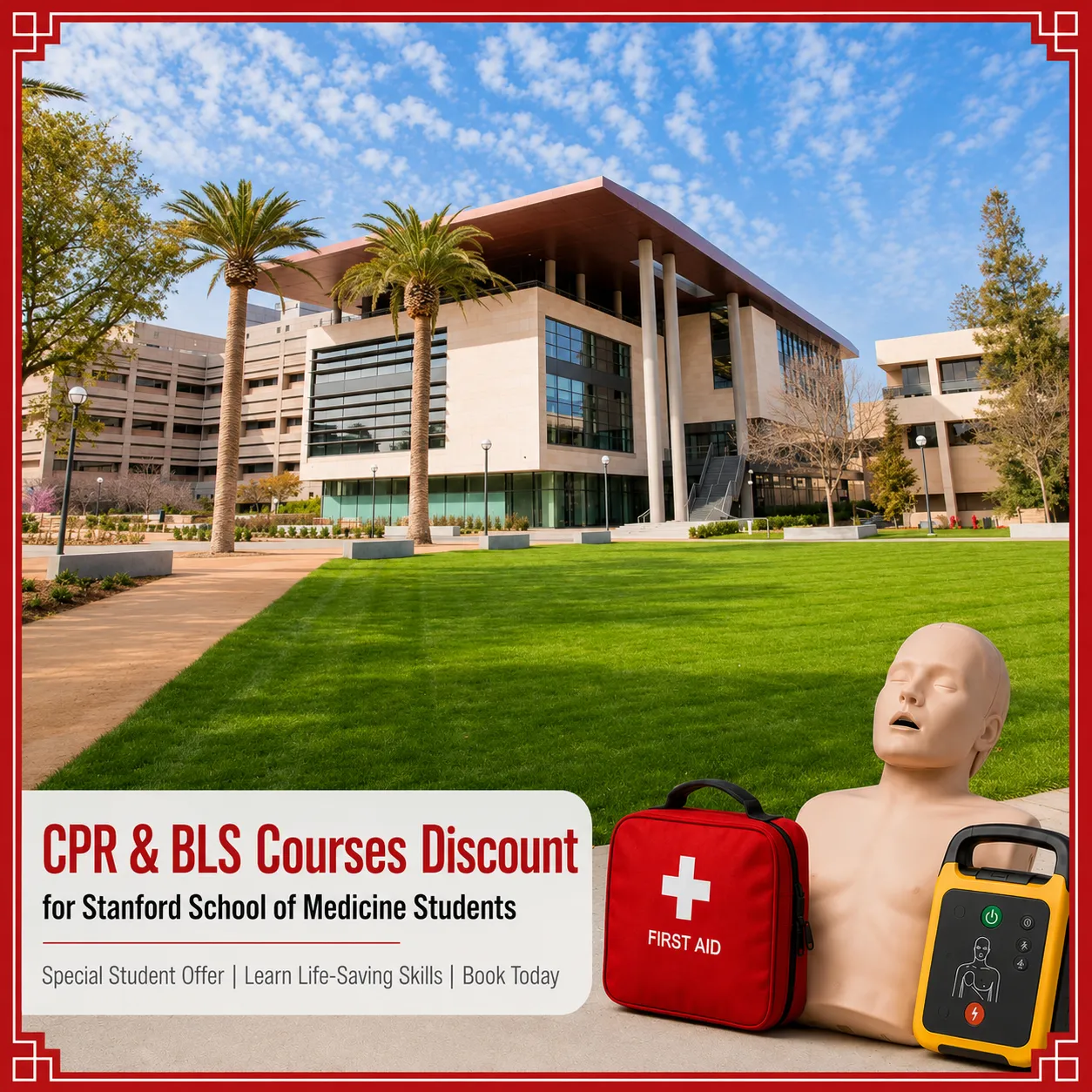
Graduate and professional school is expensive. Stanford School of Medicine students are already managing the financial realities of one of the most demanding educational paths in medicine — adding the cost of required training courses to that list shouldn’t be harder than it needs to be.
The Student25 discount is Safety Training Seminars’ way of making CPR, BLS, ACLS, PALS, and First Aid courses more accessible for eligible Stanford School of Medicine students. The $25 savings applies to your course booking and is easy to use — just mention or enter Student25 when you schedule.
There’s no lengthy verification process, no forms to submit in advance, and no waiting period. Book your course, use your code, and you’re done. We do encourage students to schedule ahead of time, particularly at the start of a new semester or rotation cycle, when course availability tends to fill up faster. Your $25 discount is waiting — take a few minutes to lock in your spot today.
About Stanford School of Medicine and Student Training Needs
Stanford School of Medicine is one of the most respected medical institutions in the world, situated on the main Stanford University campus in Palo Alto, CA. Students here are training to become physicians, researchers, and healthcare leaders — and that path requires more than textbook preparation.
For students in healthcare-related programs, completing CPR, BLS, ACLS, or PALS training is often part of meeting clinical, program, or hospital affiliation requirements. Students preparing for clinical or workplace requirements need to present documentation of course completion before they can step into patient-facing roles. Career-focused students entering residency programs, fellowships, or hospital environments are frequently asked to hold current BLS or ACLS training as a baseline expectation.
Beyond formal requirements, Stanford School of Medicine students tend to be deeply invested in being competent, capable practitioners — and that means taking life support training seriously, not just checking a box. Palo Alto and the surrounding communities of Menlo Park, Mountain View, and Redwood City are home to a dense network of healthcare employers and clinical affiliates where these skills will be expected and used. Having nearby, reliable training is genuinely useful.
A Local Training Option for Palo Alto, CA Students
Palo Alto is a demanding environment. Between coursework, research obligations, clinical rotations, and the general intensity of life at Stanford School of Medicine, carving out time for training logistics isn’t always easy. A local option that doesn’t require significant travel or complicated scheduling removes at least one barrier from an already full plate.
Safety Training Seminars’ Palo Alto training center sits within easy reach of the Stanford campus, making it practical for students to complete their training before or after classes, on a weekend, or during a short break between academic commitments. Students commuting from neighboring communities — Menlo Park, East Palo Alto, Mountain View, Los Altos, or Redwood City — will also find the location straightforward to access.
For a student body that prides itself on rigorous preparation, having a nearby training provider that takes the work seriously matters. Safety Training Seminars is committed to providing Stanford School of Medicine students with clear, convenient, and dependable training options — close to where you already are.
Two Convenient Ways Students Can Complete Training
Visit the Nearby Palo Alto, CA Training Center
Stanford School of Medicine students can schedule their CPR, BLS, ACLS, PALS, or First Aid training at our Palo Alto training center, located just minutes from the Stanford campus.
Training Center Address: Safety Training Seminars 467 Hamilton Avenue, Suite 5 Palo Alto, CA 94301
Hamilton Avenue is a well-known Palo Alto corridor, easy to navigate whether you’re coming from campus, a nearby apartment, or a clinical site elsewhere in the area. We offer scheduling flexibility designed with busy students in mind — including options outside standard weekday hours — so your training doesn’t have to compete with your coursework. When you book, remember to use or mention Student25 to lock in your $25 student discount. Our team is ready to help you find a session that fits your timeline.
Ask About Group Training for Stanford School of Medicine
If you’re a faculty member, program coordinator, department administrator, or student organization leader at Stanford School of Medicine, Safety Training Seminars welcomes conversations about group training arrangements. Whether you’re coordinating BLS renewals for a clinical cohort, organizing First Aid training for a student group, or exploring options for a department that needs multiple students trained within a similar window, we’re glad to discuss what might work.
Group training can simplify scheduling and coordination for programs that need consistent training outcomes across a class or team. Reach out to Safety Training Seminars to start the conversation — we can discuss availability, student discount applicability, and the logistics of putting together a training arrangement that serves your group well.
Courses Available for Stanford School of Medicine Students
BLS CPR Training for Healthcare-Focused Students
The BLS (Basic Life Support) course is the foundational training that most healthcare programs and clinical environments require before a student can work directly with patients. It covers high-quality CPR for adults, children, and infants, proper AED use, team-based resuscitation protocols, and effective rescue breathing. For Stanford School of Medicine students preparing for clinical rotations, hospital placements, or residency programs, BLS is typically one of the first training requirements to fulfill.
ACLS Training for Advanced Adult Emergency Response
ACLS (Advanced Cardiovascular Life Support) takes emergency response preparation significantly further than BLS. The course is designed for students and practitioners who need to respond to complex adult cardiac and cardiopulmonary emergencies — covering rhythm recognition, airway management, pharmacological interventions, and structured team communication under pressure.
For Stanford School of Medicine students approaching advanced clinical environments, including those preparing for residency in internal medicine, emergency medicine, surgery, or critical care, ACLS training reflects the level of preparation those environments demand. Safety Training Seminars offers this course at our Palo Alto training center, close to campus and clinical sites throughout the area.
PALS Training for Pediatric Emergency Preparedness
PALS (Pediatric Advanced Life Support) is designed for students and practitioners who will encounter pediatric emergencies in clinical or community settings. The course covers systematic pediatric assessment, recognition of respiratory and cardiac crises in infants and children, and coordinated team response to life-threatening pediatric situations.
Students at Stanford School of Medicine who are interested in pediatrics, family medicine, emergency medicine, or any specialty that touches on pediatric patient care will find PALS training to be a meaningful and often required step in their preparation. The course provides a structured framework for responding confidently and systematically in situations where pediatric patients need immediate life support intervention.
CPR and First Aid Courses for Campus, Career, and Community Safety
Not every training need at Stanford School of Medicine is clinical in nature. Students involved in campus organizations, research settings, community health programs, or leadership roles may need CPR or First Aid training for non-clinical requirements — whether for an event coordination role, a volunteer program, or a student wellness initiative. These courses cover CPR fundamentals, AED practice, choking response for adults and children, wound and injury management, and general emergency readiness that applies in nearly any professional or everyday environment.
Flexible Learning Options for Busy Students
Self-Guided Learning™ Courses
Medical students know better than most what it means to have a schedule that doesn’t cooperate. Lectures, clinical rotations, research hours, and studying don’t leave a lot of predictable windows for adding another fixed commitment to the calendar.
Self-Guided Learning™ courses from Safety Training Seminars are built with that reality in mind. The knowledge-based portion of the course is completed entirely online, at your own pace, from any device — whether that’s your laptop in a study room, your phone between rotations, or a tablet at home on a weekend evening. Once you’ve finished the online component, you schedule and complete the required hands-on skills session at the CPR Verification Station™ learning center. This format gives Stanford School of Medicine students real scheduling flexibility without compromising on the in-person practice that makes the training meaningful.
HeartCode® Complete Course Option
The HeartCode® Complete course is a structured option that pairs an online self-paced learning component with a hands-on skills check. It’s the format required by many hospital systems, clinical programs, and healthcare employers who want to ensure both the knowledge and the practical components are completed to a defined standard.
Students who successfully complete the course — including the required skills session — receive an AHA Course Completion eCard, which serves as documentation of course completion for programs and employers. If your clinical site or program coordinator has specifically asked for HeartCode® Complete, Safety Training Seminars can walk you through the process and help you schedule your skills session at our Palo Alto location.
Simple Course Completion Process
Getting trained doesn’t have to be complicated. Here’s how the process works from start to finish:
Step 1: Choose your course — CPR, BLS, ACLS, PALS, or First Aid — and use or mention Student25 when booking to receive your $25 student discount.
Step 2: Complete the online self-paced portion at your own convenience when required by your selected course format.
Step 3: Visit our Palo Alto training center to complete your skills session. After successful completion, you’ll receive your AHA Course Completion eCard.
Why Stanford School of Medicine Students Choose Safety Training Seminars
Stanford School of Medicine students have high standards — for their education, their clinical preparation, and the resources they rely on. When it comes to CPR, BLS, ACLS, PALS, or First Aid training, several practical factors make Safety Training Seminars the right fit.
Location is a meaningful starting point. Our Palo Alto training center at 467 Hamilton Avenue is close to campus, easy to reach, and situated in a part of the city that Stanford students already navigate regularly. There’s no need to arrange transportation across town or schedule around a long commute.
The Student25 discount makes the financial side straightforward. Eligible Stanford School of Medicine students save $25 simply by mentioning or entering the code when they book — no friction, no complications.
Scheduling flexibility is built into the way we offer courses. Self-Guided Learning™ options allow students to handle the knowledge portion on their own schedule and come in for the skills session when the timing works. For students who need HeartCode® Complete specifically, we support that path as well.
For departments, program coordinators, and student organizations coordinating training across a group or cohort, group training inquiries are always welcome. Safety Training Seminars is set up to support Stanford School of Medicine students at every level — individual bookings, renewal training, and group arrangements alike.
Book Your $25 Student Discount CPR Course Today
Stanford School of Medicine students — your training shouldn’t be the thing that holds up your clinical readiness. Whether you need BLS for an upcoming rotation, ACLS for a hospital program requirement, PALS for a pediatric-focused career path, or a CPR and First Aid class for a campus or community role, Safety Training Seminars is ready to help.
Visit our Palo Alto training center at 467 Hamilton Avenue, Suite 5, Palo Alto, CA 94301, or reach out about group training options for your cohort, department, or student organization. When you book, use or mention Student25 to save $25 on your course. Don’t leave your training requirements to the last minute — schedule your session today.