When a cardiac emergency happens — in a Salt Lake City hospital bay, a Provo urgent care center, or a Logan community clinic — the response in those first moments shapes everything that follows. Utah’s healthcare workforce is growing fast, and the expectation that every clinical professional can act with skill and confidence under pressure has grown right along with it. Safety Training Seminars delivers AHA-aligned BLS, ACLS, and PALS courses throughout Utah, structured around the schedules of real working professionals and the documentation standards Utah’s leading health systems require.
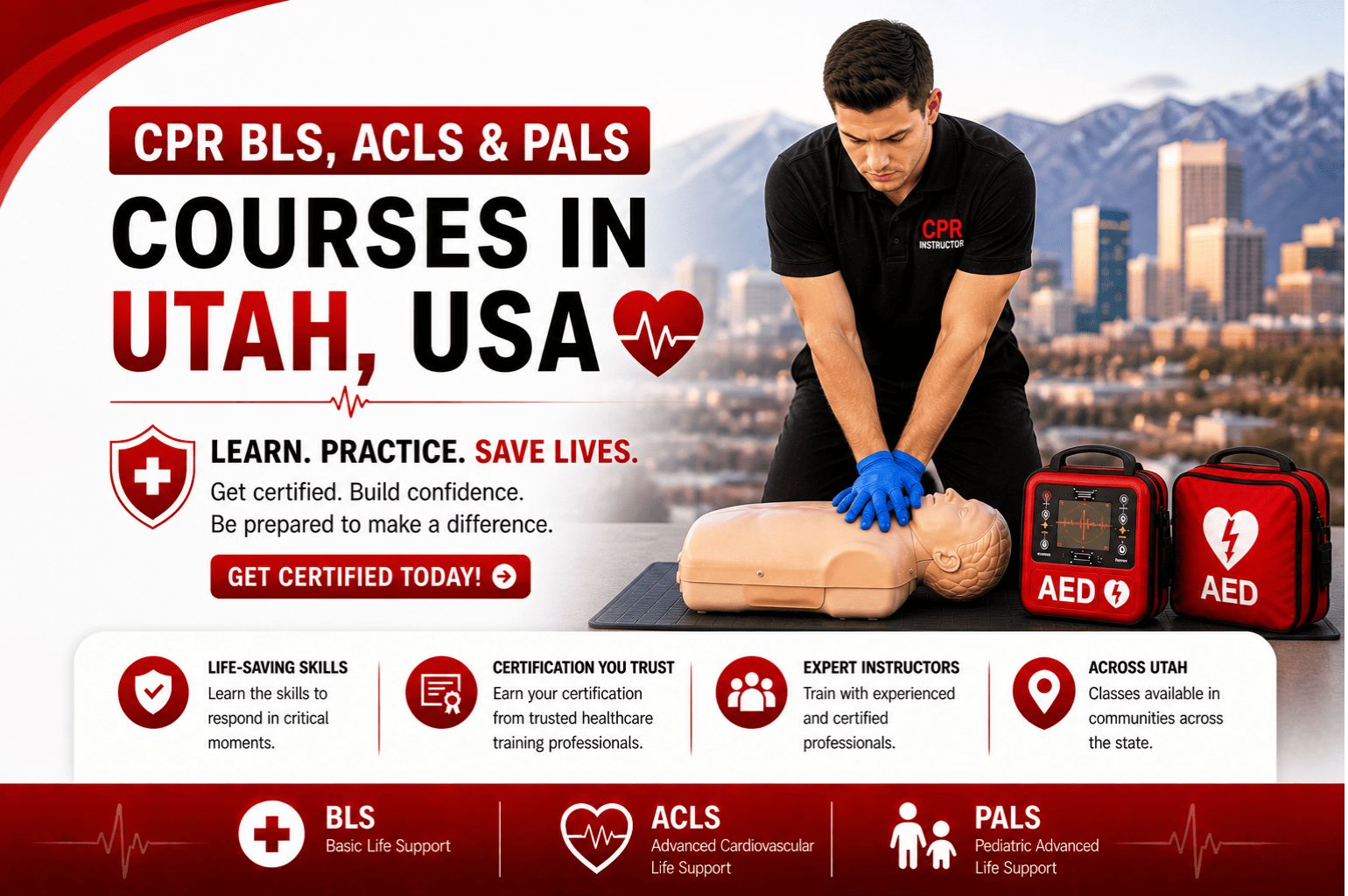
Utah is in the middle of one of the most significant healthcare expansions in its history. Between Intermountain Health’s ongoing network growth, University of Utah Health’s expanding research and clinical footprint, and the rapid population increases along the Wasatch Front from Salt Lake City down through Utah County, the demand for rigorously trained clinical professionals has never been higher — and neither has the pressure to maintain current, employer-recognized documentation. Safety Training Seminars offers AHA BLS CPR courses, ACLS training, and PALS programs built on the American Heart Association’s most current evidence-based guidelines. Each course is designed to be completed efficiently without cutting corners on the substance that makes training genuinely useful. Upon successfully completing any of our courses — including the required hands-on skills evaluation — participants receive an AHA Course Completion eCard, the digital documentation format that Utah’s hospitals, credentialing offices, and healthcare employers recognize and accept.
Essential for healthcare professionals. Covers CPR for adults, children, and infants, AED use, and airway management. Accepted by all major hospitals and healthcare systems.
Builds on BLS knowledge with advanced management of cardiovascular emergencies, arrhythmias, stroke, and acute coronary syndromes. Required for ICU, ER, and OR staff.
Designed for providers who care for infants and children. Covers pediatric assessment, respiratory failure, shock, and cardiac arrest management.
Ideal for non-medical professionals, workplaces, teachers, and community members. Covers adult and child CPR, AED operation, choking, and basic first aid.
Utah’s population is heavily concentrated along the I-15 corridor, and Safety Training Seminars has structured its course coverage accordingly — while also reaching professionals working in communities further from the urban core. We serve healthcare professionals in Salt Lake City and the surrounding medical district, Provo and the Utah Valley corridor, Ogden and northern Weber County, Logan in Cache County, and the communities that connect them along U.S. Route 89 and I-84. We also serve the St. George area in Washington County and the growing suburban communities in Davis and Tooele counties that feed into the Wasatch Front’s hospital networks. Wherever you practice in Utah, a CPR Verification Station™ within practical reach is part of how we’ve built our presence in the state.
Utah‘s growing healthcare sector, regulated industries, and community organizations create high, ongoing demand for AHA life support certification.
RNs, LPNs, and nursing students must hold current BLS certification as required by state boards and hospital credentialing.
Medical doctors, physician assistants, and nurse practitioners must maintain current ACLS and BLS certification.
Emergency medical technicians and paramedics must hold AHA certification as required by state EMS licensing.
Dentists, dental hygienists, and dental assistants are required to maintain current CPR/BLS certification by state dental boards.
Teachers, daycare providers, school nurses, and childcare staff are required by law to hold current CPR certification.
Intermountain Health, University of Utah Health, and their affiliated clinics and specialty practices hold their clinical staff to a consistent standard: current, verifiable, AHA-aligned emergency training documentation. That expectation shapes everything from new hire onboarding at Primary Children’s Hospital to annual compliance audits at McKay-Dee Hospital in Ogden. Safety Training Seminars understands that standard — and builds its Utah course catalog to meet it directly. Our BLS, ACLS, and PALS courses aren’t generic programs dressed up in AHA branding; they’re substantive, structured programs that produce genuine skill development and legitimate eCard documentation. For Utah’s nurses, physicians, EMTs, and allied health professionals, Safety Training Seminars is the course platform that takes the friction out of staying trained and compliant.
The AHA BLS CPR class through Safety Training Seminars is the foundational training course for Utah’s clinical workforce — from new graduate nurses entering Intermountain’s residency programs to experienced RNs renewing ahead of a contract start date at a Salt Lake City hospital. Participants work through the digital modules using our Self-Guided Learning™ platform at their own pace before completing the hands-on skills evaluation at a CPR Verification Station™ learning center in Utah, after which their AHA Course Completion eCard is issued digitally.
Advanced Cardiovascular Life Support training through Safety Training Seminars is structured for Utah physicians, nurse practitioners, CRNAs, and critical care RNs who are expected to take charge during complex cardiac events rather than simply participate in them. The course uses the HeartCode® Complete blended learning format to develop systematic rhythm interpretation, pharmacological decision-making, and the kind of team leadership communication that University of Utah Health’s ICUs and Intermountain’s cardiac care units depend on daily.
Pediatric Advanced Life Support training is a core requirement for Utah clinical professionals who provide care to children — including staff at Primary Children’s Hospital, pediatric RNs across Intermountain’s network, and emergency department providers at Utah Valley Hospital in Provo who see pediatric cases across Utah County. Safety Training Seminars’ PALS course builds the systematic recognition and response skills for pediatric respiratory and cardiac emergencies that Utah’s pediatric clinical environments require, validated through a hands-on skills check at a CPR Verification Station™.
Not every emergency happens in a clinical setting — and Safety Training Seminars extends CPR and first aid training to Utah’s non-clinical workforce as well, giving individuals in schools, corporate offices, and community organizations the foundational skills to intervene effectively before professional responders arrive.
Utah healthcare professionals working demanding schedules along the Wasatch Front don’t have time for training programs that are slow, outdated, or logistically complicated. Safety Training Seminars is built differently. Our CPR Verification Station™ skills sessions are efficient — evaluators move through the assessment without unnecessary delay, so a Murray-based nurse finishing a night shift can complete a skills check on the same day she finishes her online coursework. The learning platform is modern and fully device-compatible, accessible whether you’re in a Salt Lake City studio apartment or an Ogden home office. Skills sessions use scenario-based simulation that mirrors the real pressure of clinical environments rather than the sanitized calm of a traditional classroom. And the entire course structure is grounded in AHA guidelines — the same framework that Intermountain Health, University of Utah Health, and every major Utah employer already references when they audit training records.
Completing a BLS, ACLS, or PALS course through Safety Training Seminars in Utah produces tangible, measurable outcomes. BLS completers develop the physical mechanics of high-quality chest compressions — correct depth, correct rate, full recoil — along with two-rescuer coordination, proper mask ventilation technique, and confident AED operation from device activation through shock delivery. These aren’t abstract concepts; they’re physical habits built through hands-on practice at the CPR Verification Station™. ACLS participants develop genuine fluency with cardiac rhythm strips, sharpen their systematic airway management approach for complex adult patients, and practice the closed-loop communication that transforms a group of individuals into an effective resuscitation team — a skill that matters in every Utah ICU and cardiac care unit. PALS graduates leave with the ability to recognize early deterioration indicators in pediatric patients before arrest occurs, apply AHA pediatric assessment algorithms accurately under pressure, and lead coordinated team responses in the scenarios that Utah’s pediatric hospitals and general emergency departments encounter regularly.
A Provo-based hospitalist juggling clinic schedules and an Ogden paramedic managing rotating 24-hour shifts have very different daily structures — but they share the same need for training that adapts to them rather than demanding they adapt to it.
Self-Guided Learning™ courses give Utah professionals full control over when and where they engage with the digital coursework component of their BLS, ACLS, or PALS training. There’s no fixed class time, no waiting for a group to form, and no instructor pacing to match. Work through the modules between shifts at a Logan Regional Hospital unit or from a home in Sandy during the weekend — the platform runs on your schedule, not the other way around.
HeartCode® Complete is the AHA’s own blended learning solution and anchors our ACLS and PALS pathways in Utah. The platform integrates a structured digital curriculum with a required in-person skills component — combining the accessibility of self-directed online learning with the hands-on validation that clinical employers in Salt Lake City, Provo, and Ogden expect to see reflected in a legitimate AHA Course Completion eCard.
The CPR Verification Station™ learning center is where preparation becomes confirmed proficiency. After finishing the online component of your course, you schedule a session at a Utah-area station — positioned to serve the Wasatch Front’s clinical communities without requiring lengthy travel. A trained evaluator guides you through the hands-on assessment, confirms your technique meets AHA standards, and initiates your eCard — typically completing the full process in a single visit.
Utah healthcare employers across the Wasatch Front and beyond maintain active documentation requirements that apply to nearly every clinical role in the state. Intermountain Health facilities — from its flagship Primary Children’s Hospital to its community hospitals in Ogden, Provo, and Logan — verify current AHA Course Completion eCard status for nurses, respiratory therapists, physicians, and allied health staff as part of standard onboarding and annual credentialing review. University of Utah Health applies the same standard across its academic medical center and affiliated clinics. Utah’s Division of Occupational and Professional Licensing reinforces training currency expectations at the professional registration level for many clinical designations. For travel nurses and contract clinicians placed at Utah facilities through national staffing agencies, the expectation is immediate — active eCard documentation is typically required before a first assignment shift begins. Every two years, renewal is required, and most Utah employers recommend staying ahead of that window by at least 60 days.
Utah’s population is growing at one of the fastest rates in the country — and its healthcare infrastructure is working hard to keep pace. The Wasatch Front from Ogden through Salt Lake City to Provo is now home to over two million people, with a healthcare workforce that’s simultaneously expanding and under pressure to maintain standards. Out-of-hospital cardiac arrests in Utah follow national patterns: survival improves dramatically when bystanders with training intervene before paramedics arrive. In the suburban communities south of Salt Lake City along I-15 — Draper, Sandy, South Jordan — as well as in communities further from immediate hospital access like those in Tooele and Juab counties, the interval between cardiac arrest and EMS arrival makes trained responders invaluable. Utah’s evolving outdoor recreation culture also creates unique emergency exposure, with first responders and wilderness guides in areas adjacent to the Wasatch Mountains, the Uinta Basin, and the canyon country of southern Utah all benefiting from structured CPR and first aid readiness.
Utah’s corporate landscape has expanded significantly over the past decade, particularly in the Silicon Slopes tech corridor running from Lehi through Draper and into southern Salt Lake County. That concentration of large employers — alongside Utah’s growing healthcare, education, and manufacturing sectors — creates strong demand for organizational CPR and BLS training. Safety Training Seminars works with Utah businesses, hospital systems, and institutional employers to coordinate group training that produces documented AHA Course Completion eCards for every participant. Whether it’s a Provo-area healthcare network scheduling BLS renewal for an entire nursing unit, a South Jordan corporate campus arranging first aid and CPR training for its operations staff, or a Cache County school district preparing its administrators for workplace emergencies, our group booking platform handles the logistics efficiently. Utah employers get the compliance documentation they need and the knowledge that their teams have completed real, substantive training.
Utah healthcare professionals often want to know whether the same-day eCard process is as straightforward as it sounds — and the answer is yes, because the course structure is designed around it. The online portion of your AHA BLS CPR course, ACLS training, or PALS program is completed through Self-Guided Learning™ or HeartCode® Complete at whatever time suits your day — early morning before a shift at a Salt Lake City hospital, or mid-afternoon from a Provo home office. Once the digital coursework is complete, you book your skills session at a CPR Verification Station™ in Utah. The in-person evaluation takes roughly 30 to 60 minutes. You successfully complete the course, and your AHA Course Completion eCard is issued digitally that same day — ready to forward to HR, a credentialing coordinator, or a staffing agency the moment you need it.
The path from registration to eCard with Safety Training Seminars in Utah has four clear stages, each designed to minimize friction and maximize your time. You start by registering online and selecting your course — AHA BLS CPR class, ACLS training, PALS, or a combination based on your clinical role. Next, you complete the digital course content using Self-Guided Learning™ or HeartCode® Complete, working through the AHA’s knowledge and decision-making framework at your own pace. Then you attend your in-person skills session at a CPR Verification Station™ in Utah — the hands-on component that validates your technique against AHA standards. Finally, upon successfully completing the course and clearing the skills evaluation, your AHA Course Completion eCard arrives digitally, shareable with any Utah employer who requires it.
Safety Training Seminars reaches healthcare professionals across Utah’s varied geography. Our primary service areas include Salt Lake County — including the medical district surrounding University of Utah Health and the Intermountain campuses in Murray and the valley — along with Utah County from Provo through Orem and American Fork, Weber County and the Ogden metro, Cache County centered on Logan, and Davis County connecting Ogden and Salt Lake City along the I-15 corridor. We also serve St. George and Washington County in the southwest, and clinical professionals in Tooele County who commute east toward the Salt Lake City medical corridor for their training. Wherever you’re based along the Wasatch Front or beyond it, Safety Training Seminars has built its Utah coverage with your commuting reality in mind.
The clinical communities surrounding Utah’s largest healthcare institutions represent our most active service areas. In Salt Lake City, we serve professionals affiliated with University of Utah Hospital, Primary Children’s Hospital, Huntsman Cancer Hospital, and the Intermountain Medical Center campus in Murray — one of Intermountain Health’s flagship facilities. In Provo and the Utah Valley area, staff from Utah Valley Hospital and Intermountain’s affiliated outpatient network are within our service range. In Ogden, professionals at McKay-Dee Hospital — a major Intermountain facility serving Weber and Davis counties — have access to skills stations positioned to minimize commute time. In Logan, clinical staff at Logan Regional Hospital can complete BLS, ACLS, and PALS training without traveling south to the Salt Lake metro. Our CPR Verification Station™ locations are deliberately positioned near these healthcare clusters, because we understand that Utah clinical professionals don’t have spare hours to spend on unnecessary travel.
Completing an AHA BLS CPR class or ACLS training through Safety Training Seminars pays dividends that extend across your professional and personal life. The most immediate return is clinical readiness — the physical habit of correct compression technique, the familiarity with AED operation under pressure, and the decision-making framework that separates an effective emergency response from a panicked one. From a career standpoint, a current AHA Course Completion eCard is the documented baseline that Utah healthcare employers require before extending clinical roles, and having it current removes a friction point that can otherwise slow job transitions, new assignment starts, and promotion processes. Beyond the professional dimension, the confidence that comes from genuine hands-on practice — not just reading about CPR — transfers to every setting where an emergency might unfold.
Utah’s clinical professionals carry demanding schedules, and AHA Course Completion eCard renewals have a way of arriving at the least convenient moments. Safety Training Seminars makes the renewal process in Utah as frictionless as the initial course. BLS renewal combines updated digital content with a hands-on skills reassessment at a CPR Verification Station™ near you — most Utah professionals complete the full process within a single day. ACLS renewal walks participants through the AHA’s most recent guideline updates and scenario reinforcement, ensuring that cardiac resuscitation skills remain aligned with current best practice. PALS renewal revisits pediatric assessment frameworks and response algorithms, keeping clinical professionals who work in Utah’s pediatric units current between their initial training and their next full evaluation cycle. Don’t wait for your eCard to expire — Salt Lake City, Provo, Ogden, and Logan area professionals can complete renewal efficiently without rearranging their week.
Utah’s healthcare employment market moves quickly, and an expired AHA Course Completion eCard can create complications that a little advance planning prevents entirely. Safety Training Seminars makes it easy to stay current. Select your AHA BLS CPR class, ACLS training, or PALS program through our online enrollment platform, work through the digital coursework on your own schedule, and complete your skills evaluation at a CPR Verification Station™ in Salt Lake City, Provo, Ogden, Logan, or another Utah service location near you. Your eCard is issued digitally the same day you successfully complete the course — immediately available to share with any employer or credentialing office that requires it. Whether you’re enrolling for the first time or keeping your renewal current, Safety Training Seminars delivers the quality, credibility, and efficiency that Utah’s healthcare professionals deserve.
This section covers the most common questions people have about CPR, BLS, ACLS, PALS and First Aid courses. At Safety Training Seminars, we provide clear information about course content, scheduling options, training formats, and what to expect during your session.
The digital portion of the AHA BLS CPR class through our Self-Guided Learning™ or HeartCode® Complete platform generally takes two to three hours, and you can complete it from anywhere in Utah with an internet connection. The hands-on skills evaluation at a CPR Verification Station™ in Utah typically runs between 30 and 60 minutes.
Yes — same-day eCard delivery is the standard experience for Safety Training Seminars participants in Utah, not an exception. After finishing the online coursework through Self-Guided Learning™ or HeartCode® Complete and attending your CPR Verification Station™ skills session, your AHA Course Completion eCard is issued digitally as soon as you successfully complete the course.
The requirement spans virtually every direct patient care role in Utah’s health systems. Registered nurses, physicians, physician assistants, nurse practitioners, CRNAs, respiratory therapists, surgical technologists, EMTs, and paramedics working at Intermountain Health, University of Utah Health, and their affiliated facilities throughout Salt Lake, Utah, Weber, and Cache counties are all required to maintain current AHA Course Completion eCards.
ACLS and PALS courses through Safety Training Seminars use a two-part structure. The cognitive component — covering rhythm interpretation, pharmacology, pediatric algorithms, and clinical decision-making — is completed digitally through the HeartCode® Complete platform or our Self-Guided Learning™ system at your own pace and from any device.
AHA Course Completion eCards are valid for two years. Most Utah healthcare employers — particularly those within Intermountain Health’s network and University of Utah Health’s affiliated facilities — recommend initiating renewal 60 to 90 days before the expiration date to avoid any compliance gap.

