Pennsylvania’s healthcare system never sleeps — and neither does the expectation that its clinical workforce is ready for any emergency. From the academic medical corridors of Philadelphia’s University City to the community hospitals serving Scranton and Altoona, healthcare professionals across the Commonwealth carry the responsibility of knowing exactly what to do when a patient’s life is on the line. Safety Training Seminars delivers AHA-aligned BLS, ACLS, and PALS courses built for that weight — practical, credible, and accessible throughout Pennsylvania.
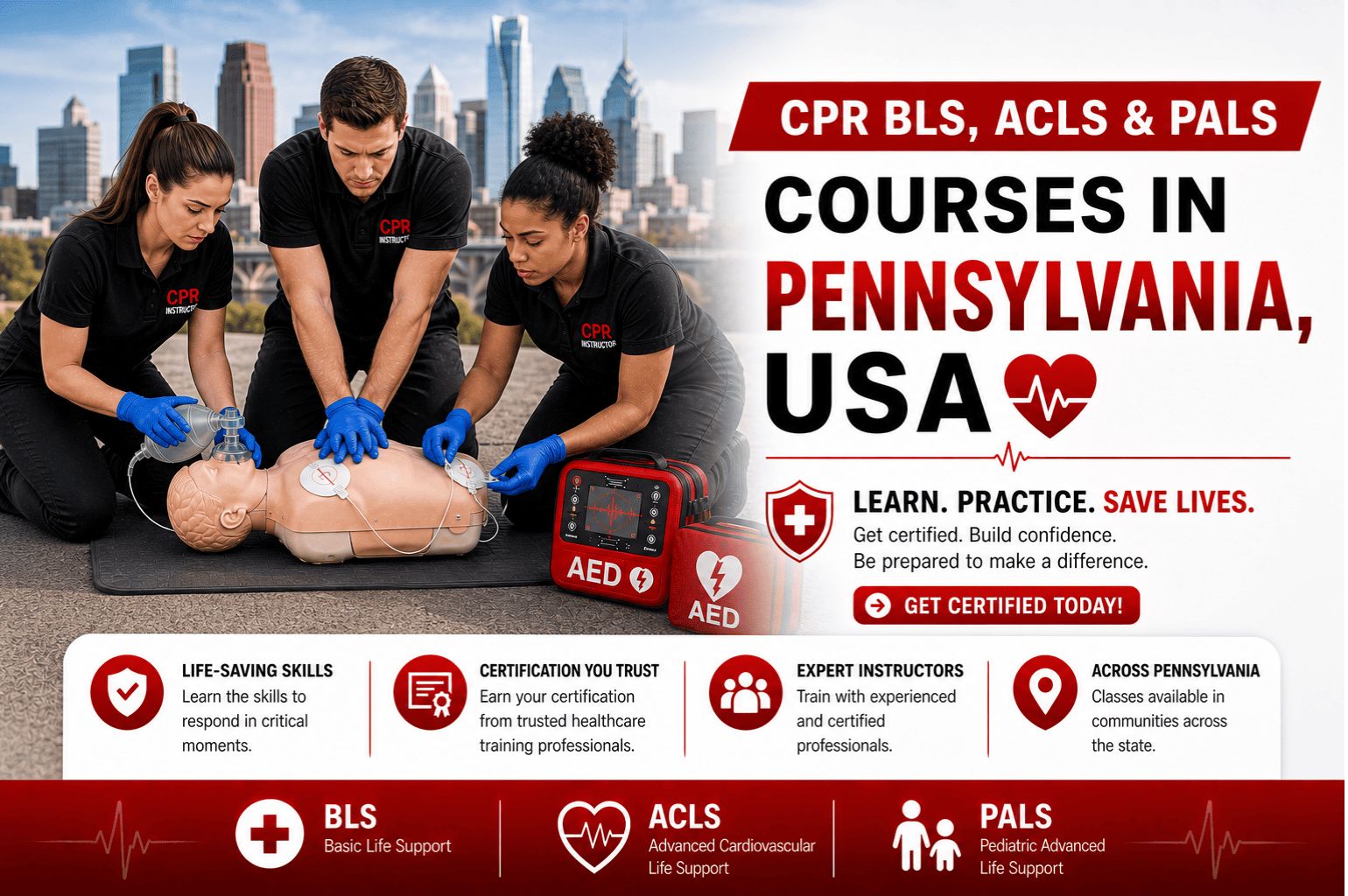
Pennsylvania is home to one of the most robust and demanding healthcare ecosystems on the East Coast, with major academic medical centers, regional hospital networks, and thousands of community-based clinical practices all operating under strict emergency preparedness standards. The American Heart Association’s training guidelines are the benchmark — and Safety Training Seminars delivers BLS, ACLS, and PALS courses that meet them completely. Our AHA BLS CPR courses are structured around the AHA’s most current resuscitation science, ensuring that participants in Pittsburgh, Lancaster, Philadelphia, and beyond are trained to intervene with the speed and accuracy that cardiac and pediatric emergencies demand. Every course culminates in an AHA Course Completion eCard — the digital documentation standard that Pennsylvania’s healthcare employers, credentialing offices, and licensing boards expect to see on file.
Essential for healthcare professionals. Covers CPR for adults, children, and infants, AED use, and airway management. Accepted by all major hospitals and healthcare systems.
Builds on BLS knowledge with advanced management of cardiovascular emergencies, arrhythmias, stroke, and acute coronary syndromes. Required for ICU, ER, and OR staff.
Designed for providers who care for infants and children. Covers pediatric assessment, respiratory failure, shock, and cardiac arrest management.
Ideal for non-medical professionals, workplaces, teachers, and community members. Covers adult and child CPR, AED operation, choking, and basic first aid.
Pennsylvania stretches from the Delaware Valley in the east to the Allegheny highlands in the west, and Safety Training Seminars has built its course infrastructure to serve that full span. We provide AHA BLS CPR classes, ACLS training, and PALS programs across Philadelphia — including University City and Old City — as well as Pittsburgh, Pittsburgh West, Lancaster, Scranton, State College, Altoona, and Chadds Ford. Whether you’re traveling south on I-79 into Allegheny County or heading east on the Pennsylvania Turnpike through Chester and Delaware counties, you’ll find a CPR Verification Station™ learning center positioned to fit your route. We’ve designed our coverage so that geography never becomes a barrier to completing your training.
Pennsylvania‘s growing healthcare sector, regulated industries, and community organizations create high, ongoing demand for AHA life support certification.
RNs, LPNs, and nursing students must hold current BLS certification as required by state boards and hospital credentialing.
Medical doctors, physician assistants, and nurse practitioners must maintain current ACLS and BLS certification.
Emergency medical technicians and paramedics must hold AHA certification as required by state EMS licensing.
Dentists, dental hygienists, and dental assistants are required to maintain current CPR/BLS certification by state dental boards.
Teachers, daycare providers, school nurses, and childcare staff are required by law to hold current CPR certification.
When Penn Medicine, UPMC, Jefferson Health, or Geisinger Health System has your name on a staff roster, your training documentation needs to hold up to institutional review from day one. Safety Training Seminars has built its course catalog around the credibility that Pennsylvania’s leading healthcare employers require and the accessibility that busy clinical professionals genuinely need. Our BLS, ACLS, and PALS offerings aren’t generic — they’re grounded in AHA guidelines, delivered through a modern learning framework, and supported by hands-on skills evaluation at our CPR Verification Station™ locations throughout the Commonwealth. Safety Training Seminars exists to make high-quality emergency training straightforward for the nurses, physicians, EMTs, and allied health professionals who keep Pennsylvania’s healthcare system running.
The AHA BLS CPR class available through Safety Training Seminars is the foundational course for clinical professionals working across Pennsylvania’s hospitals, outpatient centers, and emergency services — from Philadelphia’s teaching hospitals to the regional medical campuses serving Lackawanna and Centre counties. Students complete the knowledge-based content through our Self-Guided Learning™ format and then demonstrate hands-on competency at a CPR Verification Station™ learning center before receiving their AHA Course Completion eCard.
Advanced Cardiovascular Life Support training through Safety Training Seminars is built for Pennsylvania’s physicians, advanced practice registered nurses, and critical care professionals who need to lead — not just participate in — complex resuscitation scenarios. The course uses the HeartCode® Complete blended learning structure to deliver rhythm interpretation, pharmacology application, and coordinated team response skills that translate directly to the high-acuity environments found throughout Pittsburgh’s UPMC network and Philadelphia’s hospital campuses.
Pediatric Advanced Life Support training is a requirement for Pennsylvania clinical staff who interact with children in emergency situations — including RNs at Children’s Hospital of Philadelphia, pediatric intensivists at UPMC Children’s Hospital of Pittsburgh, and ER professionals across Lancaster General and Geisinger’s pediatric units. Safety Training Seminars’ PALS course builds systematic recognition and response skills for respiratory failure, shock, and cardiac arrest in pediatric patients, validated through a hands-on skills check.
Pennsylvania workplaces, schools, and community organizations face the same cardiac emergency risks as clinical settings — and Safety Training Seminars provides CPR and first aid training that prepares non-clinical participants to respond with confidence when professional medical help hasn’t arrived yet.
Pennsylvania professionals evaluating CPR training options have likely encountered the usual obstacles — rigid class schedules, slow eCard processing, or training formats that don’t reflect how emergencies actually unfold. Safety Training Seminars removes those friction points. Our skills testing is fast and evaluator-guided, so you’re not waiting days for feedback on your technique. The learning system is fully modern, accessible from any device whether you’re in a Philadelphia high-rise or a rural Lancaster County home. Every skills session incorporates real-life simulation that mirrors clinical environments, not just abstract demonstration. And the entire course structure rests on the AHA framework that Pennsylvania’s top health systems already recognize and trust.
Training with Safety Training Seminars in Pennsylvania produces outcomes, not just documentation. BLS completers develop high-quality, rate-correct chest compression mechanics, proper ventilation technique with and without adjuncts, and the confidence to operate an AED under pressure — skills that translate immediately to hospital codes, emergency department scenarios, and out-of-hospital cardiac events across the Commonwealth. ACLS participants sharpen their clinical reasoning across cardiac rhythms, practice systematic airway management in complex cases, and develop the team communication habits that separate effective resuscitation from chaos. PALS graduates refine their ability to detect early deterioration in pediatric patients, apply AHA pediatric algorithms, and lead coordinated team responses — capabilities that Pennsylvania’s pediatric clinical environments depend on every day.
Philadelphia hospitalists, Pittsburgh trauma nurses, and Scranton-based EMTs don’t share the same schedule — but they share the same need for training that works around their lives rather than against them. Safety Training Seminars structures its Pennsylvania course offerings accordingly.
The Self-Guided Learning™ format gives Pennsylvania’s healthcare professionals complete control over when and where they complete the knowledge-based portion of their BLS, ACLS, or PALS course. Whether you finish modules during a quiet stretch between night shifts at a Lancaster County hospital or from your home in Chadds Ford on a Sunday afternoon, the platform accommodates your pace without penalty.
HeartCode® Complete is the AHA’s own blended learning solution, and it anchors our most popular course pathway in Pennsylvania. The platform delivers structured digital instruction followed by a mandatory hands-on skills component — a combination that satisfies both the knowledge and performance standards the AHA requires and that Pennsylvania healthcare employers confirm in their hiring and compliance processes.
After completing the online portion of your course, the CPR Verification Station™ learning center is where your preparation becomes documented proficiency. At stations positioned throughout Philadelphia, Pittsburgh, Lancaster, Scranton, and other Pennsylvania areas we serve, evaluators guide your hands-on skills session, confirm your technique meets AHA standards, and initiate your AHA Course Completion eCard delivery — often within the same calendar day.
Pennsylvania’s healthcare employment landscape is rigorous about training documentation. Hospitals operating under Joint Commission accreditation — including the major systems in Philadelphia, Pittsburgh, and Harrisburg — require active AHA Course Completion eCards for nurses, respiratory therapists, and physicians before they begin clinical rotations or shifts. Pennsylvania’s State Board of Nursing and the Department of Health’s facility licensure standards don’t leave room for ambiguity: your BLS, ACLS, or PALS documentation must be current. Travel nurses placed through agencies serving the Philadelphia metro or the greater Pittsburgh market face the same expectation — often with tighter timelines, since onboarding windows are compressed. Renewal is required every two years, and many Pennsylvania employers build their own internal reminders at 18 months to prevent gaps in team compliance before your eCard reaches its expiration date.
Pennsylvania’s combination of dense urban centers and sprawling rural regions creates a unique emergency response landscape. In Philadelphia’s Old City neighborhoods, Allegheny County’s suburban corridors, and the rural stretches of Centre and Blair counties, out-of-hospital cardiac arrest response times vary significantly — and bystander action during those critical first minutes determines outcomes in ways that EMS arrival times simply cannot. The AHA estimates survival rates for cardiac arrest can double or triple when trained bystanders intervene before paramedics reach the scene. Beyond the community dimension, Pennsylvania’s employers — from hospital systems in Scranton to manufacturing operations in the Lehigh Valley — face growing workplace safety expectations that include first responder readiness. CPR and ACLS training aren’t just professional requirements; they’re a genuine contribution to the safety of the communities Pennsylvania’s workforce calls home.
Pennsylvania organizations across every sector are increasingly approaching CPR and BLS training as both a compliance investment and a risk management strategy. Safety Training Seminars works with Pennsylvania businesses — healthcare networks, corporate campuses, school districts, and municipal employers — to coordinate group training that can scale from a department of eight to a facility of several hundred. A hospital unit in State College scheduling nursing staff for simultaneous ACLS renewal, a corporate headquarters near Pittsburgh West arranging BLS training for its occupational health team, or a Lancaster County school district ensuring administrative staff are first-responder ready — our group booking process handles each of these efficiently. Completing group courses through Safety Training Seminars gives Pennsylvania employers documented AHA Course Completion eCards for every participant, creating the paper trail that compliance officers and risk managers need.
The question we hear often from Pennsylvania nurses and clinicians is whether same-day completion is genuinely achievable — not just a marketing phrase. It is, and here’s the actual mechanism. You complete the online component of your AHA BLS CPR course, ACLS training, or PALS program through our Self-Guided Learning™ or HeartCode® Complete platform at whatever time works for your day. Once you’ve finished the digital modules, you schedule your skills appointment at a CPR Verification Station™ near you — available across Philadelphia, Pittsburgh, Lancaster, Altoona, Scranton, and other Pennsylvania service areas. The evaluator walks you through the hands-on assessment, you successfully complete the course, and your AHA Course Completion eCard is issued digitally before the day is out.
The path from registration to eCard with Safety Training Seminars in Pennsylvania follows four clear stages. You begin by registering online and selecting your course — BLS, ACLS, PALS, or a combination of them — through our enrollment platform. Next, you work through the digital coursework at your own pace using Self-Guided Learning™ or HeartCode® Complete, building the clinical knowledge the AHA requires for your course level. Then you attend your scheduled skills session at a CPR Verification Station™ learning center in Pennsylvania, where your hands-on performance is evaluated against AHA standards. Finally, upon successfully completing the course and skills check, your AHA Course Completion eCard is delivered digitally — ready to share with HR, credentialing staff, or any Pennsylvania employer who needs to see it.
Safety Training Seminars’ reach across Pennsylvania extends well beyond the major metros. In addition to Philadelphia — including its University City medical district and Old City neighborhoods — and Pittsburgh and its western suburbs, we serve professionals in Lancaster, Scranton, Altoona, State College, Chadds Ford, and the surrounding communities throughout Chester, Delaware, Dauphin, Lackawanna, and Blair counties. Our course infrastructure follows Pennsylvania’s major travel corridors: I-76 across the turnpike, I-81 through the northeast, I-83 into York and Harrisburg, and Route 30 through Lancaster County — ensuring that wherever in the Commonwealth you’re based, a CPR Verification Station™ is within practical reach.
Pennsylvania’s concentration of major medical institutions creates natural clusters of demand for AHA BLS CPR training, ACLS programs, and PALS courses. Safety Training Seminars serves professionals affiliated with Penn Medicine and its affiliated campuses throughout the Philadelphia region, UPMC Presbyterian and its extensive network across western Pennsylvania, Jefferson Health spanning Philadelphia and its surrounding counties, Children’s Hospital of Philadelphia and UPMC Children’s Hospital of Pittsburgh for pediatric-focused PALS training, Geisinger Medical Center in Danville serving central Pennsylvania, and Moses Taylor Hospital and Regional Hospital of Scranton in the northeast. Clinical staff in the medical districts surrounding these institutions — including University City’s research hospital corridor and Pittsburgh’s Oakland neighborhood, home to UPMC’s flagship campus — will find our CPR Verification Station™ locations close enough to visit between shifts.
Completing an AHA BLS CPR class or ACLS training through Safety Training Seminars does something more lasting than adding a credential to a file. In the immediate term, you come away with the physical memory and clinical decision-making skills to intervene effectively during a cardiac emergency — skills that save lives in ways that theoretical knowledge alone cannot. From a career standpoint, holding a current AHA Course Completion eCard opens access to Pennsylvania’s most competitive clinical roles and satisfies the documentation requirement that most hospital employers, staffing agencies, and clinical placement programs in the state require upfront. And at a human level, there’s a measurable shift in composure that comes from having practiced — rather than just read about — what to do when someone in front of you needs help.
Two years passes quickly in clinical practice, and an expired BLS, ACLS, or PALS eCard can create complications at exactly the wrong moment — during a hospital credentialing review, a contract renewal, or a new position offer in Philadelphia or Pittsburgh. Safety Training Seminars makes the renewal process in Pennsylvania efficient and unobtrusive. BLS renewal follows the same blended format as initial training, refreshing your compression mechanics and AED technique without requiring you to repeat content you’ve already mastered. ACLS renewal walks you through updated guidelines and scenario-based reinforcement, keeping your rhythm recognition and pharmacology knowledge aligned with current AHA standards. PALS renewal similarly revisits pediatric assessment and response frameworks, ensuring that clinical professionals working in Pennsylvania’s children’s hospitals and pediatric units remain sharp between initial training and their next evaluation.
Pennsylvania’s healthcare employers aren’t lenient about expired documentation — and the window between an expiring eCard and a compliance gap is shorter than it seems. Safety Training Seminars makes it easy to act before that becomes an issue. Select your AHA BLS CPR class, ACLS training, or PALS program through our online enrollment platform, complete the digital coursework on your schedule, and attend a skills session at a CPR Verification Station™ near you in Philadelphia, Pittsburgh, Lancaster, Scranton, or any of the other Pennsylvania communities we serve. Your AHA Course Completion eCard is delivered the same day you successfully complete the course — and it’s immediately shareable with any employer who needs to see it. Don’t let your training lapse. Enroll today and keep your emergency response skills — and your career — exactly where they need to be.
This section covers the most common questions people have about CPR, BLS, ACLS, PALS and First Aid courses. At Safety Training Seminars, we provide clear information about course content, scheduling options, training formats, and what to expect during your session.
The online portion of the AHA BLS CPR course through Safety Training Seminars typically takes two to three hours to work through using our Self-Guided Learning™ or HeartCode® Complete platform. The hands-on skills session at a CPR Verification Station™ in Pennsylvania generally runs 30 to 60 minutes.
Yes. Once you successfully complete both the online coursework and the hands-on skills check at a CPR Verification Station™ learning center in Pennsylvania — available in Philadelphia, Pittsburgh, Lancaster, Scranton, Altoona, and other areas — your eCard is issued digitally on the same day. It can be shared with employers, credentialing staff, or HR departments immediately.
Virtually all direct patient care roles in Pennsylvania require current AHA training documentation. This includes registered nurses, physicians, physician assistants, CRNAs, respiratory therapists, surgical technologists, paramedics, and EMTs working across Pennsylvania health systems including Penn Medicine, UPMC, Jefferson Health, and Geisinger.
Pennsylvania ACLS and PALS courses through Safety Training Seminars use a blended structure. The cognitive component — rhythm interpretation, pharmacology review, pediatric assessment algorithms — is completed digitally through the HeartCode® Complete platform or our Self-Guided Learning™ system at your own pace.
AHA Course Completion eCards are valid for two years. Most Pennsylvania hospital credentialing offices and healthcare employers recommend initiating renewal 60 to 90 days before the eCard expires to avoid any gap in compliance documentation. Professionals working through staffing agencies or contract positions in the Philadelphia or Pittsburgh markets may face even tighter timelines, as agencies often require active documentation before a new assignment begins.

