Every second matters when a cardiac emergency strikes — whether it happens in a Billings hospital corridor, a Bozeman ski resort, or a Missoula school gymnasium. Montana’s vast geography and spread-out communities make it even more critical that healthcare professionals, first responders, and everyday residents are equipped with life-saving skills. Safety Training Seminars brings American Heart Association BLS CPR, ACLS, and PALS courses directly to Montana residents, giving you a fast, flexible path to successfully completing your training and receiving your AHA Course Completion eCard without disrupting your schedule.
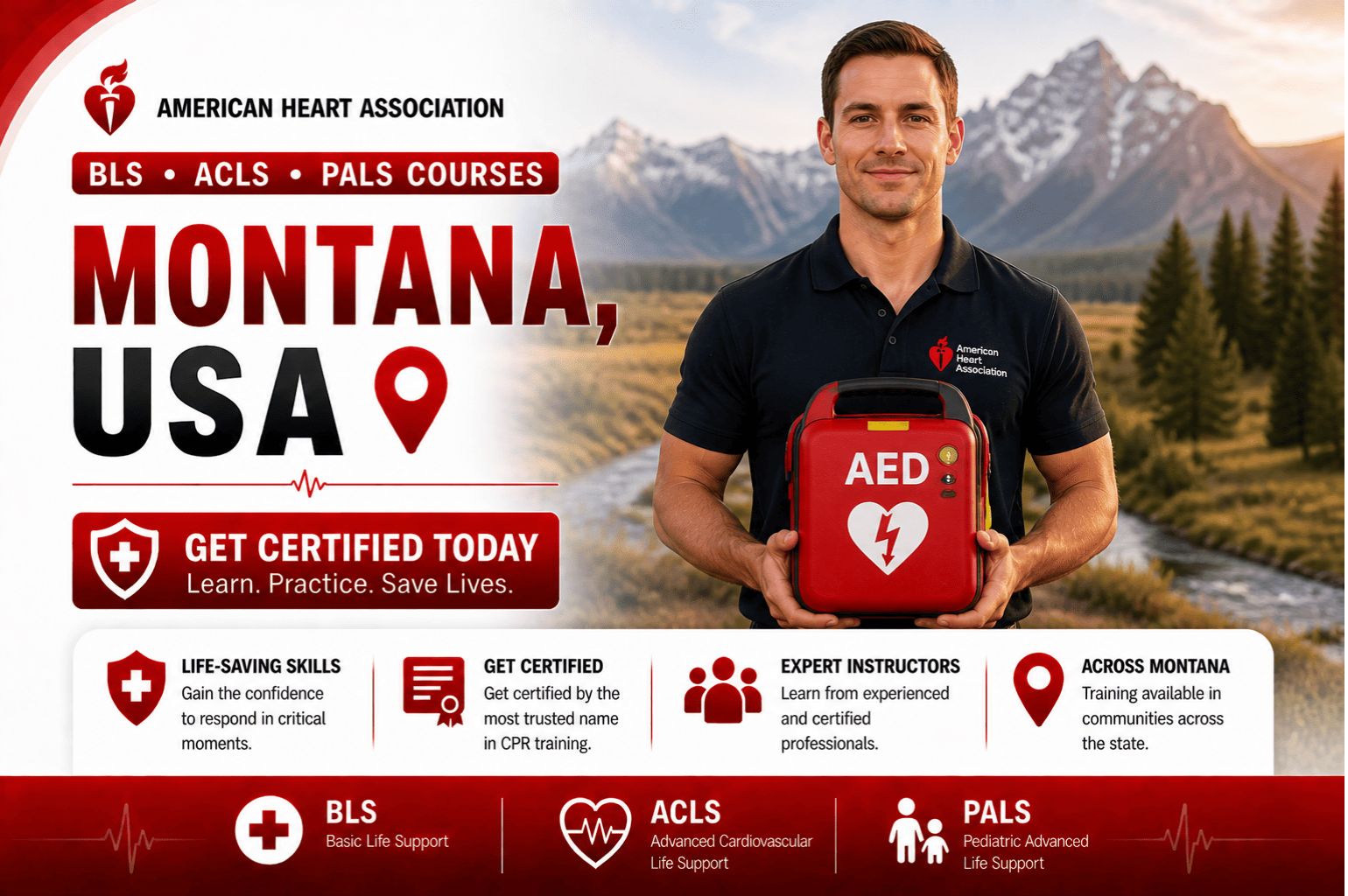
Montana is one of the most geographically expansive states in the country, and that distance between communities puts a real premium on having trained individuals in every corner of the state — from Yellowstone County in the south to Flathead County in the northwest. Safety Training Seminars partners with the American Heart Association to deliver AHA BLS CPR courses, ACLS training, and PALS programs that meet the standards healthcare employers across Montana expect.
Whether you work at a major system like Billings Clinic, SCL Health St. Vincent in Billings, or Providence St. Patrick Hospital in Missoula, your employer likely requires current AHA training. Our courses are built around real clinical scenarios, evidence-based AHA guidelines, and a learning model that works for busy professionals. Every participant who successfully completes the course receives an official AHA Course Completion eCard — the same credential recognized by hospitals, clinics, urgent care centers, and long-term care facilities throughout the state.
Essential for healthcare professionals. Covers CPR for adults, children, and infants, AED use, and airway management. Accepted by all major hospitals and healthcare systems.
Builds on BLS knowledge with advanced management of cardiovascular emergencies, arrhythmias, stroke, and acute coronary syndromes. Required for ICU, ER, and OR staff.
Designed for providers who care for infants and children. Covers pediatric assessment, respiratory failure, shock, and cardiac arrest management.
Ideal for non-medical professionals, workplaces, teachers, and community members. Covers adult and child CPR, AED operation, choking, and basic first aid.
Montana’s cities and towns each carry their own healthcare demands, and Safety Training Seminars is proud to serve professionals across the entire state. From the medical hub of Billings — home to Billings Clinic, one of the largest healthcare systems between Minneapolis and Seattle — to Bozeman’s fast-growing healthcare corridor along North 19th Avenue, to Missoula’s western Montana medical community anchored by Providence St. Patrick Hospital and Community Medical Center, our training reaches where it’s needed most. We also serve healthcare workers in Great Falls, Helena, Kalispell, Butte, Havre, and the surrounding regions — making quality AHA BLS CPR training accessible no matter where you practice in Big Sky Country.
Montana‘s growing healthcare sector, regulated industries, and community organizations create high, ongoing demand for AHA life support certification.
RNs, LPNs, and nursing students must hold current BLS certification as required by state boards and hospital credentialing.
Medical doctors, physician assistants, and nurse practitioners must maintain current ACLS and BLS certification.
Emergency medical technicians and paramedics must hold AHA certification as required by state EMS licensing.
Dentists, dental hygienists, and dental assistants are required to maintain current CPR/BLS certification by state dental boards.
Teachers, daycare providers, school nurses, and childcare staff are required by law to hold current CPR certification.
Across Montana’s 56 counties, from Cascade and Lewis and Clark counties in the center of the state to Missoula and Lake counties in the west, healthcare workers and community members need training they can count on. Safety Training Seminars has built a reputation for delivering AHA-aligned CPR, BLS, ACLS, and PALS courses that combine flexibility with clinical rigor. Our approach blends a proven digital learning system with hands-on skills sessions, giving Montana professionals a well-rounded training experience that satisfies employer requirements and builds genuine confidence. When you train with us, you’re not just going through the motions — you’re preparing for real emergencies in real Montana settings.
The AHA BLS CPR Class is designed specifically for nurses, physicians, paramedics, dental professionals, and other clinical staff who need a solid foundation in cardiac life support skills. Professionals at facilities like Bozeman Health Deaconess Hospital or St. James Healthcare in Butte can complete the online learning portion on their own time and then attend a skills session at a nearby CPR Verification Station™ learning center to demonstrate their competency and receive their AHA Course Completion eCard.
Advanced Cardiovascular Life Support training in Montana is built for healthcare providers who manage high-stakes cardiac events — think emergency department teams at Benefis Health System in Great Falls or ICU staff at Billings Clinic who need to move fast and work effectively as a team. The ACLS course covers advanced airway management, rhythm interpretation, pharmacology, and systematic team-based resuscitation so that when a code is called, you’re ready to lead or support without hesitation.
Pediatric Advanced Life Support training addresses the unique physiological differences in children and infants, preparing nurses, physicians, and pediatric specialists for respiratory emergencies, shock, and cardiac arrest in young patients. Whether you work in the pediatric unit at Community Medical Center in Missoula or a rural clinic in Sanders County where pediatric emergencies can feel especially isolating, PALS training gives you structured, AHA-aligned protocols to follow when it matters most.
Not every cardiac emergency happens in a hospital — and in Montana, where the nearest emergency room might be an hour away along US-89 or I-15, knowing CPR and basic first aid can genuinely save a life before paramedics arrive. This course is ideal for teachers, coaches, office workers, childcare providers, and anyone who wants to be prepared when an emergency unfolds in their community, workplace, or home.
Montana has no shortage of training options, but Safety Training Seminars stands apart because of how the experience is designed from start to finish. Our fast skills testing model means you’re not spending an entire day in a classroom — you complete the knowledge component at your own pace online, then come in for an efficient, focused skills session at a CPR Verification Station™ learning center that confirms you’ve mastered the techniques. The platform is modern, mobile-friendly, and built around the latest AHA science, while the real-life simulation scenarios during the skills check reflect actual clinical situations. This is a trusted training format that thousands of healthcare professionals across Montana have used to successfully complete their AHA BLS CPR course, ACLS training, and PALS program.
The skills you develop through Safety Training Seminars’ Montana courses go well beyond pushing a button on an AED. During BLS training, you’ll master high-quality chest compressions — the right depth, rate, and recoil — along with rescue breathing techniques and two-rescuer CPR protocols used in professional healthcare settings. ACLS participants work through systematic assessment of cardiac rhythms, learn to manage airways in deteriorating patients, and practice medication administration sequencing. PALS learners gain confidence managing pediatric respiratory distress, shock states, and cardiac arrest using age-appropriate algorithms. First aid participants learn how to control severe bleeding, manage choking, recognize stroke symptoms, and respond to common medical emergencies until advanced help arrives.
Montana’s healthcare workforce is stretched across long shifts, rural call schedules, and multi-facility systems — which is exactly why Safety Training Seminars offers multiple ways to successfully complete your training.
Self-Guided Learning™ courses let you move through the knowledge content entirely at your own pace, on any device, at any time. A nurse in Kalispell wrapping up a night shift can complete modules on her phone before bed, and an EMT in Livingston near Paradise Valley can fit sessions into an unpredictable schedule. There are no mandatory login times, no class schedules to coordinate around, and no waiting for a seat to open up.
HeartCode® Complete is the American Heart Association’s blended learning course that pairs a fully online cognitive component with a required hands-on skills session. It covers the same clinical content as a traditional course but gives you the freedom to complete the learning half on your schedule. Once you finish the online portion, you’ll book a brief skills check at a nearby CPR Verification Station™ location to demonstrate your technique and receive your AHA Course Completion eCard.
The CPR Verification Station™ learning center is where online learning becomes real-world readiness. After completing your digital coursework, you’ll attend a hands-on skills session where trained staff guide you through compression technique, mask ventilation, AED use, and team scenarios. It’s efficient, focused, and designed to confirm mastery rather than repeat classroom theory. Most sessions can be completed in under an hour, making it a realistic option even for Montana healthcare workers with demanding schedules.
Hospitals and healthcare facilities across Montana are clear about their expectations: current AHA training is non-negotiable for most clinical roles. Billings Clinic, SCL Health St. Vincent, and Bozeman Health Deaconess Hospital — like most Magnet-status and Joint Commission-accredited systems — require staff to maintain current AHA BLS CPR training at all times, with renewal typically required every two years. ACLS is commonly required for RNs in critical care, emergency, and procedural settings, while PALS is expected for pediatric nurses, neonatology staff, and many emergency department clinicians. Rural health systems and tribal health facilities in counties like Glacier, Crow, and Roosevelt counties are increasingly adopting the same standards. Letting your training lapse can delay employment offers, affect your unit assignment, or create compliance issues during Joint Commission surveys — none of which anyone wants to deal with.
Montana’s geography creates a healthcare landscape unlike almost any other state. With a population spread across 147,000 square miles and average ambulance response times that can exceed 20 minutes in rural areas — particularly in places like Wheatland County, Phillips County, or the rural stretches along US-2 near the Hi-Line — bystander CPR and early defibrillation are often the only bridge between cardiac arrest and survival. The state has invested heavily in improving cardiac outcomes, but those efforts only work if enough trained hands are present when minutes count. For healthcare professionals working in Montana’s hospitals and clinics, staying current on AHA BLS CPR standards is both a professional responsibility and a practical necessity. For community members and workplace first responders, it’s the kind of preparation that turns a tragedy into a survival story.
Montana employers in healthcare, mining, construction, hospitality, and outdoor recreation face real workplace safety obligations — and CPR readiness is often at the center of those requirements. Safety Training Seminars works with businesses, hospital systems, long-term care facilities, and corporate groups across Yellowstone, Gallatin, Missoula, and Cascade counties to coordinate group training that fits team schedules and meets OSHA and employer compliance standards. Group bookings can be arranged to coincide with shift rotations, staff meetings, or annual training calendars, making it easy for HR directors and clinical managers to keep their entire workforce compliant and confident. If you’re managing a multi-department facility or a dispersed workforce across multiple Montana locations, we can work with you to develop a training timeline that makes sense.
One of the most common questions from Montana healthcare workers is whether they can start and finish their training in a single day. The answer, in most cases, is yes. You begin by completing the online portion of your chosen course — BLS, ACLS, or PALS — through our Self-Guided Learning™ platform or the HeartCode® Complete program at your own pace. Once that’s done, you book a skills session at a local CPR Verification Station™ learning center, attend the hands-on check, and successfully demonstrate your technique. Within hours of completing the skills portion, your AHA Course Completion eCard is issued digitally, ready for you to share with your employer or HR department. The whole process is streamlined so that you’re not losing a full workday to training logistics.
The process is straightforward from start to finish. First, you register online through Safety Training Seminars and select the course that matches your clinical role — AHA BLS CPR Class, ACLS, PALS, or CPR and First Aid. Next, you complete the online coursework through the Self-Guided Learning™ system or HeartCode® Complete at whatever pace fits your schedule. Then you book and attend your hands-on skills session at a nearby CPR Verification Station™ learning center, where you’ll demonstrate proficiency in the core skills required by the AHA. Once you successfully complete the course, your AHA Course Completion eCard is issued electronically — typically the same day — and you’re fully current.
Safety Training Seminars serves healthcare professionals and community members throughout Montana, with coverage that extends well beyond the major cities. In addition to Billings, Bozeman, and Missoula, we serve participants in Great Falls along the I-15 corridor, Helena near Last Chance Gulch and the Capitol district, Kalispell and the Flathead Valley, Butte in Silver Bow County, Havre on the Hi-Line, and Livingston near the northern entrance to Yellowstone National Park. We also reach communities in Glendive, Miles City, Sidney, and Lewistown — areas where training access has historically been limited and where the value of convenient AHA BLS CPR training is felt most acutely.
Healthcare professionals in Montana often prefer to train near the facilities where they work, and our CPR Verification Station™ network is strategically positioned to make that possible. In Billings, participants training near Billings Clinic or St. Vincent Healthcare off 17th Street West have convenient access to skills sessions that fit between shifts. In Missoula, healthcare workers near Providence St. Patrick Hospital and Community Medical Center along Brooks Street can complete skills checks without long commutes. Bozeman Health Deaconess Hospital staff in the North 19th Avenue medical corridor, Great Falls providers near Benefis Health System, and Kalispell Regional Medical Center employees in Flathead County all have accessible training options designed around the healthcare zones they already work in. Rural and critical access hospitals — including facilities in Shelby, Conrad, Roundup, and Forsyth — can connect with us to arrange group sessions or nearby skills check options.
The benefits of completing AHA BLS CPR training extend far beyond satisfying an employer requirement. On a fundamental level, you develop the ability to step in when someone’s life depends on immediate action — whether that’s a stranger in a Billings restaurant, a coworker at a Bozeman tech company, or a family member at home. For healthcare professionals, staying current reflects a standard of care that colleagues, patients, and employers all respect. There’s also a meaningful career advantage: many nursing positions, travel nurse contracts, and advanced clinical roles require current AHA training as a baseline condition of hire. And perhaps most importantly, training builds real confidence — the kind that allows you to act clearly and effectively in a high-stress moment rather than freeze because you’re unsure of what to do.
AHA course completions don’t last forever, and Montana healthcare employers track renewal windows carefully. BLS renewal is required every two years, and most hospital systems begin reminding employees six to eight weeks before the expiration date on their AHA Course Completion eCard. ACLS renewal follows the same two-year cycle, with refreshed content reflecting the most current AHA guidelines on cardiac pharmacology, rhythm management, and team resuscitation. PALS renewal is equally important for pediatric and emergency clinicians, covering updated neonatal and pediatric resuscitation algorithms. Safety Training Seminars makes renewal straightforward — experienced providers can often move through the online refresher content more quickly, then complete a brief skills check to receive their updated eCard. Don’t wait until your card has already expired; plan your renewal at least a month in advance to avoid any gap in compliance.
If your AHA training is coming up for renewal — or if you’ve never completed the course and your employer is asking questions — now is the time to act. Safety Training Seminars makes it easy to enroll in an AHA BLS CPR class, ACLS training, or PALS course in Montana without the scheduling headaches that come with traditional training formats. Register online in minutes, complete your coursework at your own pace through our Self-Guided Learning™ platform, and book your skills session at a CPR Verification Station™ learning center near you. Whether you’re in Billings, Bozeman, Missoula, or anywhere in between, we’re here to help you successfully complete your training and get back to doing what you do best — taking care of Montana.
This section covers the most common questions people have about CPR, BLS, ACLS, PALS and First Aid courses. At Safety Training Seminars, we provide clear information about course content, scheduling options, training formats, and what to expect during your session.
The total time depends on your pace, but most Montana participants complete the online learning portion of the AHA BLS CPR Class in one to two hours. The hands-on skills session at a CPR Verification Station™ learning center typically takes under an hour. This means many healthcare professionals in Billings, Missoula, or Great Falls can start and finish the entire course in a single day, making it one of the most time-efficient ways to stay compliant with employer requirements.
In most cases, yes. Once you successfully complete the course — including both the online learning and the in-person skills session — your AHA Course Completion eCard is issued digitally and typically available the same day. This allows you to immediately forward it to your HR department or clinical manager without waiting days for a physical card to arrive in the mail.
The list is extensive. Registered nurses, physicians, physician assistants, paramedics, EMTs, respiratory therapists, dental hygienists, physical therapists, and occupational therapists working in Montana hospitals, outpatient clinics, long-term care facilities, and surgical centers are almost universally required to hold current AHA training. ACLS is a standard requirement for emergency department, ICU, and cardiac care nurses, while PALS is expected of pediatric and neonatal staff. Many travel nursing agencies and locum tenens firms also require current AHA training as a non-negotiable placement condition.
The model is straightforward and built around your schedule. You complete the online portion — either through a Self-Guided Learning™ course or HeartCode® Complete — on your own time and at your own pace, with no mandatory login times or live sessions to attend. Once you finish the digital learning, you register for a hands-on skills session at a nearby CPR Verification Station™ learning center, where you’ll demonstrate compression technique, rescue breathing, AED use, and team protocols. It’s a flexible format that works especially well for Montana healthcare workers managing rotating shifts, on-call schedules, or long commutes.
AHA course completions are valid for two years from the date of issue. Most Montana healthcare employers — including major systems like Billings Clinic, Bozeman Health, and Benefis Health System in Great Falls — expect employees to renew before their current eCard expires. It’s a good practice to begin the renewal process at least four to six weeks before expiration, particularly if you’re in a high-demand specialty where scheduling a skills session might require some lead time. Waiting until your card has already lapsed can create compliance issues and, in some cases, temporarily affect your ability to work in certain clinical settings.

