Minnesota is home to some of the most respected medical institutions in the world — and one of the most demanding healthcare workforces in the Midwest. From the research floors of Mayo Clinic in Rochester to the busy emergency departments of Hennepin Healthcare in Minneapolis and the community hospitals stretching north toward the Iron Range, Minnesota’s clinical professionals are expected to arrive current, trained, and ready. Safety Training Seminars delivers American Heart Association BLS CPR, ACLS, and PALS courses across Minnesota through a process that matches the high standards this state’s healthcare culture demands.
Minnesota occupies a unique position in American healthcare — it’s home to Mayo Clinic, one of the most globally recognized medical institutions in existence, and to M Health Fairview and Allina Health, two of the largest regional health networks in the upper Midwest. That concentration of institutional excellence raises the baseline expectation for clinical training across the entire state. Minnesota’s nurses, physicians, paramedics, and allied health professionals don’t just need AHA training — they work in an environment where the quality of that training is implicitly held to a higher standard.
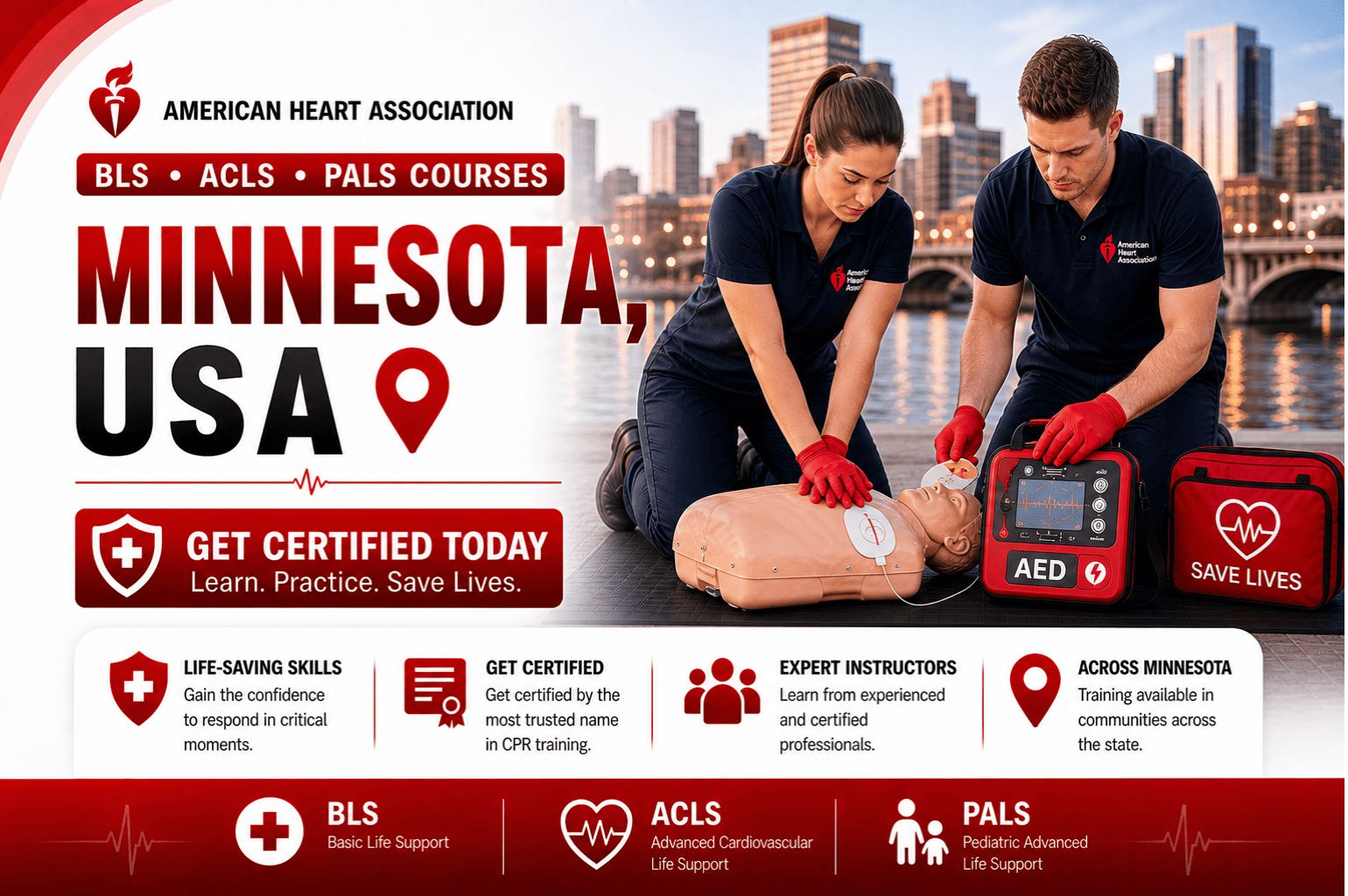
Safety Training Seminars rises to that standard with a complete lineup of American Heart Association courses. The AHA BLS CPR Course provides Minnesota’s clinical workforce with the foundational resuscitation skills that every hospital, clinic, and health system in the state requires. ACLS prepares advanced providers for the complex cardiac presentations common in Minnesota’s high-volume emergency and critical care settings. PALS training equips pediatric and neonatal specialists — from the children’s hospitals of the Twin Cities to the rural critical access facilities of northern Minnesota — with the systematic assessment and resuscitation skills that improve outcomes for the state’s youngest patients. Every course concludes with an AHA Course Completion eCard accepted statewide without question.
Essential for healthcare professionals. Covers CPR for adults, children, and infants, AED use, and airway management. Accepted by all major hospitals and healthcare systems.
Builds on BLS knowledge with advanced management of cardiovascular emergencies, arrhythmias, stroke, and acute coronary syndromes. Required for ICU, ER, and OR staff.
Designed for providers who care for infants and children. Covers pediatric assessment, respiratory failure, shock, and cardiac arrest management.
Ideal for non-medical professionals, workplaces, teachers, and community members. Covers adult and child CPR, AED operation, choking, and basic first aid.
Minnesota’s healthcare workforce doesn’t live and work exclusively in the Twin Cities — it spans a state nearly as large as Montana, from the suburban corridors of Bloomington, Brooklyn Center, and Eagan to the northern communities of Duluth, Hibbing, and International Falls. Safety Training Seminars provides BLS CPR, ACLS, PALS, and First Aid training to professionals in Minneapolis, St. Paul, Bloomington, Brooklyn Center, Brooklyn Park, Plymouth, Maple Grove, Minnetonka, Edina, Burnsville, Eagan, Apple Valley, Woodbury, St. Cloud, Mankato, Rochester, Duluth, Moorhead, Bemidji, Brainerd, Alexandria, Willmar, Winona, and Faribault. Whether you’re commuting into downtown Minneapolis on I-35W from Dakota County or working in a St. Cloud clinic off US-10, training access fits around your Minnesota schedule.
Minnesota‘s growing healthcare sector, regulated industries, and community organizations create high, ongoing demand for AHA life support certification.
RNs, LPNs, and nursing students must hold current BLS certification as required by state boards and hospital credentialing.
Medical doctors, physician assistants, and nurse practitioners must maintain current ACLS and BLS certification.
Emergency medical technicians and paramedics must hold AHA certification as required by state EMS licensing.
Dentists, dental hygienists, and dental assistants are required to maintain current CPR/BLS certification by state dental boards.
Teachers, daycare providers, school nurses, and childcare staff are required by law to hold current CPR certification.
Minnesota’s dominant health systems — M Health Fairview, Allina Health, HealthPartners, Essentia Health, and Sanford Health — operate across a combined footprint that reaches from the Twin Cities metro deep into outstate Minnesota. Each maintains rigorous AHA training standards for clinical staff, and each credentialing department is configured to verify AHA eCard documentation upon hire and at every renewal cycle.
The presence of Mayo Clinic in Rochester — and its affiliated hospital and clinic network across the southern part of the state — means that a significant portion of Minnesota’s clinical workforce operates under one of the most exacting training compliance environments in the country. That culture of clinical precision extends across the state’s healthcare landscape in ways that make AHA training quality genuinely visible to Minnesota employers.
Safety Training Seminars provides BLS CPR, ACLS, PALS, and First Aid courses built to meet those expectations — through a learning model that respects how busy Minnesota’s clinical professionals actually are.
The AHA BLS CPR Course in Minnesota covers adult, child, and infant resuscitation, AED operation, and two-rescuer technique aligned to the most current AHA guidelines — meeting the documentation requirements of every major Minnesota health system, from Allina Health’s Twin Cities hospitals to Essentia Health’s Duluth-based network.
Minnesota’s ACLS course sharpens the rhythm recognition, pharmacological decision-making, and team resuscitation leadership skills that the state’s emergency physicians, hospitalists, and critical care nurses rely on in high-acuity environments — from the Level I trauma center at Hennepin Healthcare to the cardiac units at Abbott Northwestern Hospital in Minneapolis.
Children’s Minnesota — operating two flagship hospitals in Minneapolis and St. Paul — along with the pediatric units at M Health Fairview Masonic Children’s Hospital sets the pediatric care standard in Minnesota, and the PALS course builds the systematic assessment, pediatric airway management, and resuscitation skills that providers across the state need to meet that bar.
Minnesota’s educators, corporate employees, construction workers, agricultural communities, and outdoor recreation workforce need practical emergency response skills that don’t require a clinical background — and this course delivers actionable CPR and First Aid training for the real emergencies that happen in Minnesota’s schools, offices, farms, and public spaces.
Minnesota’s healthcare culture is defined by precision, evidence-based practice, and high institutional expectations — and those values deserve a training model that reflects them. The difference with Safety Training Seminars isn’t just convenience, though the flexibility is real. It’s the quality of the skills assessment experience itself.
The CPR Verification Station™ skills check is fast and focused precisely because Minnesota participants arrive having already worked through the AHA curriculum online. There’s no time wasted on group instruction or re-reviewing concepts covered in the digital component — every minute of the hands-on session goes directly toward demonstrating competency. The simulation scenarios are built on real clinical situations that Minnesota’s emergency and critical care providers actually face, which means the learning transfers directly rather than sitting in the abstract. The digital platform is fully device-agnostic, accessible from any connection in Minneapolis’s Elliot Park medical district or a clinic in rural Otter Tail County. And the AHA Course Completion eCard at the end is accepted by every Minnesota employer — from the enormous M Health Fairview and Allina networks to the smallest critical access hospital on the Iron Range.
Minnesota’s BLS completers develop chest compression technique — depth, rate, recoil, and timing — as a genuine practiced reflex, not a memorized checklist. AED operation is built into the skills session with the kind of hands-on repetition that makes it accessible in the chaos of a real cardiac event. Two-rescuer coordination, ventilation timing, and the smooth handoff between compressors are practiced until they’re automatic — particularly valuable for Minnesota’s critical access hospital teams in communities like Thief River Falls, Ely, or Cook, where a code response may involve two or three providers rather than a full team.
ACLS training builds rhythm interpretation across monitored cardiac presentations — shockable and non-shockable arrest rhythms, unstable tachycardias and bradycardias, post-cardiac arrest care, and acute stroke protocol decision trees. The pharmacological decision-making component is structured for speed and accuracy. Team leadership skills are practiced through scenarios that mirror the controlled urgency of Minnesota’s real emergency environments, where clear communication and fast role assignment are the difference between an effective resuscitation and a disorganized one.
PALS equips Minnesota pediatric providers with the Pediatric Assessment Triangle as a systematic first reflex, the ability to differentiate and respond to the full range of pediatric shock and respiratory presentations, and cardiac arrest management protocols calibrated specifically for pediatric physiology. First Aid content includes bleeding control, fracture and spinal management, recognition of anaphylaxis and environmental exposure — including cold-related emergencies, which are a genuine Minnesota occupational and outdoor recreation hazard — and sudden illness response applicable in settings ranging from a Duluth school to a construction site in Shakopee.
The Twin Cities metro is home to one of the densest concentrations of healthcare employers in the Midwest — which means Minnesota’s clinical professionals face intense scheduling demands, long commutes on I-494 and I-694, and training compliance expectations that don’t bend for operational realities. Our learning model was designed to remove the friction that traditional training formats build in.
Self-Guided Learning™ gives Minnesota professionals complete control over when the online portion gets done — and in a state where a night shift nurse at Regions Hospital in St. Paul and a clinic provider in St. Cloud have very different schedules and very different daily realities, that flexibility is the point. The curriculum is available anytime, on any device, from anywhere in Minnesota. No group enrollment, no minimum size, no fixed window.
HeartCode® Complete is the AHA’s adaptive blended solution — an intelligent online curriculum combined with a structured, evaluator-led skills session. For Minnesota professionals who want a guided path through BLS, ACLS, or PALS training from start to AHA Course Completion eCard, HeartCode® Complete delivers that structure without sacrificing scheduling flexibility.
The CPR Verification Station™ is where the online learning becomes documented AHA competency. Minnesota participants schedule their in-person skills session, work through a focused, standardized evaluator-led check, and receive their AHA Course Completion eCard digitally — typically the same day. No all-day classroom, no group-scheduling dependency, no lag between demonstrating the skills and holding the documentation.
Minnesota’s major health systems are explicit and consistent about what they require. Allina Health — operating Abbott Northwestern, United Hospital, Mercy Hospital, Unity Hospital, and Owatonna Hospital across the metro and southern Minnesota — requires current AHA BLS credentials for all clinical staff and mandates ACLS and PALS for specialty roles. M Health Fairview’s network, which includes the University of Minnesota Medical Center, Ridgeview Medical Center, and River Falls Area Hospital, holds identical standards. HealthPartners, operating Regions Hospital in St. Paul and Park Nicollet Methodist Hospital in St. Louis Park, follows the same AHA-aligned documentation requirements.
Essentia Health — serving Duluth, Brainerd, Graceville, and communities across northern and central Minnesota — maintains current AHA training requirements for its clinical workforce. Sanford Health, extending into western Minnesota from Moorhead and Worthington, requires the same. Mayo Clinic’s network, which includes Saint Marys Hospital and Rochester Methodist Hospital, operates under some of the most rigorous credentialing standards in the country.
Minnesota Board of Nursing and Minnesota Board of Medical Practice both recognize AHA credentials as the documentation standard for clinical training compliance. Most Minnesota health systems begin tracking renewal eligibility 60 to 90 days before the two-year AHA expiration date, and providers who allow a gap in their documentation face scheduling restrictions, onboarding delays, and in some systems, temporary removal from the clinical schedule until documentation is restored.
Non-clinical Minnesota employers also carry significant training obligations. Manufacturers in the Twin Cities industrial corridor, construction companies working the metro’s ongoing development projects, agricultural employers across the southwestern farm belt, and school districts from Minneapolis Public Schools to Duluth Public Schools all operate under training requirements that make CPR and First Aid a standard workforce expectation.
Minnesota’s healthcare institutions are world-class — but a cardiac arrest doesn’t wait for an ambulance, and the minutes between collapse and professional response are where outcomes are actually determined. In Bloomington, Brooklyn Center, and the dense residential corridors of the Twin Cities metro, even fast EMS response means that bystander CPR in the first few minutes makes a measurable difference in survival and neurological outcomes. In Greater Minnesota — in Roseau County, Koochiching County, Itasca County, and the remote communities of the Arrowhead region — EMS coverage is thinner and distances are longer, making trained community members an essential part of the cardiac emergency response chain that professional services alone cannot complete.
Minnesota’s winters add an additional layer of urgency. Cold exposure emergencies, vehicle accidents on icy roads, snowmobile incidents, and ice fishing accidents generate emergency calls across the state every winter that require responders who can manage cardiac and trauma presentations in conditions that slow response times and complicate transport. Every trained employee, teacher, outdoor guide, and community member in Minnesota represents a real addition to that response capacity.
The state’s large manufacturing and agricultural sectors also present workplace cardiac risk that trained employees are uniquely positioned to address. Distribution facilities along I-494 in the southwest metro, food processing plants in St. Cloud, and farm operations across the Minnesota River Valley all operate in environments where OSHA-aligned workplace safety expectations include CPR-trained responders on every shift.
Minnesota’s corporate and institutional landscape is as diverse as its geography — from the Fortune 500 headquarters clustered along Nicollet Mall in downtown Minneapolis to the manufacturing campuses of St. Cloud, the agricultural processing facilities of Mankato and Worthington, and the healthcare networks operating across 87 counties. Safety Training Seminars works with Minnesota businesses, health systems, school districts, and government agencies to coordinate group BLS CPR, ACLS, PALS, and First Aid training that fits institutional calendars and operational realities.
Group training for Minnesota’s healthcare networks allows HR and credentialing teams to align renewal cycles across departments and facilities — reducing the administrative burden of tracking individual expiration dates and eliminating the last-minute compliance scrambles that affect scheduling and staffing. Corporate employers in the Twin Cities tech and financial services sectors, manufacturing companies in St. Cloud and the I-94 corridor, and school systems from Brooklyn Center to Brainerd all benefit from group training that builds genuine CPR response capacity while meeting OSHA-aligned safety compliance expectations.
A Minnesota provider facing a start-date deadline at Allina Health, a renewal window closing before a quarterly compliance review, or a credential that lapsed during a leave of absence has a genuine same-day resolution available through Safety Training Seminars.
Register online and access the Self-Guided Learning™ curriculum immediately — available from any device, any location in Minnesota. Complete the AHA online content at your own pace, typically in under two hours. Book a CPR Verification Station™ skills session at the next available convenient slot. Attend the focused, efficient hands-on check. Receive your AHA Course Completion eCard electronically — often within hours of finishing the skills session. No physical card request, no processing delay, no coordinator follow-up needed. Documentation in hand before the workday ends.
The process is four stages, each designed to minimize friction for busy Minnesota professionals. First, register online with Safety Training Seminars and select your course — AHA BLS CPR, ACLS, PALS, or CPR and First Aid. Second, complete the digital curriculum through Self-Guided Learning™ or HeartCode® Complete at your own pace, from anywhere in Minnesota, on any device. Third, schedule and attend your CPR Verification Station™ skills session at a time and location that works for your schedule. Fourth, receive your AHA Course Completion eCard digitally upon successfully completing the skills check — immediately shareable with your employer, credentialing portal, or HR system. No waiting, no mail, no follow-up required.
Safety Training Seminars serves Minnesota professionals across all 87 counties. In the Twin Cities metro, that includes Hennepin, Ramsey, Dakota, Anoka, Washington, Scott, Carver, and Wright Counties — covering Minneapolis, St. Paul, Bloomington, Brooklyn Center, Brooklyn Park, Maple Grove, Plymouth, Minnetonka, Edina, Burnsville, Eagan, Apple Valley, Roseville, Maplewood, Woodbury, Lakeville, and Shakopee. In Greater Minnesota, we serve Stearns County (St. Cloud), Olmsted County (Rochester), St. Louis County (Duluth), Blue Earth County (Mankato), Clay County (Moorhead), Beltrami County (Bemidji), Crow Wing County (Brainerd), Douglas County (Alexandria), Kandiyohi County (Willmar), and Winona County — as well as the Iron Range communities of Hibbing, Virginia, and Ely, and the border communities of Worthington, International Falls, and Thief River Falls.
Minnesota’s hospital network is one of the most concentrated and institutionally prestigious in the upper Midwest, and Safety Training Seminars serves providers at its most prominent facilities. In Minneapolis, that includes Hennepin Healthcare (HCMC) on Park Avenue, Abbott Northwestern Hospital in the Midtown neighborhood, Fairview Southdale Hospital in Edina, and Children’s Minnesota Minneapolis on Chicago Avenue. In St. Paul, United Hospital on Smith Avenue, Regions Hospital on Phalen Boulevard, and Children’s Minnesota St. Paul anchor the eastern metro clinical workforce.
In the western and southern suburbs, Park Nicollet Methodist Hospital in St. Louis Park, Ridgeview Medical Center in Waconia, Allina Health Mercy Hospital in Coon Rapids, and Allina Health Unity Hospital in Fridley represent concentrated zones of training demand. Maple Grove Hospital and North Memorial Health in Robbinsdale serve the northwest metro corridor.
In Rochester, Mayo Clinic’s Saint Marys and Rochester Methodist campuses generate significant training volume. In Duluth, Essentia Health St. Mary’s Medical Center and St. Luke’s Hospital serve the northeastern Minnesota clinical workforce. Sanford Health Moorhead, CentraCare in St. Cloud, Mayo Clinic Health System in Mankato, and Essentia Health in Brainerd and Bemidji extend our service reach across central, western, and northern Minnesota. The medical office clusters along Nicollet Mall in downtown Minneapolis, along Energy Park Drive in St. Paul, and near the Rochester Clinic campus all represent dense zones of healthcare workforce training demand.
Minnesota’s healthcare culture places a premium on clinical excellence — and maintaining current AHA credentials is part of what that means in practice. For nurses, physicians, and allied health professionals moving between Allina Health, M Health Fairview, HealthPartners, and other major Minnesota employers, current BLS, ACLS, or PALS documentation removes an administrative barrier from the mobility that Minnesota’s competitive healthcare labor market enables. Providers who arrive at a new position with current AHA documentation avoid the onboarding delays and scheduling holds that lapsed credentials create.
For Minnesota’s broader community — the teachers in Brooklyn Center, the factory workers in St. Cloud, the outdoor guides in the Boundary Waters corridor, and the volunteers in small Iron Range communities — CPR training provides the kind of actionable confidence that changes what happens in the first minutes of a cardiac emergency. Trained people move. They recognize, they compress, and they buy time for EMS to arrive. In a state as diverse geographically and demographically as Minnesota, every trained community member makes the whole system more resilient.
Minnesota health systems track AHA renewal on the standard two-year cycle, and their credentialing departments are consistent about enforcement. BLS renewal is the broadest requirement — expected of virtually every clinical employee in the state, from CNAs to attendings. ACLS renewal applies to emergency medicine, critical care, cardiology, and advanced practice providers across Allina Health, M Health Fairview, HealthPartners, Essentia, Sanford, and Mayo Clinic’s network. PALS renewal is specifically required for pediatric and neonatal providers at Children’s Minnesota, M Health Fairview Masonic Children’s Hospital, and pediatric service lines at regional hospitals across the state.
Safety Training Seminars makes renewal as efficient as initial training. The online Self-Guided Learning™ component is available immediately upon registration. The CPR Verification Station™ skills session can be scheduled at your convenience. The renewal curriculum is calibrated for experienced Minnesota providers — not padded with introductory content that wastes the time of professionals who’ve been doing this for years. The AHA Course Completion eCard is delivered digitally upon successful completion, ready to submit before the prior credential fully expires.
Minnesota’s healthcare employers expect currency, precision, and readiness — and so does every cardiac emergency that doesn’t wait for a convenient moment. Whether you’re a nurse finishing a rotation at Regions Hospital in St. Paul, a paramedic covering Anoka County, a clinic provider in St. Cloud, or a corporate safety coordinator building a training program for a Bloomington headquarters team, Safety Training Seminars has a clear path to your AHA Course Completion eCard.
Enroll online today and start your Self-Guided Learning™ course immediately. Schedule your CPR Verification Station™ skills session at your convenience. Walk away with your AHA Course Completion eCard the same day. BLS CPR, ACLS, PALS, and First Aid training — accessible from Minneapolis and St. Paul to Duluth, Rochester, and every Minnesota community in between. Don’t wait for a compliance deadline to force the decision. Enroll with Safety Training Seminars today.
This section covers the most common questions people have about CPR, BLS, ACLS, PALS and First Aid courses. At Safety Training Seminars, we provide clear information about course content, scheduling options, training formats, and what to expect during your session.
Most Minnesota professionals can complete the entire BLS CPR process — registration, online learning, skills session, and AHA Course Completion eCard — within a single day. The Self-Guided Learning™ online component typically runs 60 to 90 minutes, and the CPR Verification Station™ skills session is usually complete in under an hour. Once the skills check is done, the AHA Course Completion eCard is issued electronically and immediately ready to submit to your employer or upload to your credentialing profile. No mail delays, no processing window, no coordinator follow-up needed.
Allina Health, M Health Fairview, HealthPartners, Essentia Health, Sanford Health, and Mayo Clinic all require current AHA BLS credentials for clinical staff and mandate ACLS or PALS for specialty and emergency roles. CentraCare Health in St. Cloud, Essentia Health’s Duluth network, Mayo Clinic Health System’s regional hospitals, and the critical access facilities serving Greater Minnesota hold the same standards. Children’s Minnesota — with campuses in Minneapolis and St. Paul — specifically requires PALS for its pediatric and neonatal care teams.
The AHA requires a hands-on skills check to issue a BLS, ACLS, or PALS Course Completion eCard, so in-person skills demonstration is part of the process. However, the knowledge-based component — completed through Self-Guided Learning™ or HeartCode® Complete — is done entirely online, at your own pace, from anywhere in Minnesota.
Mayo Clinic, like all major Minnesota health systems, requires AHA-issued documentation for BLS, ACLS, and PALS — specifically the AHA Course Completion eCard. The eCard issued through Safety Training Seminars’ courses meets Mayo Clinic’s documentation requirements, as it is the standard AHA credential accepted across every institution in the state.
The AHA renewal cycle is every two years, and Minnesota’s major health systems — Allina Health, M Health Fairview, HealthPartners, Essentia Health, Sanford Health, and Mayo Clinic — align their internal compliance tracking to that timeline. Most Minnesota hospital credentialing departments begin renewal reminders 60 to 90 days before the expiration date.

