Indiana’s healthcare workforce is one of the most geographically spread in the Midwest — from the busy trauma centers of Indianapolis to the community hospitals anchoring small cities like Kokomo, Muncie, and Terre Haute. When a cardiac emergency strikes, whether inside a Carmel surgery center or on a factory floor in Lake County, the outcome often hinges on who’s standing closest and whether they’re trained. Safety Training Seminars delivers American Heart Association BLS CPR, ACLS, and PALS courses to Indiana professionals through a process built around real schedules and real urgency.
Indiana’s healthcare sector spans some of the largest academic medical centers in the Midwest alongside a network of critical access hospitals serving rural counties that stretch from the Michigan border south to the Ohio River. That range — from the high-volume trauma units of IU Health Methodist Hospital to the tight-staffed ERs of rural Madison or Orange County — means training standards can’t be one-size-fits-all, but the credential requirements are consistent: current AHA documentation, renewed on schedule, and accepted by every employer in the state.
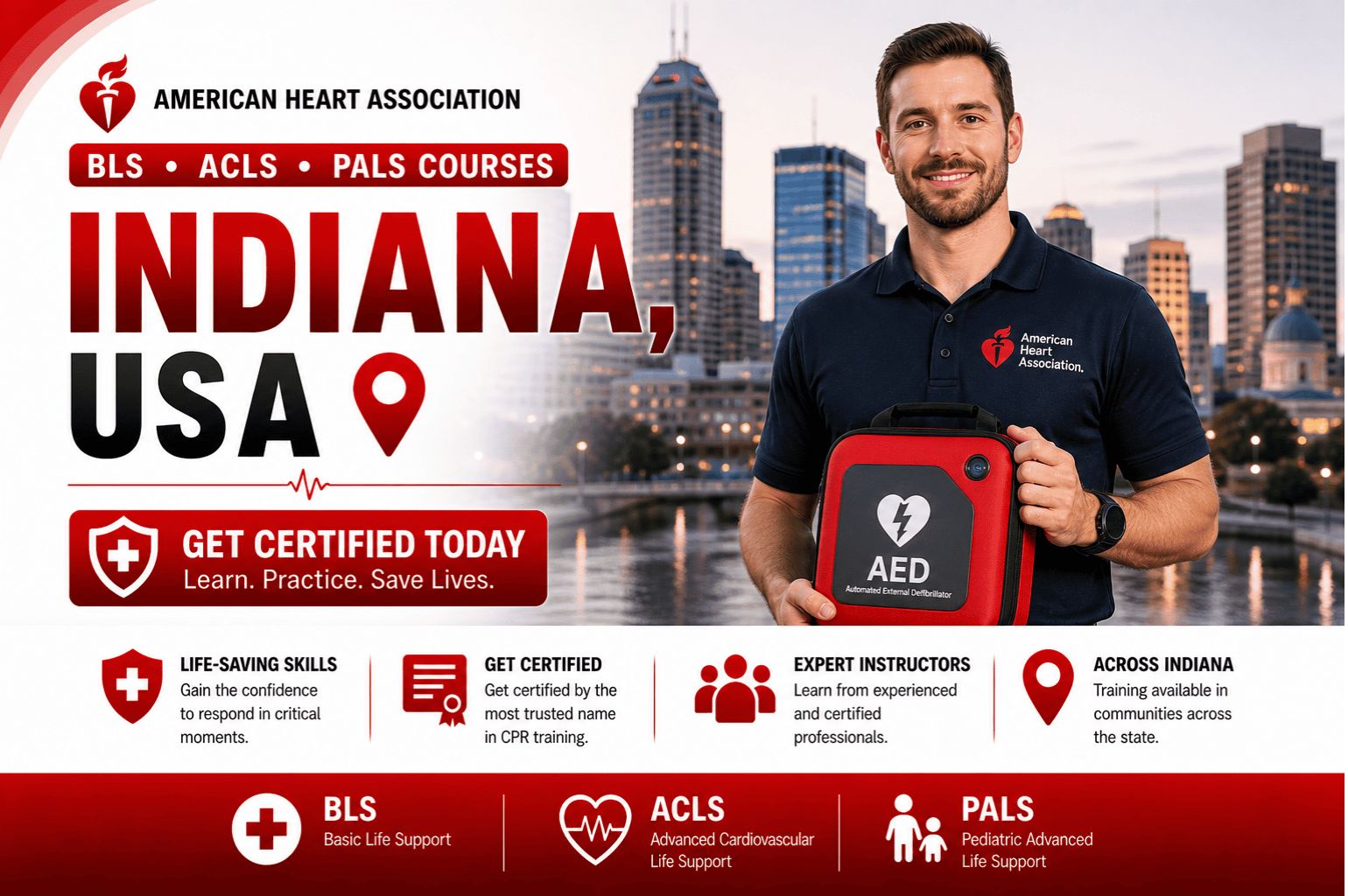
Safety Training Seminars brings the full suite of American Heart Association training to Indiana’s workforce. Our AHA BLS CPR Course covers the foundational resuscitation skills every clinical employee needs. ACLS prepares Indiana’s advanced providers — emergency physicians, ICU nurses, paramedics — for the complex cardiac scenarios their roles demand. PALS training equips pediatric specialists and neonatal teams with the assessment-first approach that changes outcomes for Indiana’s youngest patients. Every course delivers an AHA Course Completion eCard upon successful completion, accepted statewide without exception.
Essential for healthcare professionals. Covers CPR for adults, children, and infants, AED use, and airway management. Accepted by all major hospitals and healthcare systems.
Builds on BLS knowledge with advanced management of cardiovascular emergencies, arrhythmias, stroke, and acute coronary syndromes. Required for ICU, ER, and OR staff.
Designed for providers who care for infants and children. Covers pediatric assessment, respiratory failure, shock, and cardiac arrest management.
Ideal for non-medical professionals, workplaces, teachers, and community members. Covers adult and child CPR, AED operation, choking, and basic first aid.
Indiana’s geography requires a training provider that covers the whole state — not just the metro core. Safety Training Seminars serves BLS CPR, ACLS, PALS, and First Aid students in Indianapolis, Carmel, Fishers, Noblesville, Fort Wayne, South Bend, Mishawaka, Evansville, Bloomington, Lafayette, Muncie, Anderson, Terre Haute, Columbus, Kokomo, and Highland. From the northern suburbs along US-30 in Lake County to the river communities of Floyd and Clark Counties in the south, and the agricultural heartland stretching across Tippecanoe and Cass Counties, our training reaches Indiana professionals wherever their work takes them.
Indiana‘s growing healthcare sector, regulated industries, and community organizations create high, ongoing demand for AHA life support certification.
RNs, LPNs, and nursing students must hold current BLS certification as required by state boards and hospital credentialing.
Medical doctors, physician assistants, and nurse practitioners must maintain current ACLS and BLS certification.
Emergency medical technicians and paramedics must hold AHA certification as required by state EMS licensing.
Dentists, dental hygienists, and dental assistants are required to maintain current CPR/BLS certification by state dental boards.
Teachers, daycare providers, school nurses, and childcare staff are required by law to hold current CPR certification.
Indiana’s two dominant health systems — IU Health and Ascension St. Vincent — set the credentialing bar that most clinical employers in the state follow. Parkview Health in Fort Wayne, Beacon Health System in South Bend, and Community Health Network across the Indianapolis suburbs add their own rigorous training requirements on top of that foundation. Indiana professionals don’t just need CPR training — they need AHA-aligned documentation that holds up to employer compliance review on day one.
That’s exactly what Safety Training Seminars provides. Our BLS CPR, ACLS, and PALS courses are built to meet those institutional standards while making the training process far less disruptive to Indiana’s hardworking healthcare professionals.
The AHA BLS CPR Course in Indiana delivers adult, child, and infant CPR, two-rescuer technique, and AED operation aligned to the latest AHA guidelines — fully accepted by every major Indiana health system from IU Health’s network hospitals to Deaconess Health System in Evansville.
Indiana’s ACLS course sharpens the rhythm recognition, medication decision-making, and resuscitation team leadership skills that ER nurses, critical care providers, and paramedics rely on in high-acuity situations — from Eskenazi Health’s Level I trauma center in Indianapolis to the cardiac units at Parkview Regional Medical Center in Fort Wayne.
Riley Hospital for Children at IU Health sets the standard for pediatric care in Indiana, and the PALS course prepares providers across the state to meet that standard — building systematic assessment skills, pediatric airway management, and resuscitation protocols that apply in every pediatric and neonatal setting statewide.
Indiana’s manufacturing plants, school systems, construction crews, and corporate offices need practical CPR and First Aid training that prepares non-clinical employees to respond with confidence when emergencies happen far from a hospital — and this course delivers those skills without the complexity of a clinical curriculum.
Indiana has no shortage of training options in theory — but in practice, most of them require clinical employees to block off a full workday, fight Indianapolis traffic on I-465 or I-65, and sit through material they’ve already reviewed in previous renewal cycles. Our approach rejects that model entirely.
The CPR Verification Station™ skills assessment is fast and efficient by design. Indiana participants arrive having already worked through the AHA curriculum online, so the hands-on session focuses entirely on skills demonstration — not re-teaching concepts. The scenarios used in the skills check reflect real-life clinical situations, not simplified exercises, which means providers leave genuinely prepared rather than just technically documented. The digital learning platform works on any device and any connection speed, which matters for rural Indiana providers who may not have the same broadband access as their Indianapolis counterparts. And the AHA Course Completion eCard that comes out the other side is recognized by every Indiana employer — no questions, no delays.
BLS completers in Indiana develop chest compression technique that meets AHA depth and rate standards, rescue breathing that integrates correctly with compressions, and the fast, decisive AED operation that can restore a shockable rhythm before irreversible damage sets in. Two-rescuer coordination — critical for the small clinical teams common in Indiana’s rural and critical access hospitals — is practiced until the handoff between compressors is seamless.
ACLS training adds the rhythm interpretation layer that separates a provider who can run a code from one who merely follows the algorithm. Indiana’s ACLS completers work through monitored cardiac arrest, unstable arrhythmias, post-resuscitation care, and stroke protocols — the full range of scenarios their advanced roles demand. Team communication is threaded through every scenario, because Indiana’s high-pressure emergency environments don’t have room for confusion about who’s leading and what comes next.
A travel nurse rotating through IU Health Arnett Hospital in Lafayette, a paramedic working 24-hour shifts for Fort Wayne Fire Department, and a hospitalist covering a rural critical access hospital in Winchester all face the same challenge: mandatory training requirements and almost no predictable downtime to meet them. Our learning model was built around that constraint.
Self-Guided Learning™ removes every scheduling barrier. Indiana professionals access the AHA online curriculum whenever a window opens — between patient blocks, after a long shift, or during a slow overnight. There’s no group enrollment to wait for, no fixed start time, and no geographic requirement. Whether you’re in Carmel or in a community north of Logansport, the course comes to you.
HeartCode® Complete is the AHA’s structured blended solution — an adaptive online curriculum paired with a hands-on skills session. It’s ideal for Indiana providers who want a guided, end-to-end path through BLS, ACLS, or PALS training rather than a fully self-directed experience, and it delivers an AHA Course Completion eCard once both components are successfully completed.
The CPR Verification Station™ is the in-person skills component that converts online learning into documented AHA competency. Indiana participants schedule a focused session, demonstrate their skills to a trained evaluator, and receive their AHA Course Completion eCard digitally — without the delays of a traditional scheduled class or the inflexibility of fixed group training times.
Indiana’s largest employers in healthcare are consistent on this point: current AHA BLS credentials are non-negotiable for clinical staff. IU Health — which operates hospitals from Methodist and University Hospital in Indianapolis to facilities in Bloomington, Lafayette, and beyond — requires BLS for all bedside providers and mandates ACLS and PALS for specialty roles. Ascension St. Vincent’s network across central Indiana mirrors those standards. Parkview Health in Fort Wayne and Beacon Health System in South Bend maintain identical expectations for their clinical employees.
Compliance timelines in Indiana typically follow the AHA’s two-year renewal cycle. Most hospital credentialing departments begin renewal tracking 60 to 90 days before expiration, and providers who miss that window can face schedule disruptions, onboarding delays, and in some cases, temporary removal from clinical duties until their documentation is current. For Indiana providers who hold or are pursuing Indiana Medical Licensing Board requirements, maintaining current AHA credentials is often directly tied to their continued clinical eligibility.
Non-clinical sectors are also increasingly engaged. Indiana’s large manufacturing corridor — from the auto suppliers of Elkhart County to the steel industry communities in Lake and Porter Counties — has seen growing OSHA-aligned demand for First Aid and CPR training at the workplace level.
Indiana ranks among the higher-risk states for cardiovascular disease, particularly in its rural southern and central counties where access to emergency cardiac care is limited and EMS response times can stretch well beyond the critical window. In communities like Spencer, Sullivan, or Paoli, a trained bystander who can sustain high-quality CPR until EMS arrives isn’t a backup plan — they’re often the primary intervention.
In the Indianapolis metro, volume is the challenge. IMPD and Indianapolis EMS respond to thousands of cardiac calls annually across Marion County, and even with fast response times, bystander CPR in the minutes before arrival dramatically improves survival odds. Carmel, Fishers, and Noblesville — fast-growing communities in Hamilton County — are expanding both their residential population and their healthcare workforce, increasing the overall demand for trained providers at every level.
Indiana’s manufacturing and logistics sectors add workplace safety urgency to the picture. Distribution facilities along I-70 and I-74, production plants in Shelby and Decatur Counties, and construction sites throughout the growing Indianapolis suburbs all represent environments where cardiac events occur and where OSHA expects meaningful emergency response capability from trained employees on every shift.
Indiana’s diverse economy — spanning healthcare, advanced manufacturing, logistics, education, and agriculture — creates a wide range of organizational CPR training needs. Safety Training Seminars works with Indiana businesses, health systems, school districts, and corporate HR teams to coordinate group BLS CPR, ACLS, PALS, and First Aid training that fits operational realities.
Group training for Indiana manufacturers allows safety managers to build CPR-trained responder coverage across every shift without pulling workers off the floor for a full day at a time. Hospital HR teams in Fort Wayne, South Bend, or Indianapolis can coordinate department-wide renewal cycles that simplify compliance tracking and reduce last-minute scrambles before accreditation reviews. School corporations across central Indiana — from Carmel Clay Schools to MSD of Lawrence Township — can ensure that staff and coaches hold current CPR and First Aid documentation as their employment agreements require.
Indiana professionals facing a tight deadline — a new role at IU Health starting Monday, a compliance window closing at week’s end, or a renewal that somehow fell off the calendar — have a real same-day path available through Safety Training Seminars.
The online portion is available immediately upon registration, accessible on any device and completable in a single sitting. Once the digital curriculum is finished, the CPR Verification Station™ skills session is booked at a convenient Indiana location. The hands-on check is focused and efficient — not a drawn-out classroom exercise — and once you’ve successfully demonstrated your skills, the AHA Course Completion eCard is delivered electronically. For most Indiana participants, the entire process — from logging in for the first time to holding a valid AHA eCard — is achievable within a single day.
The four-step process is designed to eliminate friction at every stage. First, you register online with Safety Training Seminars and choose your course — AHA BLS CPR, ACLS, PALS, or CPR and First Aid. Second, you complete the online learning curriculum at your own pace, on any device, from anywhere in Indiana. Third, you schedule and attend your CPR Verification Station™ skills session at a location accessible from your part of the state. Fourth, after demonstrating competency in the hands-on component, your AHA Course Completion eCard is issued digitally — ready to forward to your employer, upload to a credentialing portal, or store for your own records. No mail delays, no scheduling backlogs, no unnecessary steps between completion and documentation.
Safety Training Seminars serves Indiana professionals across all 92 counties. In the north, that includes Lake, Porter, LaPorte, St. Joseph, Elkhart, and Kosciusko Counties — communities like Highland, Merrillville, Valparaiso, Michigan City, South Bend, Goshen, and Warsaw. Central Indiana coverage spans Marion, Hamilton, Hendricks, Johnson, Boone, and Madison Counties — Indianapolis, Carmel, Fishers, Noblesville, Greenwood, Zionsville, and Anderson. In the east, Allen, Delaware, Grant, and Randolph Counties are served — Fort Wayne, Muncie, Marion, and Winchester. Southern Indiana coverage includes Monroe, Bartholomew, Vanderburgh, Clark, and Floyd Counties — Bloomington, Columbus, Evansville, Jeffersonville, and New Albany.
Indiana’s hospital network drives the majority of AHA training demand, and Safety Training Seminars serves providers affiliated with the state’s most prominent medical institutions. In Indianapolis and the surrounding metro, that includes IU Health Methodist Hospital, IU Health University Hospital, IU Health North Hospital in Carmel, Ascension St. Vincent Indianapolis, Community Hospital East and North, Eskenazi Health, and Franciscan Health Indianapolis.
In Fort Wayne, Parkview Regional Medical Center and Parkview North Hospital are the primary training demand drivers, along with Lutheran Hospital and Dupont Hospital. In South Bend and Mishawaka, Beacon Health System’s Memorial Hospital and Saint Joseph Health System anchor the clinical workforce. Terre Haute Regional Hospital and Union Hospital serve Vigo County’s healthcare community. In Evansville, Deaconess Health System and St. Mary’s Medical Center represent the primary institutions whose staff regularly need BLS, ACLS, and PALS documentation. Medical office clusters along Meridian Street’s healthcare corridor in Indianapolis, along Dupont Road in Fort Wayne, and near the Notre Dame health district in South Bend all fall within our service range.
The professional case for maintaining current AHA credentials in Indiana is straightforward — employers require it, compliance timelines enforce it, and a lapsed card creates real and immediate consequences for clinical staff. But the human case goes deeper than documentation.
Indiana loses thousands of residents to sudden cardiac arrest each year — many in settings where a trained bystander could have made a life-saving difference. Every nurse, teacher, coach, office worker, or factory employee who completes an AHA BLS CPR class in Indiana adds to a statewide safety network that emergency services alone can’t build. The confidence that comes from training is real and durable — trained responders don’t hesitate, don’t freeze, and don’t stand by hoping someone more qualified shows up.
For Indiana healthcare professionals, current credentials also translate to career flexibility. Cross-system mobility between IU Health, Ascension, Community, and Parkview is common in Indiana’s competitive healthcare labor market, and arriving with current AHA documentation removes an administrative barrier that can slow an offer or a start date significantly.
The AHA’s two-year renewal cycle is the baseline expectation for Indiana healthcare employers, and most credentialing departments track it closely. BLS renewal is the most universal requirement — applying to nurses, respiratory therapists, surgical technologists, EMTs, and physicians alike across every Indiana health system. ACLS renewal is standard for those in emergency, critical care, and advanced practice roles. PALS renewal is required for pediatric specialists, neonatal providers, and transport teams — particularly at Riley Hospital for Children, Peyton Manning Children’s at Ascension St. Vincent, and the pediatric service lines at Parkview and Beacon.
Safety Training Seminars makes the renewal process as efficient as the initial training — the same online-plus-skills model, the same rapid eCard delivery, and a renewal curriculum that’s appropriately calibrated for experienced providers rather than padded with introductory content. Renewing on schedule protects employment status, scheduling eligibility, and the clinical standing that Indiana providers have worked hard to build.
Indiana’s healthcare employers don’t wait, and neither should you. Whether your BLS card expires next month or you’re starting a new role that requires current ACLS documentation before the first shift, Safety Training Seminars has a clear, fast path forward.
Enroll online today and access the Self-Guided Learning™ curriculum immediately — no waiting, no scheduling lead time. Complete the online portion at your own pace, book your CPR Verification Station™ skills session when it fits your Indiana schedule, and walk away with your AHA Course Completion eCard the same day. From Carmel to Fort Wayne, South Bend to Evansville, and every community in between — Safety Training Seminars delivers BLS CPR, ACLS, PALS, and First Aid training that fits Indiana life.
Don’t let a lapsed credential slow down everything you’ve built. Enroll today.
This section covers the most common questions people have about CPR, BLS, ACLS, PALS and First Aid courses. At Safety Training Seminars, we provide clear information about course content, scheduling options, training formats, and what to expect during your session.
Most Indiana professionals complete the full BLS CPR process within a single day. The Self-Guided Learning™ online component typically takes between 60 and 90 minutes depending on your pace, and the CPR Verification Station™ skills session usually runs 45 minutes to an hour.
IU Health, Ascension St. Vincent, Community Health Network, Franciscan Health, Parkview Health, Beacon Health System, Deaconess Health System, and Eskenazi Health all require current AHA BLS credentials for clinical staff, and mandate ACLS or PALS for specialty roles depending on department and patient population. Indiana’s critical access hospitals — from Witham Health Services in Lebanon to Margaret Mary Health in Batesville — hold the same standards for their bedside providers.
The AHA requires a hands-on skills check to issue a BLS, ACLS, or PALS Course Completion eCard — so a fully online-only path doesn’t meet that standard. However, the online Self-Guided Learning™ or HeartCode® Complete component can be completed entirely at your own pace and on your own schedule, making the overall process very flexible.
Yes — Indiana OSHA regulations align with federal standards that require certain high-risk workplaces to maintain first aid and CPR response capability. Manufacturing facilities, construction sites, and large distribution centers in Indiana are particularly affected. Beyond strict regulatory requirements, many Indiana school systems, fitness facilities, and corporate employers have integrated CPR and First Aid training into their standard employee onboarding and annual compliance programs.
The American Heart Association recommends renewal every two years for BLS, ACLS, and PALS, and Indiana’s major health systems align their credentialing compliance windows to that cycle. Most Indiana hospitals begin tracking renewal eligibility 60 to 90 days before the expiration date. Providers who miss that window can face scheduling restrictions and delays to their clinical eligibility until documentation is updated.

