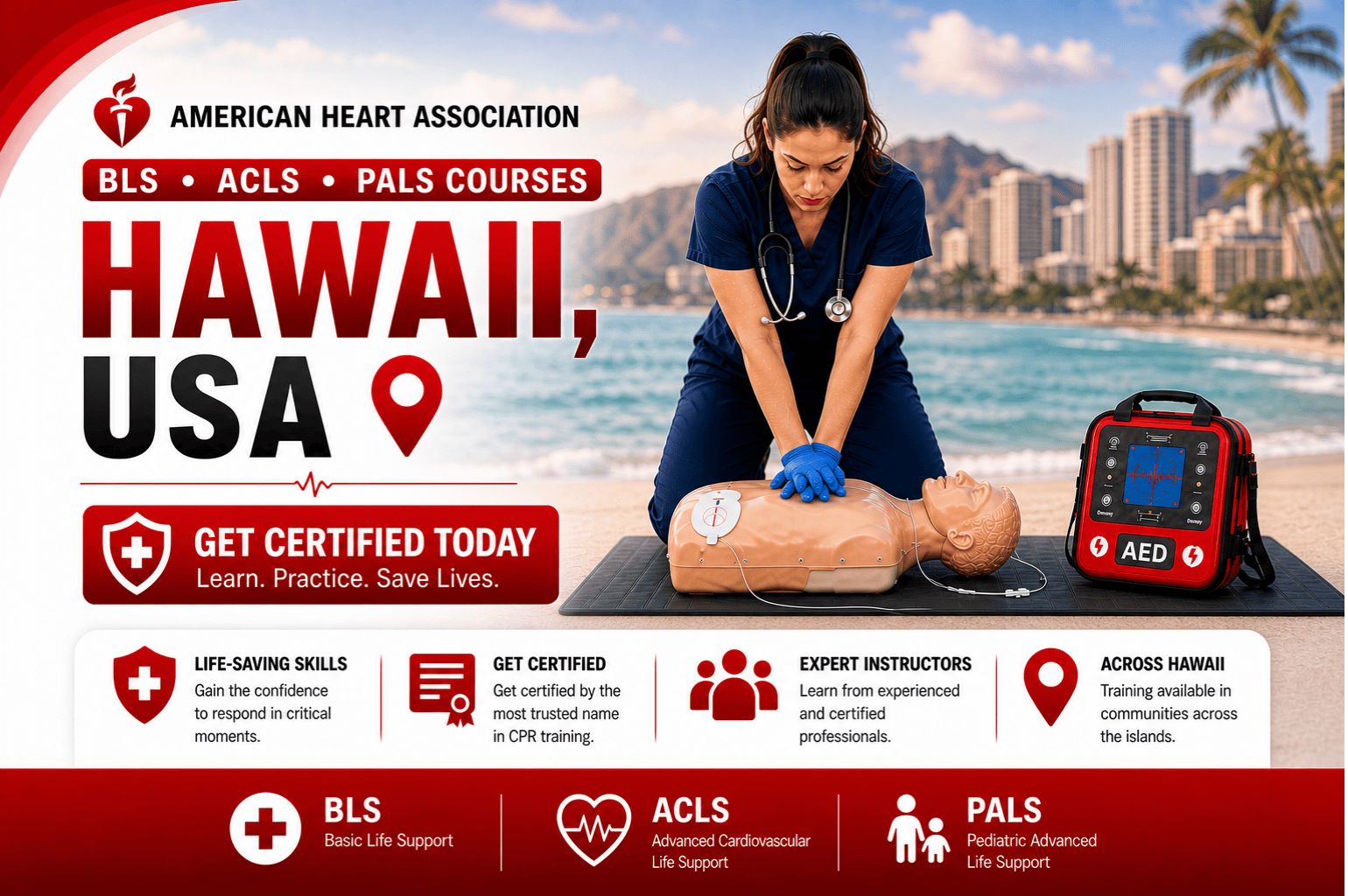
Island geography changes everything about emergency response. When help is minutes away on the mainland, it can be significantly longer across Hawaii’s neighbor islands — and that gap is exactly where trained bystanders, prepared healthcare workers, and skilled first responders make a life-or-death difference. From the busy hospital corridors of Honolulu to the rural clinics of the Big Island’s North Kohala Coast, Safety Training Seminars brings American Heart Association BLS CPR, ACLS, and PALS courses to Hawaii’s healthcare community with the flexibility this unique state demands.
Hawaii’s healthcare system faces challenges that no mainland state fully understands. Provider shortages on the neighbor islands, high patient-to-staff ratios at facilities serving both residents and the millions of tourists who visit each year, and the geographic reality that advanced care isn’t always minutes away — all of these factors make high-quality AHA training not just a compliance requirement, but a genuine community health asset.
Safety Training Seminars delivers the full range of American Heart Association courses to Hawaii’s clinical workforce. Our AHA BLS CPR Course gives nurses, techs, and emergency providers the evidence-based cardiac skills their employers require. The ACLS course prepares Hawaii’s advanced providers for the rhythm recognition, pharmacology, and team leadership demands of complex resuscitation scenarios. PALS training ensures pediatric and neonatal specialists across every island have the assessment tools to catch deterioration early and respond effectively. Each course concludes with an AHA Course Completion eCard — accepted statewide and recognized by Hawaii’s major health systems without exception.
Essential for healthcare professionals. Covers CPR for adults, children, and infants, AED use, and airway management. Accepted by all major hospitals and healthcare systems.
Builds on BLS knowledge with advanced management of cardiovascular emergencies, arrhythmias, stroke, and acute coronary syndromes. Required for ICU, ER, and OR staff.
Designed for providers who care for infants and children. Covers pediatric assessment, respiratory failure, shock, and cardiac arrest management.
Ideal for non-medical professionals, workplaces, teachers, and community members. Covers adult and child CPR, AED operation, choking, and basic first aid.
Hawaii isn’t one community — it’s a collection of distinct islands, each with its own healthcare infrastructure and workforce needs. Safety Training Seminars serves providers and community members on Oahu, including Honolulu, Kailua, Pearl City, Aiea, Kaneohe, Waipahu, and Ewa Beach. On Maui, we cover Kahului, Kihei, Lahaina, Wailuku, and Haiku. The Big Island’s communities — Kailua-Kona, Hilo, Waimea, and Pahoa — are also within our reach, as are Lihue, Kapaa, and Princeville on Kauai. No matter which island you call home or work on, the training process is designed to fit around island life, not fight against it.
Hawaii‘s growing healthcare sector, regulated industries, and community organizations create high, ongoing demand for AHA life support certification.
RNs, LPNs, and nursing students must hold current BLS certification as required by state boards and hospital credentialing.
Medical doctors, physician assistants, and nurse practitioners must maintain current ACLS and BLS certification.
Emergency medical technicians and paramedics must hold AHA certification as required by state EMS licensing.
Dentists, dental hygienists, and dental assistants are required to maintain current CPR/BLS certification by state dental boards.
Teachers, daycare providers, school nurses, and childcare staff are required by law to hold current CPR certification.
Hawaii’s largest health systems — The Queen’s Health Systems, Hawaii Pacific Health, and Maui Health — hold their clinical staff to rigorous AHA training standards that match the high-acuity, high-volume environments their providers work in every day. Tourism alone contributes thousands of medical emergencies annually across Oahu’s Waikiki district, Maui’s resort corridors, the Kohala Coast on the Big Island, and Kauai’s north shore — meaning Hawaii’s providers need to be as ready for a cardiac arrest on a hotel beach as in a hospital room.
Safety Training Seminars rises to that challenge with a comprehensive course catalog built for Hawaii’s realities. Here’s what’s available:
The AHA BLS CPR Course in Hawaii delivers adult, child, and infant resuscitation skills, AED use, and team-based CPR technique in a format that meets the requirements of every major Hawaii health system — from Queen’s Medical Center in Honolulu to Hilo Medical Center on the Big Island.
Hawaii’s ACLS course is built for the experienced providers — emergency physicians, critical care nurses, and paramedics — who manage cardiac arrest and complex arrhythmias in high-stakes settings, including the neighbor island hospitals where advanced backup can be a flight away.
Kapiolani Medical Center for Women & Children and pediatric units across Hawaii’s hospital network rely on PALS-trained staff who can recognize respiratory failure, classify shock, and lead pediatric resuscitations with confidence — skills this course builds through scenario-driven, assessment-first learning.
Hawaii’s resort workers, surf instructors, lifeguards, school staff, and community members need practical, no-nonsense training for the emergencies that happen outside hospital walls — from beach cardiac events to workplace injuries — and this course delivers exactly that.
Training options in Hawaii have historically been limited by geography — particularly for providers on the neighbor islands who couldn’t easily access training centers on Oahu. Our model breaks that constraint entirely.
The skills assessment process is fast and focused, built around real-life simulation rather than passive group instruction. Hawaii participants arrive at a CPR Verification Station™ prepared — because the online learning component has already walked them through the science and protocols in depth — and the hands-on session moves at the pace of a competent provider, not the slowest person in a large classroom. The entire framework runs on a modern digital learning platform that works on any device, in any location, at any time — which matters enormously when your commute involves a harbor ferry or a 40-minute drive down the Hana Highway. And because it’s all backed by the American Heart Association, the AHA Course Completion eCard you receive is trusted by every employer in Hawaii from day one.
AHA BLS CPR completers in Hawaii leave with compression technique, ventilation skills, and AED operation as genuine reflexes — not theoretical knowledge. The training emphasizes high-quality CPR from the first moment of recognition, because in Hawaii’s island setting, that bystander response window can be the only intervention a patient receives before EMS arrives.
ACLS training develops rhythm interpretation across monitored presentations, post-cardiac arrest care management, airway decision-making under pressure, and the kind of calm, directive team communication that separates an effective resuscitation from a chaotic one. For Big Island and Maui providers who sometimes operate with smaller teams, those leadership skills carry extra weight.
PALS completers master the Pediatric Assessment Triangle, work through differentiated shock pathways, and develop systematic approaches to pediatric airway and respiratory management. First Aid content covers bleeding control, fracture stabilization, anaphylaxis response, and stroke recognition — skills that translate directly into safer beaches, workplaces, and communities across every Hawaiian island.
A nurse finishing a 12-hour shift at Pali Momi Medical Center in Aiea and a physician providing coverage at Kona Community Hospital on the Big Island face the same problem: mandatory training requirements and almost no time to meet them through traditional formats. Our learning model was built with exactly that tension in mind.
Self-Guided Learning™ gives Hawaii professionals total control over when and where the online portion gets done. There’s no scheduled class to register for, no group to wait on, and no fixed timeline. Whether you’re working in a Honolulu hospital or a remote clinic near Pahoa, the curriculum comes to you — accessible on any device, whenever the window opens.
HeartCode® Complete integrates an adaptive AHA online course with a structured skills session, guiding Hawaii providers through the full BLS, ACLS, or PALS learning experience in a coherent, end-to-end format. It’s the right choice for providers who want a thorough, guided process rather than a self-paced one, and it culminates in an AHA Course Completion eCard upon successfully completing both components.
The CPR Verification Station™ is the hands-on component that converts online learning into documented AHA competency. Hawaii participants schedule their session, demonstrate their skills in a focused, evaluator-led check, and receive their AHA Course Completion eCard digitally — completing the process without the scheduling constraints of traditional classroom formats.
Hawaii’s major health systems are unambiguous about their requirements. The Queen’s Health Systems — operating Queen’s Medical Center on Oahu and Queen’s North Hawaii Community Hospital in Waimea — requires current AHA BLS credentials for all clinical staff. Hawaii Pacific Health, which operates Pali Momi Medical Center, Straub Medical Center, Kapiolani Medical Center, and Wilcox Medical Center on Kauai, maintains the same standards across every campus. Maui Health System, including Maui Memorial Medical Center in Kahului, requires AHA BLS for bedside providers and ACLS or PALS for specialty roles.
On the Big Island, Hilo Medical Center and Kona Community Hospital follow Hawaii Department of Health guidelines and AHA renewal timelines. Most Hawaii healthcare employers operate on a two-year renewal cycle, consistent with AHA standards. Providers who let their credentials lapse can face schedule disruptions, delayed onboarding, or gaps in their clinical eligibility — particularly problematic in a state where healthcare staffing is already under significant pressure.
Hospitality employers — hotels, cruise operators, and resort chains along the Kohala Coast and in Waikiki — are also increasingly implementing CPR and First Aid requirements as part of their employee safety training programs.
Geography is the defining factor. On Oahu, EMS response is reasonably fast — but even there, peak traffic on H-1 through downtown Honolulu or the Likelike Highway toward Kaneohe can meaningfully extend response times. On Maui, the Big Island, and Kauai, the picture is more serious. A cardiac emergency in a remote area near Hana, or in a rural community above the Waimea Canyon on Kauai, may mean a 20-minute or longer wait for professional response.
That window is where bystander CPR — and the confidence to provide it — changes outcomes. The survival rate for cardiac arrest increases dramatically with each minute of high-quality CPR before defibrillation. Training the people who are already there is not a supplement to Hawaii’s emergency medical system — it’s a critical part of it.
Tourism adds another layer. Hawaii hosts between nine and ten million visitors annually, many of them older adults with elevated cardiovascular risk. Resort pools, beach parks, luau venues, snorkeling charters, and golf courses are all settings where cardiac events occur — and where trained employees and bystanders are the first and often only line of response before EMS arrives.
Hawaii’s hospitality, healthcare, education, and government sectors all have organized CPR training needs that go beyond individual compliance. Safety Training Seminars works with Hawaii businesses and institutions to structure group BLS, ACLS, PALS, and First Aid training that makes logistical sense — especially for organizations with staff spread across multiple sites or islands.
Hotel groups managing properties in Waikiki, Kaanapali, and the Kohala Coast can coordinate group bookings to ensure all guest-facing employees hold current CPR and First Aid credentials. School districts across Oahu, Maui, and the Big Island can organize teacher and staff training that meets Hawaii Department of Education safety expectations. Healthcare networks can align renewal cycles across departments to minimize scheduling conflicts and simplify compliance tracking for HR teams.
Group training through Safety Training Seminars is an efficient way to meet OSHA-aligned workplace safety requirements while building a genuine culture of preparedness — something Hawaii’s unique environment makes more important, not less.
For Hawaii providers who need documentation quickly — a new position at Queens or Maui Health, a license renewal, or a compliance audit coming up — the same-day path is real and straightforward.
Complete the online portion of your BLS, ACLS, or PALS course through Self-Guided Learning™ at whatever pace works for you. Schedule your CPR Verification Station™ skills session for a time that fits your island schedule. Attend the focused, evaluator-led session, demonstrate your skills, and receive your AHA Course Completion eCard digitally — often within hours of completing the hands-on component. No waiting for a physical card in the mail, no uncertain processing timelines, and no need to request a copy from a training center weeks later.
The process has four clear stages, each designed to reduce friction for busy Hawaii professionals. Registration happens online through Safety Training Seminars — you select your course, create your account, and gain immediate access to the curriculum. The online learning component is completed at your own pace, on any device, from any island. When you’re ready for the hands-on portion, you schedule your CPR Verification Station™ skills session at a convenient location. After successfully completing the skills check, your AHA Course Completion eCard is issued digitally and ready to submit to your employer immediately.
That’s it. No commute to a distant training center, no scheduling conflicts, no all-day commitment required.
Safety Training Seminars serves all four of Hawaii’s counties — Honolulu County (Oahu), Maui County (which includes Maui, Molokai, and Lanai), Hawaii County (the Big Island), and Kauai County. Within those counties, our training is available to professionals in communities across every island, including urban centers like Honolulu’s downtown and Kakaako district, suburban communities like Mililani, Kapolei, and Hawaii Kai on Oahu, and rural communities like Pahoa, Captain Cook, and Naalehu on the Big Island.
We also serve the healthcare and hospitality workforce in resort-dense areas including Ko Olina on Oahu’s west side, Wailea and Kaanapali on Maui, the Mauna Kea and Mauna Lani resort corridors on the Big Island, and Poipu on Kauai’s south shore.
Hawaii’s hospital network is both the primary driver of AHA training demand and the clearest indicator of where that demand is concentrated. Safety Training Seminars serves providers at Queen’s Medical Center on Punchbowl Street in Honolulu, Straub Medical Center in Honolulu’s downtown medical district, Kapiolani Medical Center for Women & Children in the Diamond Head neighborhood, Pali Momi Medical Center in Aiea, and Castle Medical Center in Kailua on Oahu’s windward side.
On Maui, Maui Memorial Medical Center in Kahului and Kula Hospital serve the island’s core medical workforce. The Big Island’s Hilo Medical Center, Kona Community Hospital in Kealakekua, and North Hawaii Community Hospital in Waimea each represent distinct geographic zones of training demand. Wilcox Medical Center in Lihue and Samuel Mahelona Memorial Hospital in Kapaa serve Kauai County’s healthcare community. Clinic clusters throughout Moanalua, Ala Moana, and Kakaako on Oahu and the medical office district near Kahului on Maui are also within our service area.
In Hawaii, the case for CPR training goes beyond career compliance — it’s woven into the fabric of community responsibility. When a snorkeler goes into cardiac arrest on a Maui boat tour, when a tourist collapses at a Waikiki hotel pool, or when a construction worker on a Big Island development site experiences a cardiac event miles from the nearest hospital, the people around them are the first responders. Training turns that proximity into a genuine advantage rather than a helpless bystander experience.
Professionally, Hawaii healthcare workers who maintain current AHA credentials stay competitive in a tight, high-demand labor market. Facilities across the state are actively recruiting qualified clinical staff, and arriving with current BLS, ACLS, or PALS documentation removes an administrative hurdle from the onboarding process.
The confidence piece is real and lasting. People who have trained don’t hesitate in the way untrained bystanders do. They recognize, they move, and they make a difference.
AHA credentials follow a two-year renewal schedule, and Hawaii employers track it carefully — particularly given the state’s persistent clinical staffing challenges. A provider with a lapsed BLS card represents both a compliance issue and a scheduling problem for departments already operating lean. BLS renewal is required across virtually every clinical role in Hawaii, from entry-level CNAs to attending physicians. ACLS renewal is standard for providers in emergency medicine, critical care, and procedural settings. PALS renewal applies to the pediatric specialists at Kapiolani and the neonatal teams at facilities throughout the state.
Safety Training Seminars supports renewal through the same online-plus-skills-check model used for initial training. There’s no need to sit through introductory-level content you’ve already mastered — the renewal curriculum is calibrated for experienced providers and focuses on the updates that matter most in current AHA guidelines.
Hawaii’s geographic realities create real urgency around training access. Don’t wait for a department audit, a schedule conflict, or an expired card to force the issue. Safety Training Seminars provides BLS CPR, ACLS, PALS, and CPR and First Aid courses to Hawaii professionals across every island — through a process that respects the realities of island life, island schedules, and island distances.
Enroll online today and begin your Self-Guided Learning™ course immediately. Schedule your CPR Verification Station™ skills session at your convenience, and walk away with your AHA Course Completion eCard before your next shift begins. Whether you’re in Honolulu, Kailua-Kona, Kahului, or Lihue — the training comes to you.
Be the person who knows what to do. Enroll with Safety Training Seminars today.
This section covers the most common questions people have about CPR, BLS, ACLS, PALS and First Aid courses. At Safety Training Seminars, we provide clear information about course content, scheduling options, training formats, and what to expect during your session.
The AHA BLS CPR course is structured to fit around Hawaii’s demanding professional schedules. The Self-Guided Learning™ online component typically takes 60 to 90 minutes at your own pace — accessible from any device, on any island. The CPR Verification Station™ skills session generally runs under an hour. Most Hawaii participants complete both components and receive their AHA Course Completion eCard within a single day, making same-day turnaround genuinely achievable for providers on tight deadlines.
ACLS training is required for Hawaii providers working in emergency departments, ICUs, cardiac care units, procedural areas, and advanced practice roles — including at Queen’s Medical Center, Pali Momi, Hilo Medical Center, and Maui Memorial. PALS is specifically required for those in pediatric care, neonatal units, and pediatric transport — most notably at Kapiolani Medical Center for Women & Children and pediatric service lines across the neighbor island hospitals. Some Hawaii providers in family medicine and rural clinics elect to complete PALS as a preparedness measure given their distance from specialized pediatric facilities.
The training uses a blended format — the knowledge component is completed online through Self-Guided Learning™ or HeartCode® Complete, while the hands-on skills portion is completed in person at a CPR Verification Station™ location. The American Heart Association requires a verified skills check to issue a BLS, ACLS, or PALS Course Completion eCard. This in-person component ensures that Hawaii providers can genuinely perform the skills in real-world conditions — which matters even more in an island healthcare environment where backup resources may be limited.
Yes. Once you successfully complete the online learning and the CPR Verification Station™ skills session, your AHA Course Completion eCard is issued electronically — typically the same day. This is particularly valuable for Hawaii providers who are onboarding at a new facility, renewing ahead of a schedule audit, or returning to clinical work after a period away. The digital eCard is immediately shareable with your employer and doesn’t require a physical mailing or processing delay.
The AHA recommends renewal every two years for BLS, ACLS, and PALS credentials, and Hawaii’s major health systems — including The Queen’s Health Systems, Hawaii Pacific Health, and Maui Health — follow that cycle for their compliance tracking. Most Hawaii employers begin flagging renewal needs 60 to 90 days before expiration. Because healthcare staffing in Hawaii is already stretched, a lapsed credential can affect scheduling eligibility and department compliance reviews quickly. Safety Training Seminars makes renewal just as accessible as initial training — same process, same speed, same AHA Course Completion eCard at the end.

