Every second matters when a cardiac emergency strikes — whether it happens on a hospital floor in Little Rock, a clinic in Fayetteville, or a break room in Fort Smith. Arkansas healthcare professionals, first responders, and everyday community members need fast access to life-saving training they can actually trust. Safety Training Seminars brings American Heart Association BLS CPR, ACLS, and PALS courses directly to Arkansas residents, making it easier than ever to build the skills that matter most when lives are on the line.
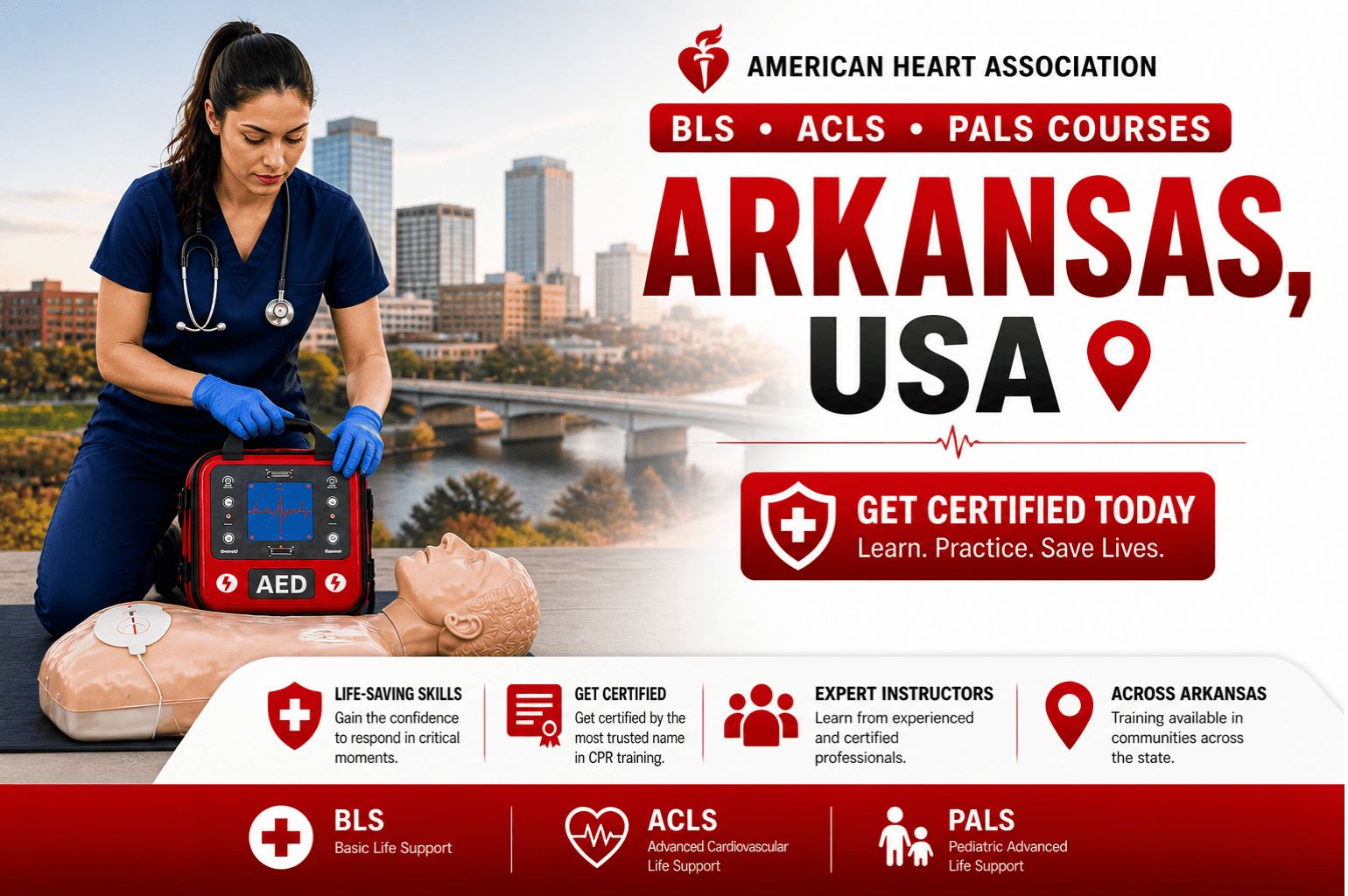
Arkansas is home to a growing and diverse healthcare workforce — from the trauma teams at UAMS Medical Center in Little Rock to the community health clinics scattered across Benton County, Sebastian County, and Pulaski County. That means the demand for reliable, up-to-date AHA training has never been higher across the state.
Safety Training Seminars offers American Heart Association BLS CPR courses designed specifically for healthcare providers who need science-backed, skills-focused training. Our ACLS course prepares nurses, paramedics, and physicians to manage complex cardiac emergencies with precision. PALS training sharpens the pediatric assessment and resuscitation skills that matter most in neonatal units, pediatric ERs, and urgent care settings throughout Arkansas. Each course follows the latest AHA guidelines and delivers an AHA Course Completion eCard upon successful completion — accepted by employers statewide.
Essential for healthcare professionals. Covers CPR for adults, children, and infants, AED use, and airway management. Accepted by all major hospitals and healthcare systems.
Builds on BLS knowledge with advanced management of cardiovascular emergencies, arrhythmias, stroke, and acute coronary syndromes. Required for ICU, ER, and OR staff.
Designed for providers who care for infants and children. Covers pediatric assessment, respiratory failure, shock, and cardiac arrest management.
Ideal for non-medical professionals, workplaces, teachers, and community members. Covers adult and child CPR, AED operation, choking, and basic first aid.
From the Arkansas River Valley to the Ozark foothills, Safety Training Seminars serves healthcare professionals, corporate teams, and community members throughout the state. Our courses are accessible to those working in Little Rock, North Little Rock, Fayetteville, Springdale, Jonesboro, Conway, Rogers, Bentonville, Fort Smith, and Pine Bluff — as well as surrounding rural communities that are often underserved by traditional training providers. Whether you’re commuting down I-30 from Benton or heading north on I-49 through Washington County, flexible scheduling means training fits your life, not the other way around.
Arkansas‘s growing healthcare sector, regulated industries, and community organizations create high, ongoing demand for AHA life support certification.
RNs, LPNs, and nursing students must hold current BLS certification as required by state boards and hospital credentialing.
Medical doctors, physician assistants, and nurse practitioners must maintain current ACLS and BLS certification.
Emergency medical technicians and paramedics must hold AHA certification as required by state EMS licensing.
Dentists, dental hygienists, and dental assistants are required to maintain current CPR/BLS certification by state dental boards.
Teachers, daycare providers, school nurses, and childcare staff are required by law to hold current CPR certification.
Arkansas healthcare systems are expanding rapidly — Baptist Health, CHI St. Vincent, Arkansas Children’s Hospital, and Mercy Hospital Northwest are just a few of the major networks that require their staff to maintain current AHA training. Safety Training Seminars has built its reputation on delivering courses that meet those institutional standards without the friction of outdated, classroom-only formats.
We provide a complete range of American Heart Association courses through a modern, flexible learning model. Here’s what’s available for Arkansas professionals:
The AHA BLS CPR Course is the foundational training for anyone working in a clinical or emergency setting in Arkansas. It covers adult, child, and infant CPR, AED operation, and relief of choking using the most current evidence-based techniques — and it’s accepted across hospital systems statewide.
Our ACLS course in Arkansas is built for the healthcare professionals who manage cardiac arrest, stroke, and other life-threatening emergencies. It sharpens rhythm interpretation, medication administration decision-making, and team-based resuscitation — skills that translate directly to high-pressure clinical environments throughout the state.
Arkansas pediatric care providers — from neonatologists at Arkansas Children’s to pediatric nurses across Craighead County — rely on PALS training to recognize and respond to deteriorating children quickly. This course addresses respiratory failure, shock, and pediatric cardiac arrest with a systematic, assessment-based approach.
Not every emergency happens in a hospital. This course equips non-clinical Arkansans — teachers, office workers, gym staff, and community members — with the foundational skills to respond confidently to sudden cardiac events, choking, and traumatic injuries until professional help arrives.
Arkansas professionals don’t have time for training that wastes their time. That’s why Safety Training Seminars has built a system that’s fast, modern, and effective without cutting corners on quality.
Our learning model combines an engaging digital curriculum with real-world skills practice — so participants don’t just learn the theory, they develop the muscle memory that matters in an actual emergency. The skills assessment format is structured around real-life simulation scenarios rather than rote repetition, which means participants leave genuinely prepared, not just technically compliant.
The entire process is built on a trusted training format backed by the American Heart Association. Whether you’re a first-time learner or renewing your credentials for the fifth time, the experience is designed to be clear, efficient, and worth your time.
By the end of your BLS CPR course in Arkansas, you’ll be able to recognize the signs of cardiac arrest and begin chest compressions within seconds — at the correct depth, rate, and rhythm. You’ll learn how to operate an AED with confidence, deliver rescue breaths properly, and switch seamlessly with a partner during two-rescuer CPR.
ACLS completers gain the ability to interpret cardiac rhythms on a monitor, make rapid decisions about electrical therapy, and lead a coordinated resuscitation team through high-stress scenarios. PALS training adds pediatric-specific skills — including weight-based medication dosing, pediatric airway management, and the systematic use of the Pediatric Assessment Triangle to catch deterioration early.
First aid components teach wound care, fracture management, recognition of anaphylaxis, and the correct use of epinephrine auto-injectors — practical skills that translate directly into safer homes, schools, and workplaces across Arkansas.
Healthcare workers in Arkansas are stretched thin. Between rotating hospital shifts, rural clinic schedules, and long commutes down Highway 65 or I-40, finding time for mandatory training is genuinely difficult. Our flexible learning model was built around that reality.
Self-Guided Learning™ allows Arkansas professionals to complete the knowledge-based portion of their BLS, ACLS, or PALS training entirely on their own schedule — at home, on a lunch break, or between shifts. There are no fixed class times, no waiting for a group to fill up, and no pressure to rush through material.
HeartCode® Complete is the AHA’s fully integrated blended learning solution, combining an adaptive online course with a hands-on skills session. Arkansas professionals who need a structured path to successfully complete the course will find this format delivers the depth of learning that demanding healthcare environments require.
The CPR Verification Station™ is Safety Training Seminars’ streamlined approach to the hands-on skills component. Arkansas participants visit a designated skills check location, demonstrate competency in a focused session, and receive their AHA Course Completion eCard without the delays of a traditional full-day class.
Arkansas healthcare employers are clear about their expectations. Hospitals like UAMS Medical Center, Baptist Health Medical Center – Little Rock, and CHI St. Vincent Infirmary require all clinical staff — nurses, respiratory therapists, surgical techs, and physicians — to hold a current AHA BLS CPR credential. Many positions also require ACLS or PALS depending on the department and patient population.
Most employers in Arkansas follow a two-year renewal cycle consistent with AHA guidelines. Letting a credential lapse can affect employment eligibility, departmental compliance reviews, and in some settings, clinical privileges. Staying current isn’t just a professional habit — it’s a job requirement with real consequences if overlooked.
Employers in non-clinical fields — construction, education, fitness, and hospitality — are increasingly requiring CPR and First Aid training as part of workplace safety compliance under Arkansas Department of Health and OSHA-aligned policies.
Arkansas consistently faces significant cardiovascular disease challenges. Rural counties throughout the Delta region, the Arkansas River Valley, and the Ouachita Mountains have higher rates of heart disease than the national average, and emergency medical response times in those areas can stretch well beyond the critical window for survival without bystander CPR.
In urban centers like Little Rock and Fayetteville, the sheer volume of emergency calls to systems like MEMS (Metropolitan Emergency Medical Services) and Fayetteville Fire & EMS highlights the ongoing need for trained community responders who can bridge the gap before ambulances arrive.
Workplace emergencies are also a real concern across Arkansas industries — from poultry processing plants in Springdale to distribution centers along I-555 near Jonesboro. A trained employee who can respond in the first few minutes of a cardiac event can mean the difference between a full recovery and a tragic outcome.
Businesses across Arkansas — whether you’re a healthcare network managing hundreds of staff members or a mid-size corporation in downtown Little Rock looking to meet OSHA safety requirements — can access group training solutions through Safety Training Seminars.
Corporate group bookings allow HR teams to coordinate training for entire departments at once, reducing the administrative burden of tracking individual renewals. Organizations in industries like education, manufacturing, construction, and hospitality benefit from having multiple trained employees on every shift. Group training also reinforces a culture of workplace safety that goes beyond compliance and builds genuine team confidence.
Reach out to coordinate group scheduling for your Arkansas business, clinic, school system, or organization.
Arkansas professionals don’t always have days to wait for their AHA Course Completion eCard. Our process is designed for speed without compromising quality.
The online portion of the course — available through Self-Guided Learning™ or HeartCode® Complete — can be completed in a single sitting at your own pace. Once the digital content is done, you schedule a skills session at a CPR Verification Station™ near you. During that session, a trained skills evaluator confirms your hands-on competency in a focused, efficient format. Upon successful completion, your AHA Course Completion eCard is delivered digitally — often the same day — and is immediately shareable with your employer or HR system.
The process is straightforward by design. First, you register online through Safety Training Seminars and select the course that matches your role — BLS for healthcare providers, ACLS, PALS, or CPR and First Aid. Second, you work through the online curriculum at your own pace, learning the science and protocols at home or between shifts. Third, you attend your hands-on skills session at a convenient CPR Verification Station™ location in Arkansas. Finally, once you successfully demonstrate the required skills, your AHA Course Completion eCard is issued digitally and ready to use immediately.
There are no complicated scheduling bottlenecks, no all-day class commitments, and no unnecessary delays between completing the work and receiving your documentation.
Safety Training Seminars serves CPR, BLS, ACLS, and PALS students throughout Arkansas — including Pulaski County, Benton County, Washington County, Sebastian County, Craighead County, Faulkner County, Saline County, and Garland County. Beyond the metro areas, we serve professionals in communities like Conway, Russellville, Hot Springs, Texarkana, Magnolia, Harrison, Mountain Home, and Batesville.
Whether you’re north of Little Rock along US-67, west along I-40 toward Fort Smith, or in the northeastern Delta communities near Jonesboro and West Memphis, course access is designed to minimize travel burden while maintaining the high standards Arkansas employers expect.
Healthcare professionals in Arkansas often prefer to complete their training close to their place of work. Safety Training Seminars serves providers affiliated with or employed at some of Arkansas’s most prominent medical institutions — including UAMS Medical Center, Arkansas Children’s Hospital, Baptist Health Medical Center, CHI St. Vincent Health, Mercy Hospital Northwest in Rogers, NEA Baptist Memorial Hospital in Jonesboro, Sparks Regional Medical Center in Fort Smith, and National Park Medical Center in Hot Springs.
Medical office parks in west Little Rock along Chenal Parkway, clinic clusters in the Springdale-Rogers healthcare corridor, and outpatient facilities throughout Faulkner County also represent high concentrations of professionals who benefit from conveniently located skills check access.
The immediate benefit is clear — knowing CPR can save a life. But the advantages extend well beyond that single moment. Healthcare professionals in Arkansas who hold current AHA credentials are more competitive in the job market, meet employer expectations without last-minute scrambling, and feel genuinely prepared when emergencies arise in clinical settings.
For non-clinical Arkansans, CPR knowledge translates into confidence. Whether it’s a grandparent who collapses at a family gathering in Conway or a coworker who goes into distress at a desk job in Bentonville, someone who’s completed training doesn’t freeze — they act. That confidence has value at work, at home, and in the community.
AHA credentials follow a two-year renewal cycle, and Arkansas employers track those expirations carefully. BLS renewal is the most frequently required — nearly every clinical employer in the state mandates it. ACLS renewal is standard for ER nurses, ICU physicians, paramedics, and anesthesia providers. PALS renewal is required for those working in pediatric units, neonatal care, and pediatric emergency departments.
Safety Training Seminars makes renewal simple. The same flexible process used for initial training — online learning followed by a CPR Verification Station™ skills check — applies to renewal courses. There’s no need to repeat beginner-level instruction if you’re already an experienced provider. The renewal curriculum is appropriately calibrated to build on existing knowledge while reinforcing the latest AHA updates.
Don’t wait for your employer’s deadline to remind you that your training has lapsed. Arkansas healthcare professionals, corporate teams, and community members can enroll today through Safety Training Seminars and begin the online portion immediately — on any device, at any time of day.
Safety Training Seminars has helped thousands of professionals across the country successfully complete AHA BLS CPR, ACLS, and PALS courses through a process that respects their time and delivers genuine skills. Arkansas residents deserve the same quality. Whether you’re in Little Rock, Fayetteville, Jonesboro, or anywhere in between, the process is simple, the scheduling is flexible, and your AHA Course Completion eCard is waiting on the other side.
Enroll now and be ready for what matters most.
This section covers the most common questions people have about CPR, BLS, ACLS, PALS and First Aid courses. At Safety Training Seminars, we provide clear information about course content, scheduling options, training formats, and what to expect during your session.
The BLS CPR course in Arkansas is designed to fit around a busy schedule. The online Self-Guided Learning™ portion typically takes one to two hours to complete, and the hands-on skills session at a CPR Verification Station™ is usually wrapped up in under an hour. Most Arkansas professionals can finish the entire process — from registration to receiving their AHA Course Completion eCard — within a single day.
Yes. Once you successfully complete both the online course and the in-person skills check at a CPR Verification Station™ location in Arkansas, your AHA Course Completion eCard is issued digitally and available almost immediately. This makes same-day documentation possible for professionals who need to meet employer deadlines or start a new position quickly.
Any clinical role in an Arkansas hospital, outpatient clinic, surgery center, or emergency setting will require current AHA BLS CPR training as a condition of employment. ACLS is standard for critical care nurses, emergency physicians, paramedics, and many hospitalists. PALS is typically required for pediatric nurses, neonatology teams, pediatric emergency providers, and transport teams. Non-clinical industries like education, corporate, and fitness are also increasingly requiring CPR and First Aid for staff.
Our Arkansas courses use a blended format — the knowledge-based content is completed online through Self-Guided Learning™ or HeartCode® Complete, while the hands-on skills component takes place in person at a CPR Verification Station™. The American Heart Association requires a skills check to issue a BLS, ACLS, or PALS Course Completion eCard, so the in-person component is a necessary part of the process.
The AHA recommends renewal every two years for BLS, ACLS, and PALS credentials. Most Arkansas hospitals and healthcare employers align their internal compliance requirements with this two-year cycle. It’s best to start the renewal process four to six weeks before your expiration date to avoid any gap in your credentialing status, especially if you’re in a role where lapsed training affects your ability to work.

