In a state as medically active as Washington — where Seattle’s research hospital corridor, Tacoma’s growing healthcare network, and Spokane’s regional medical hub collectively serve millions of patients — there’s no margin for outdated emergency training. When a patient deteriorates, the clinical professional in the room needs to act, not recall when they last renewed. Safety Training Seminars provides AHA-aligned BLS, ACLS, and PALS courses across Washington, built for the pace and the standards of a healthcare workforce that can’t afford to fall behind.
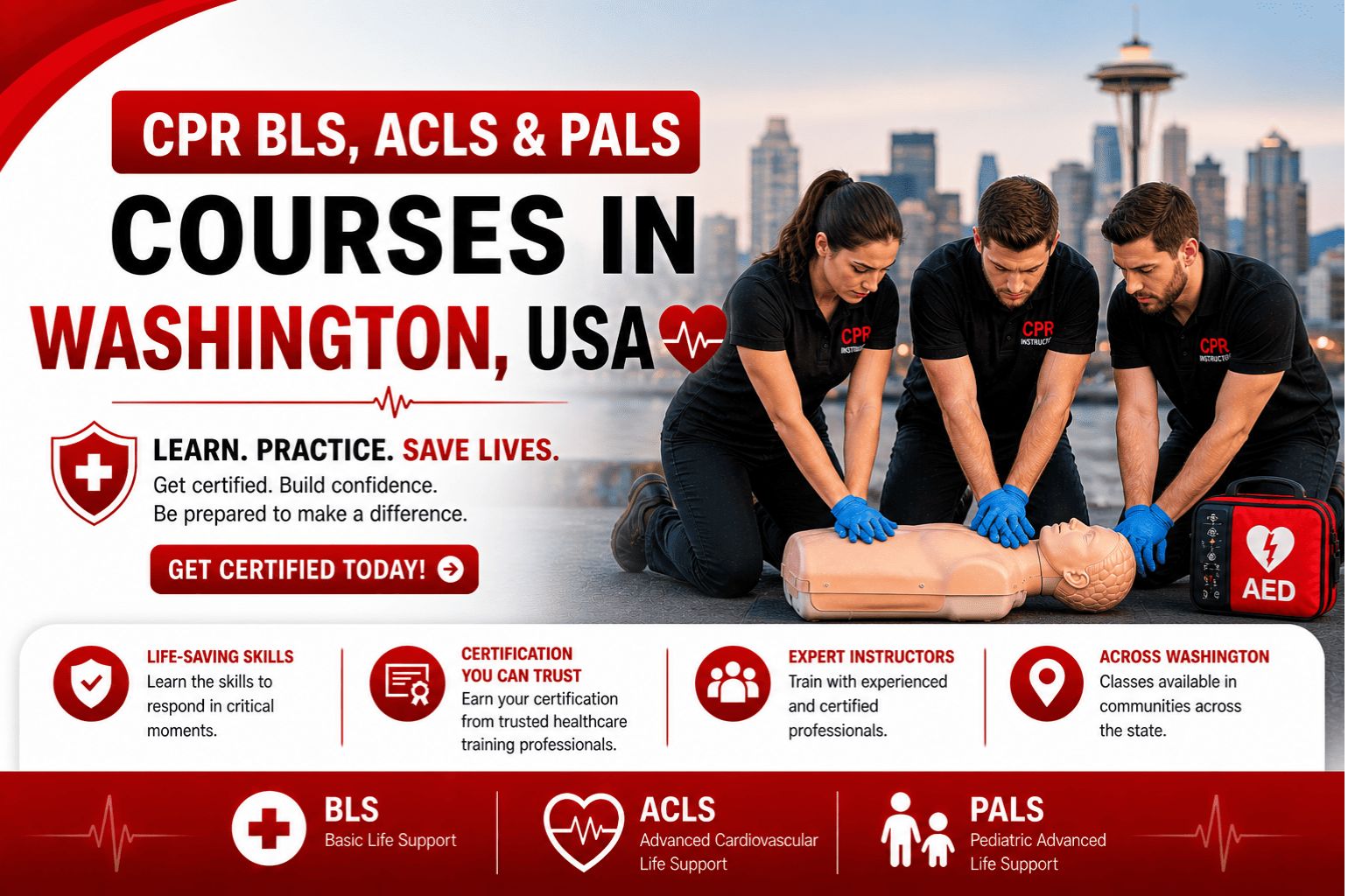
Washington’s healthcare system is one of the most sophisticated on the West Coast — and the American Heart Association’s training standards are the common thread running through the documentation requirements of every major employer in it. Safety Training Seminars delivers AHA BLS CPR courses, ACLS training, and PALS programs throughout Washington, each structured around the AHA’s current resuscitation science and designed to produce both genuine clinical skill and legitimate documentation. From the dense hospital corridors of Seattle’s First Hill medical district to the regional facilities anchoring care in Olympia, Renton, and Spokane, the professionals who complete our courses leave with an AHA Course Completion eCard that UW Medicine, Providence Health, MultiCare, and Virginia Mason Medical Center — among others — recognize as meeting their documentation standards. This isn’t checkbox training. It’s structured, evaluated, and built to hold up to scrutiny from any Washington healthcare credentialing team.
Essential for healthcare professionals. Covers CPR for adults, children, and infants, AED use, and airway management. Accepted by all major hospitals and healthcare systems.
Builds on BLS knowledge with advanced management of cardiovascular emergencies, arrhythmias, stroke, and acute coronary syndromes. Required for ICU, ER, and OR staff.
Designed for providers who care for infants and children. Covers pediatric assessment, respiratory failure, shock, and cardiac arrest management.
Ideal for non-medical professionals, workplaces, teachers, and community members. Covers adult and child CPR, AED operation, choking, and basic first aid.
Washington’s geography stretches from the rain-soaked urban density of the Puget Sound region all the way east to the high desert of the Columbia Basin — and Safety Training Seminars has built its coverage to span that range. We serve healthcare professionals in Seattle, Bellevue, Renton, Tacoma, and Olympia throughout western Washington, as well as Spokane and the Inland Northwest on the state’s eastern side. Professionals commuting along I-405 from Bellevue toward Renton, or traveling I-5 between Seattle and Tacoma, will find CPR Verification Station™ learning centers positioned along routes they already travel. We also reach clinical professionals in Everett, Kirkland, Federal Way, and the communities of Kitsap and Thurston counties that feed into the Puget Sound’s broader healthcare labor market.
Washington‘s growing healthcare sector, regulated industries, and community organizations create high, ongoing demand for AHA life support certification.
RNs, LPNs, and nursing students must hold current BLS certification as required by state boards and hospital credentialing.
Medical doctors, physician assistants, and nurse practitioners must maintain current ACLS and BLS certification.
Emergency medical technicians and paramedics must hold AHA certification as required by state EMS licensing.
Dentists, dental hygienists, and dental assistants are required to maintain current CPR/BLS certification by state dental boards.
Teachers, daycare providers, school nurses, and childcare staff are required by law to hold current CPR certification.
Washington’s top healthcare employers run rigorous credentialing operations. Harborview Medical Center, Swedish Health Services, Overlake Medical Center in Bellevue, MultiCare Tacoma General, and Providence Regional Medical Center in Everett all maintain active verification systems for clinical staff training documentation — and a lapsed or unrecognized eCard creates complications that nobody wants to manage mid-onboarding. Safety Training Seminars has earned a place in Washington’s clinical training landscape precisely because our courses are substantive, our documentation is AHA-issued, and our process doesn’t waste the time of professionals who are already stretched thin. Whether you’re seeking an AHA BLS CPR class in the Seattle metro, ACLS training near Spokane, or PALS courses in the South Puget Sound region, Safety Training Seminars delivers the preparation and the eCard your Washington employer is looking for.
The AHA BLS CPR class through Safety Training Seminars serves Washington’s broad clinical workforce — from nursing staff at UW Medical Center to emergency medical technicians stationed across Pierce and King counties. Participants complete the digital coursework through our Self-Guided Learning™ platform on their own schedule before attending a hands-on skills evaluation at a CPR Verification Station™ learning center in Washington, after which they receive their AHA Course Completion eCard upon successfully completing the course.
ACLS training through Safety Training Seminars is purpose-built for Washington’s physicians, advanced practice providers, and critical care RNs who manage complex cardiac emergencies in real time — in the ICUs of Seattle’s major medical centers and in the more resource-constrained environments of Washington’s smaller regional hospitals. The HeartCode® Complete blended learning format delivers rhythm recognition, pharmacological reasoning, and team leadership communication skills through a structure that Washington healthcare employers know and accept.
Pediatric Advanced Life Support training is a foundational requirement for Washington clinical professionals who encounter pediatric emergencies — including staff at Seattle Children’s Hospital, pediatric RNs across the Providence and MultiCare networks, and emergency department providers throughout King, Pierce, and Spokane counties who treat children in crisis. Safety Training Seminars’ PALS course develops the systematic assessment and response capabilities for life-threatening pediatric conditions, validated through a hands-on skills check at a CPR Verification Station™.
Washington’s workplaces, schools, and public spaces face the same cardiac and traumatic emergency risks as clinical settings — and Safety Training Seminars provides CPR and first aid training for non-clinical individuals who want to be prepared to respond effectively when professional emergency services are still minutes away.
Washington healthcare professionals who’ve experienced traditional CPR training know the frustrations: rigid scheduling, long waits for classroom seats, and skills sessions that feel more like box-checking than genuine preparation. Safety Training Seminars approaches the problem differently. Skills testing at our CPR Verification Station™ locations is direct and efficient — evaluators move you through the assessment without unnecessary ceremony, because a Renton-based RN finishing a 12-hour shift shouldn’t have to block off half a day for a skills check. The learning platform is genuinely modern — compatible across devices, cloud-based, and accessible whether you’re in a Bellevue high-rise or a Spokane Valley home. Every skills session uses real-scenario simulation designed to reflect the pressure of clinical reality, not just the mechanics of technique in a calm room. And every component of the course is grounded in AHA standards, which means your eCard carries the weight that Washington’s employers — from UW Medicine to MultiCare — recognize immediately.
Training with Safety Training Seminars in Washington builds capabilities that translate directly to the moments that matter. BLS completers develop compression mechanics that hold up to AHA rate, depth, and recoil standards — not just in a controlled practice session but as physical habit that persists under the stress of an actual emergency. They gain confident two-rescuer coordination, proper bag-mask ventilation technique, and AED operation skills from device recognition through shock delivery. ACLS participants develop rhythm strip interpretation that goes beyond surface recognition to clinical reasoning — knowing what the strip means for your patient and what the AHA algorithm calls for next. They practice airway management sequencing for adult patients in complex presentations and rehearse the closed-loop communication that separates organized resuscitation from reactive chaos — a distinction that matters in Seattle’s cardiac ICUs and in the community hospitals serving Thurston and Kitsap counties alike. PALS graduates refine pediatric assessment through the systematic lens of the AHA’s pediatric algorithms, develop response sequences for respiratory failure, distributive shock, and pediatric cardiac arrest, and practice leading coordinated team responses in scenarios calibrated to the real clinical environments Washington’s pediatric professionals occupy.
A Seattle hospitalist managing inpatient rounds and a Tacoma paramedic running rotating shifts both need training that fits their reality — and Safety Training Seminars designs its Washington course access with both in mind.
Self-Guided Learning™ gives Washington’s clinical professionals complete autonomy over when and where they complete the digital coursework component of their BLS, ACLS, or PALS training. No scheduled class, no group pacing, no geographic constraint — work through the AHA-aligned modules from a Bellevue apartment or an Olympia home office, at whatever hour your day allows. The digital portion is fully self-contained and device-responsive, built for the real lives of professionals who don’t keep standard hours.
HeartCode® Complete is the AHA’s integrated blended learning solution, and it’s the backbone of our ACLS and PALS pathways throughout Washington. The platform structures the cognitive curriculum — rhythm interpretation, pharmacology, pediatric algorithms, team dynamics — in a self-directed digital format, then requires an in-person skills component that brings the learning into physical practice. Washington’s healthcare employers recognize the HeartCode® Complete framework because the AHA built it to meet the same standards their own credentialing teams reference.
The CPR Verification Station™ learning center is the hands-on checkpoint that completes the blended learning process. After finishing the online coursework, you schedule your skills session at a Washington-area station — positioned across the Seattle-Bellevue metro, the South Sound corridor, Spokane, and other areas we serve. The evaluator guides you through the performance assessment, provides real-time technique feedback, and confirms your completion of the hands-on requirement. Your AHA Course Completion eCard is issued digitally once you successfully complete the course — typically the same day as your skills appointment.
Washington’s healthcare employment market is detailed and deliberate about training documentation. The state’s largest health systems — UW Medicine, Providence Health System, MultiCare Health System, Virginia Mason Franciscan Health, and Swedish Health Services — maintain active credentialing review processes that verify current AHA Course Completion eCard status for nurses, physicians, respiratory therapists, surgical technologists, and other clinical roles before and during employment. Washington’s Department of Health licensing frameworks reinforce this at the professional credential level for many clinical designations. The state’s large travel nursing market — driven in part by significant demand from Seattle-area hospitals and the health systems serving the greater Puget Sound — creates particular urgency around documentation timing, with staffing agencies routinely requiring active eCard verification before a first assignment date. Renewal every two years is the AHA standard, and Washington’s most active healthcare employers typically build internal renewal reminders into their HR systems at 18 months to keep the compliance pipeline clean.
Washington’s combination of high-density urban healthcare demand and vast rural geography creates emergency response dynamics that underscore the value of trained responders at every level of the clinical workforce. In King County alone — home to Seattle, Bellevue, and Renton — cardiac arrest response data consistently shows that bystander CPR is one of the most significant predictors of survival. Outside the urban core, in the smaller communities of eastern Washington along U.S. Route 2 and through the Palouse, where hospital distances are measured in miles rather than blocks, the interval between cardiac arrest and advanced intervention makes immediate, competent CPR the difference between life and loss. Washington’s healthcare workforce is also one of the fastest-growing in the region, driven by population increases across the Puget Sound metro and an aging demographic that increases cardiac event frequency. BLS, ACLS, and PALS training aren’t peripheral requirements — they’re central to the healthcare system’s capacity to serve Washington’s residents safely.
Washington’s corporate landscape — anchored by the major tech campuses in Bellevue, Redmond, and the Seattle waterfront, and extending into the aerospace, maritime, and logistics industries that employ hundreds of thousands across the state — creates substantial demand for workplace CPR and first aid training that goes beyond the clinical sector. Safety Training Seminars works with Washington businesses and organizations to coordinate group BLS training that produces documented AHA Course Completion eCards for every participant. Whether that’s a Renton-based healthcare network scheduling 30 nurses for simultaneous BLS renewal, a Bellevue corporate campus arranging first aid and CPR training for its facilities team, or a Tacoma school district ensuring its staff are prepared for emergencies, our group booking process is built to handle each scenario efficiently and deliver the compliance documentation that Washington employers need. Organizations that complete group training through Safety Training Seminars gain both the eCards and the operational confidence that their people know what to do.
Washington clinical professionals consistently tell us that same-day eCard delivery is the feature that makes our course model practical for their schedules — and it works because the process is genuinely designed around it. The online component of your AHA BLS CPR course, ACLS training, or PALS program is completed through Self-Guided Learning™ or HeartCode® Complete at whatever hour fits your day — early morning before a shift at Harborview, or late evening from a home in Kirkland. Once the digital coursework is done, you schedule your in-person appointment at a CPR Verification Station™ near you in Washington — available across the Seattle-Bellevue area, the South Sound corridor from Renton to Tacoma, Olympia, and Spokane. The skills session runs 30 to 60 minutes. You successfully complete the course, and your AHA Course Completion eCard is issued digitally that same day — no waiting period, no processing backlog, no delay before you can share it with HR.
The enrollment-to-eCard process with Safety Training Seminars in Washington follows a four-stage sequence that’s straightforward by design. You register online, selecting your course — AHA BLS CPR class, ACLS training, PALS, or a combined pathway — based on your clinical role and what your Washington employer requires. You work through the digital content using Self-Guided Learning™ or HeartCode® Complete, moving through the AHA’s curriculum at your own pace and on your own schedule. You attend your in-person skills evaluation at a CPR Verification Station™ in Washington, where a trained evaluator confirms that your hands-on performance meets AHA standards. And when you successfully complete the course — both the digital and skills components — your AHA Course Completion eCard is issued digitally and ready to use immediately.
Safety Training Seminars serves Washington’s clinical communities across both sides of the Cascades. On the west side, our coverage spans King County — from Seattle and Bellevue to Renton, Auburn, and Kent — along with Pierce County from Tacoma through Federal Way, Thurston County centered on Olympia, Snohomish County from Everett north, and Kitsap County across the Sound. In eastern Washington, we serve professionals in Spokane and Spokane Valley, as well as the Tri-Cities area in Benton and Franklin counties and communities in Yakima County along U.S. Route 12. Our course infrastructure follows the major travel routes Washington professionals actually use — I-5, I-90, I-405, and SR-520 — making CPR Verification Station™ access realistic regardless of where in the state you’re based.
Safety Training Seminars positions its Washington course infrastructure with the state’s major clinical campuses in mind. In Seattle and the surrounding metro, we serve professionals connected to UW Medical Center and Harborview Medical Center in the First Hill and South Lake Union medical corridors, Virginia Mason Medical Center, Swedish Medical Center’s First Hill and Cherry Hill campuses, and Seattle Children’s Hospital in the Laurelhurst neighborhood. In Bellevue, Overlake Medical Center draws clinical staff from across the Eastside — and our skills stations are accessible to that workforce. In Renton, Valley Medical Center anchors a growing clinical community in South King County. In Tacoma, MultiCare Tacoma General and St. Joseph Medical Center serve Pierce County’s significant healthcare population. In Olympia, Providence St. Peter Hospital and Capital Medical Center serve Thurston County’s clinical workforce. In Spokane, Providence Sacred Heart Medical Center and MultiCare Deaconess Hospital anchor the Inland Northwest’s emergency and inpatient care infrastructure. Our CPR Verification Station™ locations are built around these clusters.
The return on completing AHA BLS CPR training or ACLS coursework through Safety Training Seminars extends across multiple dimensions simultaneously. The most immediate benefit is readiness — the physical and cognitive preparation to respond effectively in the first minutes of a cardiac emergency, when the outcome is most malleable. For Washington’s clinical workforce, the career benefit is equally concrete: a current AHA Course Completion eCard removes the documentation barrier that slows new hire onboarding, travel assignment starts, and credentialing renewals across the state’s hospital systems. And beyond career mechanics, there’s something qualitatively different about operating in a clinical environment knowing your training is current and your skills are genuinely practiced — a confidence that shows in how you respond and how your team functions around you.
AHA Course Completion eCards expire after two years — and for Washington healthcare professionals managing demanding clinical schedules at large institutions like UW Medicine, Swedish Health, or MultiCare, the renewal window can close faster than expected. Safety Training Seminars makes the recertification process in Washington efficient enough that renewal doesn’t need to be a production. BLS renewal combines updated digital content with a hands-on skills reassessment at a CPR Verification Station™ near you — most Washington professionals complete the full process within a single calendar day. ACLS renewal incorporates the AHA’s most recent cardiac arrest management updates alongside scenario-based performance reinforcement, keeping the clinical skills of Washington’s advanced practice providers and critical care nurses aligned with current best practice. PALS renewal revisits pediatric assessment frameworks, ensuring that clinical professionals in Washington’s pediatric and emergency units maintain the pattern recognition and response fluency their roles demand. Plan your renewal before the pressure builds — Safety Training Seminars makes it easy to stay ahead of the deadline.
Washington’s healthcare credentialing environment doesn’t offer much flexibility around expired documentation — and the cost of letting your BLS, ACLS, or PALS eCard lapse is measured in delayed start dates, compliance flags, and missed clinical opportunities. Safety Training Seminars makes it simple to stay current. Register online, choose your AHA BLS CPR class, ACLS training, or PALS program, complete the digital coursework at the pace that fits your week, and attend a CPR Verification Station™ skills session in Seattle, Bellevue, Tacoma, Renton, Olympia, Spokane, or another Washington location near you. Your AHA Course Completion eCard is issued digitally the same day you successfully complete the course — shareable immediately, valid immediately, and ready for whatever your Washington employer needs to see. Start today.
This section covers the most common questions people have about CPR, BLS, ACLS, PALS and First Aid courses. At Safety Training Seminars, we provide clear information about course content, scheduling options, training formats, and what to expect during your session.
The online component of the AHA BLS CPR course takes most Washington participants two to three hours to complete through our Self-Guided Learning™ or HeartCode® Complete platform — and you can work through it from any location in the state with an internet connection. The in-person skills evaluation at a CPR Verification Station™ in Washington runs approximately 30 to 60 minutes.
Same-day eCard delivery is the standard outcome for Safety Training Seminars participants in Washington. Once you successfully complete the course — including both the online coursework and the hands-on skills evaluation at a CPR Verification Station™ — your AHA Course Completion eCard is issued digitally and immediately accessible.
The requirement is broad across Washington’s clinical workforce. Registered nurses, physicians, physician assistants, nurse practitioners, CRNAs, respiratory therapists, EMTs, paramedics, surgical techs, and clinical support staff working in Washington hospitals — including those affiliated with UW Medicine, Providence Health, Swedish, MultiCare, and Virginia Mason Franciscan Health — are all expected to hold current AHA Course Completion eCards.
Yes — that’s precisely how Safety Training Seminars structures ACLS and PALS training in Washington. The cognitive content of each course — rhythm interpretation, pediatric assessment algorithms, pharmacology, and resuscitation team communication — is delivered through the HeartCode® Complete platform or our Self-Guided Learning™ system, which you complete digitally at your own pace.
AHA Course Completion eCards are valid for two years. Washington healthcare employers — particularly those running active credentialing programs at large health systems like UW Medicine, MultiCare, and Providence — typically recommend initiating renewal at least 60 to 90 days before expiration.

